|
|
| |
| # lines: |
444 | | # code: |
444 | | # comment: | 0 | |
# blank: | 0 |
| # Variables: | 27 |
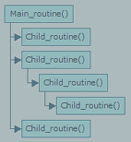
| # Callers: | 1 |
| # Callings: | 1 |
| # Words: | 139 |
| # Keywords: | 65 |
|
|
|
|
|
..
     .. Local Scalars ..
     ..
     .. Local Arrays ..
     ..
     .. External Functions ..
     ..
     .. External Subroutines ..
     ..
     .. Intrinsic Functions ..
     ..
     .. Statement Functions ..
     ..
     .. Statement Function definitions ..
     ..
     .. Executable Statements ..
     Quick return if possible
     Set machine-dependent constants for the stopping criterion.
     If norm(H) <= sqrt(OVFL), overflow should not occur.
     I1 and I2 are the indices of the first row and last column of H
     to which transformations must be applied. If eigenvalues only are
     being computed, I1 and I2 are set inside the main loop.
     ITN is the total number of QR iterations allowed.
     The main loop begins here. I is the loop index and decreases from
     IHI to ILO in steps of 1 or 2. Each iteration of the loop works
     with the active submatrix in rows and columns L to I.
     Eigenvalues I+1 to IHI have already converged. Either L = ILO, or
     H(L,L-1) is negligible so that the matrix splits.
     Perform QR iterations on rows and columns ILO to I until a
     submatrix of order 1 or 2 splits off at the bottom because a
     subdiagonal element has become negligible.
        Look for a single small subdiagonal element.
           H(L,L-1) is negligible
        Exit from loop if a submatrix of order 1 or 2 has split off.
        Now the active submatrix is in rows and columns L to I. If
        eigenvalues only are being computed, only the active submatrix
        need be transformed.
           Exceptional shift.
            S = ABS( REAL( H( I,I-1 ) ) ) + ABS( REAL( H( I-1,I-2 ) ) )
           Prepare to use Wilkinson's shift.
        Look for two consecutive small subdiagonal elements.
           Determine the effect of starting the double-shift QR
           iteration at row M, and see if this would make H(M,M-1)
           negligible.
        Double-shift QR step
           The first iteration of this loop determines a reflection G
           from the vector V and applies it from left and right to H,
           thus creating a nonzero bulge below the subdiagonal.
           Each subsequent iteration determines a reflection G to
           restore the Hessenberg form in the (K-1)th column, and thus
           chases the bulge one step toward the bottom of the active
           submatrix.  NR is the order of G
|
|
|
|
001 SUBROUTINE CLAHQR2( WANTT , WANTZ , N , ILO , IHI , H , LDH , W , ILOZ ,
002 $IHIZ , Z , LDZ , INFO )
003
004 * -- ScaLAPACK routine(version 1.7) --
005 * Univ. of Tennessee , Univ. of California Berkeley , NAG Ltd. ,
006 * Courant Institute , Argonne National Lab , and Rice University
007 * June 22 , 2000
008
009 * .. Scalar Arguments ..
010 LOGICAL WANTT , WANTZ
011 INTEGER IHI , IHIZ , ILO , ILOZ , INFO , LDH , LDZ , N
012 * ..
013 * .. Array Arguments ..
014 COMPLEX H( LDH , * ) , W( * ) , Z( LDZ , * )
015 * ..
016
017 * Purpose
018 * === ====
019
020 * CLAHQR2 is an auxiliary routine called by CHSEQR to update the
021 * eigenvalues and Schur decomposition already computed by CHSEQR , by
022 * dealing with the Hessenberg submatrix in rows and columns ILO to IHI.
023 * This version of CLAHQR(not the standard LAPACK version) uses a
024 * double - shift algorithm(like LAPACK's SLAHQR).
025 * Unlike the standard LAPACK convention , this does not assume the
026 * subdiagonal is real , nor does it work to preserve this quality if
027 * given.
028
029 * Arguments
030 * === ======
031
032 * WANTT(input) LOGICAL
033 * = .TRUE. : the full Schur form T is required ;
034 * = .FALSE. : only eigenvalues are required.
035
036 * WANTZ(input) LOGICAL
037 * = .TRUE. : the matrix of Schur vectors Z is required ;
038 * = .FALSE. : Schur vectors are not required.
039
040 * N(input) INTEGER
041 * The order of the matrix H. N >= 0.
042
043 * ILO(input) INTEGER
044 * IHI(input) INTEGER
045 * It is assumed that H is already upper triangular in rows and
046 * columns IHI + 1 : N , and that H(ILO , ILO - 1) = 0(unless ILO = 1).
047 * CLAHQR works primarily with the Hessenberg submatrix in rows
048 * and columns ILO to IHI , but applies transformations to all of
049 * H if WANTT is .TRUE..
050 * 1 <= ILO <= max(1 , IHI) ; IHI <= N.
051
052 * H(input / output) COMPLEX array , dimension(LDH , N)
053 * On entry , the upper Hessenberg matrix H.
054 * On exit , if WANTT is .TRUE. , H is upper triangular in rows
055 * and columns ILO : IHI. If WANTT is .FALSE. , the contents of H
056 * are unspecified on exit.
057
058 * LDH(input) INTEGER
059 * The leading dimension of the array H. LDH >= max(1 , N).
060
061 * W(output) COMPLEX array , dimension(N)
062 * The computed eigenvalues ILO to IHI are stored in the
063 * corresponding elements of W. If WANTT is .TRUE. , the
064 * eigenvalues are stored in the same order as on the diagonal
065 * of the Schur form returned in H , with W(i) = H(i , i).
066
067 * ILOZ(input) INTEGER
068 * IHIZ(input) INTEGER
069 * Specify the rows of Z to which transformations must be
070 * applied if WANTZ is .TRUE..
071 * 1 <= ILOZ <= ILO ; IHI <= IHIZ <= N.
072
073 * Z(input / output) COMPLEX array , dimension(LDZ , N)
074 * If WANTZ is .TRUE. , on entry Z must contain the current
075 * matrix Z of transformations , and on exit Z has been updated ;
076 * transformations are applied only to the submatrix
077 * Z(ILOZ : IHIZ , ILO : IHI). If WANTZ is .FALSE. , Z is not
078 * referenced.
079
080 * LDZ(input) INTEGER
081 * The leading dimension of the array Z. LDZ >= max(1 , N).
082
083 * INFO(output) INTEGER
084 * = 0 : successful exit
085 * > 0 : if INFO = i , CLAHQR failed to compute all the
086 * eigenvalues ILO to IHI in a total of 30*(IHI - ILO + 1)
087 * iterations ; elements i + 1 : ihi of W contain those
088 * eigenvalues which have been successfully computed.
089
090 * Further Details
091 * === ============
092
093 * Modified by Mark R. Fahey , June , 2000
094
095 * === ==================================================================
096
097 * .. Parameters ..
098 COMPLEX ZERO
099 PARAMETER( ZERO =( 0.0E + 0 , 0.0E + 0 ) )
100 REAL RZERO , RONE
101 PARAMETER( RZERO = 0.0E + 0 , RONE = 1.0E + 0 )
102 REAL DAT1 , DAT2
103 PARAMETER( DAT1 = 0.75E + 0 , DAT2 = - 0.4375E + 0 )
104 NR = MIN( 3 , I - K + 1 )
105 IF( K.GT.M )
105   106 $ CALL
 CCOPY( NR , H( K , K - 1 ) , 1 , V , 1 )
107 CALL CLARFG( NR , V( 1 ) , V( 2 ) , 1 , T1 )
108 IF( K.GT.M ) THEN
108
109 H( K , K - 1 ) = V( 1 )
110 H( K + 1 , K - 1 ) = ZERO
111 IF( K.LT.I - 1 )
111
112 $ H( K + 2 , K - 1 ) = ZERO
113 ELSE IF( M.GT.L ) THEN
114 * The real double - shift code uses H( K , K - 1 ) = - H( K , K - 1 )
115 * instead of the following.
115
116 H( K , K - 1 ) = H( K , K - 1 ) - CONJG( T1 )*H( K , K - 1 )
117 END IF
118 V2 = V( 2 )
119 T2 = T1*V2
120 IF( NR.EQ.3 ) THEN
120
121 V3 = V( 3 )
122 T3 = T1*V3
123
124 * Apply G from the left to transform the rows of the matrix
125 * in columns K to I2.
126
127 DO 60 J = K , I2
127
128 SUM = CONJG( T1 )*H( K , J ) +
129 $ CONJG( T2 )*H( K + 1 , J ) +
130 $ CONJG( T3 )*H( K + 2 , J )
131 H( K , J ) = H( K , J ) - SUM
132 H( K + 1 , J ) = H( K + 1 , J ) - SUM*V2
133 H( K + 2 , J ) = H( K + 2 , J ) - SUM*V3
134 60 CONTINUE
135
136 * Apply G from the right to transform the columns of the
137 * matrix in rows I1 to min(K + 3 , I).
138
138
139 DO 70 J = I1 , MIN( K + 3 , I )
139
140 SUM = T1*H( J , K ) + T2*H( J , K + 1 ) + T3*H( J , K + 2 )
141 H( J , K ) = H( J , K ) - SUM
142 H( J , K + 1 ) = H( J , K + 1 ) - SUM*CONJG( V2 )
143 H( J , K + 2 ) = H( J , K + 2 ) - SUM*CONJG( V3 )
144 70 CONTINUE
145
145
146 IF( WANTZ ) THEN
147
148 * Accumulate transformations in the matrix Z
149
149
150 DO 80 J = ILOZ , IHIZ
150
151 SUM = T1*Z( J , K ) + T2*Z( J , K + 1 ) +
152 $ T3*Z( J , K + 2 )
153 Z( J , K ) = Z( J , K ) - SUM
154 Z( J , K + 1 ) = Z( J , K + 1 ) - SUM*CONJG( V2 )
155 Z( J , K + 2 ) = Z( J , K + 2 ) - SUM*CONJG( V3 )
156 80 CONTINUE
156
157 END IF
158 ELSE IF( NR.EQ.2 ) THEN
159
160 * Apply G from the left to transform the rows of the matrix
161 * in columns K to I2.
162
162
163 DO 90 J = K , I2
163
164 SUM = CONJG( T1 )*H( K , J ) +
165 $ CONJG( T2 )*H( K + 1 , J )
166 H( K , J ) = H( K , J ) - SUM
167 H( K + 1 , J ) = H( K + 1 , J ) - SUM*V2
168 90 CONTINUE
169
170 * Apply G from the right to transform the columns of the
171 * matrix in rows I1 to min(K + 2 , I).
172
172
173 DO 100 J = I1 , MIN( K + 2 , I )
173
174 SUM = T1*H( J , K ) + T2*H( J , K + 1 )
175 H( J , K ) = H( J , K ) - SUM
176 H( J , K + 1 ) = H( J , K + 1 ) - SUM*CONJG( V2 )
177 100 CONTINUE
178
178
179 IF( WANTZ ) THEN
180
181 * Accumulate transformations in the matrix Z
182
182
183 DO 110 J = ILOZ , IHIZ
183
184 SUM = T1*Z( J , K ) + T2*Z( J , K + 1 )
185 Z( J , K ) = Z( J , K ) - SUM
186 Z( J , K + 1 ) = Z( J , K + 1 ) - SUM*CONJG( V2 )
187 110 CONTINUE
187
188 END IF
189 END IF
190
191 * Since at the start of the QR step we have for M > L
192 * H( K , K - 1 ) = H( K , K - 1 ) - CONJG( T1 )*H( K , K - 1 )
193 * then we don't need to do the following
194 * IF( K.EQ.M .AND. M.GT.L ) THEN
195 * If the QR step was started at row M > L because two
196 * consecutive small subdiagonals were found , then H(M , M - 1)
197 * must also be updated by a factor of(1 - T1).
198 * TEMP = ONE - T1
199 * H( m , m - 1 ) = H( m , m - 1 )*CONJG( TEMP )
200 * END IF
201 120 CONTINUE
202
203 * Ensure that H(I , I - 1) is real.
204
205 130 CONTINUE
206
207 * Failure to converge in remaining number of iterations
208
209 INFO = I
210 RETURN
211
212 140 CONTINUE
213
214 IF( L.EQ.I ) THEN
215
216 * H(I , I - 1) is negligible : one eigenvalue has converged.
217
217
218 W( I ) = H( I , I )
219
220 ELSE IF( L.EQ.I - 1 ) THEN
221
222 * H(I - 1 , I - 2) is negligible : a pair of eigenvalues have converged.
223
224 * Transform the 2 - by - 2 submatrix to standard Schur form ,
225 * and compute and store the eigenvalues.
226
226
227 CALL CLANV2 ( H( I - 1 , I - 1 ) , H( I - 1 , I ) , H( I , I - 1 ) ,
228 $ H( I , I ) , W( I - 1 ) , W( I ) , CS , SN )
229
230 IF( WANTT ) THEN
231
232 * Apply the transformation to the rest of H.
233
233
234 IF( I2.GT.I )
234
235 $ CALL CROT( I2 - I , H( I - 1 , I + 1 ) , LDH , H( I , I + 1 ) , LDH ,
236 $ CS , SN )
237 CALL CROT( I - I1 - 1 , H( I1 , I - 1 ) , 1 , H( I1 , I ) , 1 , CS ,
238 $ CONJG( SN ) )
239 END IF
240 IF( WANTZ ) THEN
241
242 * Apply the transformation to Z.
243
243
244 CALL CROT( NZ , Z( ILOZ , I - 1 ) , 1 , Z( ILOZ , I ) , 1 , CS ,
245 $ CONJG( SN ) )
246 END IF
247
248 END IF
249
250 * Decrement number of remaining iterations , and return to start of
251 * the main loop with new value of I.
252
253 ITN = ITN - ITS
254 I = L - 1
255 GO TO 10
256
257 150 CONTINUE
258 RETURN
259
260 * End of CLAHQR2
261
262 END58
25
|
|
Variables in Routine CLAHQR2()
| Summary Report |
| Data Type | Quantity | Size(byte) |
| COMPLEX | 4 | 16 |
| INTEGER | 12 | 48 |
| LOGICAL | 2 | 2 |
| REAL | 9 | 36 |
| TOTAL | 27 | 102 |
List of Variables
COMPLEX
| H( LDH, * ) | W( * ) | Z( LDZ, * ) | ZERO | |
INTEGER
| I | IHI | IHIZ | ILO | ILOZ |
| INFO | ITN | J | LDH | LDZ |
| N | NR | | | |
LOGICAL
REAL
| DAT1 | DAT2 | RONE | RZERO | SUM |
| T2 | T3 | V2 | V3 | |
Variables Dependence Graph
Put the mouse over a right hand side variable to display the corresponding line of the dependence | | - | | - | - | | H | <--- | JH( K, J ) = H( K, J ) - SUM{2H( K+1, J ) = H( K+1, J ) - SUM*V2, 3H( K+2, J ) = H( K+2, J ) - SUM*V3, 4H( J, K ) = H( J, K ) - SUM, 5H( J, K+1 ) = H( J, K+1 ) - SUM*CONJG( V2 ), 6H( J, K+2 ) = H( J, K+2 ) - SUM*CONJG( V3 ), 7H( K, J ) = H( K, J ) - SUM, 8H( K+1, J ) = H( K+1, J ) - SUM*V2, 9H( J, K ) = H( J, K ) - SUM, 10H( J, K+1 ) = H( J, K+1 ) - SUM*CONJG( V2 )}, SUMH( K, J ) = H( K, J ) - SUM{2H( K+1, J ) = H( K+1, J ) - SUM*V2, 3H( K+2, J ) = H( K+2, J ) - SUM*V3, 4H( J, K ) = H( J, K ) - SUM, 5H( J, K+1 ) = H( J, K+1 ) - SUM*CONJG( V2 ), 6H( J, K+2 ) = H( J, K+2 ) - SUM*CONJG( V3 ), 7H( K, J ) = H( K, J ) - SUM, 8H( K+1, J ) = H( K+1, J ) - SUM*V2, 9H( J, K ) = H( J, K ) - SUM, 10H( J, K+1 ) = H( J, K+1 ) - SUM*CONJG( V2 )}, V2H( K+1, J ) = H( K+1, J ) - SUM*V2{2H( J, K+1 ) = H( J, K+1 ) - SUM*CONJG( V2 ), 3H( K+1, J ) = H( K+1, J ) - SUM*V2, 4H( J, K+1 ) = H( J, K+1 ) - SUM*CONJG( V2 )}, V3H( K+2, J ) = H( K+2, J ) - SUM*V3{2H( J, K+2 ) = H( J, K+2 ) - SUM*CONJG( V3 )}, ZEROH( K+1, K-1 ) = ZERO, HH( K, K-1 ) = H( K, K-1 ) - CONJG( T1 )*H( K, K-1 ){2H( K, J ) = H( K, J ) - SUM, 3H( K+1, J ) = H( K+1, J ) - SUM*V2, 4H( K+2, J ) = H( K+2, J ) - SUM*V3, 5H( J, K ) = H( J, K ) - SUM, 6H( J, K+1 ) = H( J, K+1 ) - SUM*CONJG( V2 ), 7H( J, K+2 ) = H( J, K+2 ) - SUM*CONJG( V3 ), 8H( K, J ) = H( K, J ) - SUM, 9H( K+1, J ) = H( K+1, J ) - SUM*V2, 10H( J, K ) = H( J, K ) - SUM, 11H( J, K+1 ) = H( J, K+1 ) - SUM*CONJG( V2 )} |
| INFO | <--- | IINFO = I |
| ITN | <--- | ITNITN = ITN - ITS |
| J | <--- | IDO 70 J = I1, MIN( K+3, I ){2DO 100 J = I1, MIN( K+2, I )}, IHIZDO 80 J = ILOZ, IHIZ{2DO 110 J = ILOZ, IHIZ}, ILOZDO 80 J = ILOZ, IHIZ{2DO 110 J = ILOZ, IHIZ} |
| NR | <--- | INR = MIN( 3, I-K+1 ) |
| SUM | <--- | JSUM = CONJG( T1 )*H( K, J ) +{2SUM = T1*H( J, K ) + T2*H( J, K+1 ) + T3*H( J, K+2 ), 3SUM = T1*Z( J, K ) + T2*Z( J, K+1 ) +, 4SUM = CONJG( T1 )*H( K, J ) +, 5SUM = T1*H( J, K ) + T2*H( J, K+1 ), 6SUM = T1*Z( J, K ) + T2*Z( J, K+1 )}, T2SUM = CONJG( T1 )*H( K, J ) +{2SUM = T1*H( J, K ) + T2*H( J, K+1 ) + T3*H( J, K+2 ), 3SUM = T1*Z( J, K ) + T2*Z( J, K+1 ) +, 4SUM = CONJG( T1 )*H( K, J ) +, 5SUM = T1*H( J, K ) + T2*H( J, K+1 ), 6SUM = T1*Z( J, K ) + T2*Z( J, K+1 )}, T3SUM = CONJG( T1 )*H( K, J ) +{2SUM = T1*H( J, K ) + T2*H( J, K+1 ) + T3*H( J, K+2 ), 3SUM = T1*Z( J, K ) + T2*Z( J, K+1 ) +}, ZSUM = T1*Z( J, K ) + T2*Z( J, K+1 ) +{2SUM = T1*Z( J, K ) + T2*Z( J, K+1 )}, HSUM = CONJG( T1 )*H( K, J ) +{2SUM = T1*H( J, K ) + T2*H( J, K+1 ) + T3*H( J, K+2 ), 3SUM = CONJG( T1 )*H( K, J ) +, 4SUM = T1*H( J, K ) + T2*H( J, K+1 )} |
| T2 | <--- | V2T2 = T1*V2 |
| T3 | <--- | V3T3 = T1*V3 |
| W | <--- | HW( I ) = H( I, I ), IW( I ) = H( I, I ) |
| Z | <--- | JZ( J, K ) = Z( J, K ) - SUM{2Z( J, K+1 ) = Z( J, K+1 ) - SUM*CONJG( V2 ), 3Z( J, K+2 ) = Z( J, K+2 ) - SUM*CONJG( V3 ), 4Z( J, K ) = Z( J, K ) - SUM, 5Z( J, K+1 ) = Z( J, K+1 ) - SUM*CONJG( V2 )}, SUMZ( J, K ) = Z( J, K ) - SUM{2Z( J, K+1 ) = Z( J, K+1 ) - SUM*CONJG( V2 ), 3Z( J, K+2 ) = Z( J, K+2 ) - SUM*CONJG( V3 ), 4Z( J, K ) = Z( J, K ) - SUM, 5Z( J, K+1 ) = Z( J, K+1 ) - SUM*CONJG( V2 )}, V2Z( J, K+1 ) = Z( J, K+1 ) - SUM*CONJG( V2 ){2Z( J, K+1 ) = Z( J, K+1 ) - SUM*CONJG( V2 )}, V3Z( J, K+2 ) = Z( J, K+2 ) - SUM*CONJG( V3 ), ZZ( J, K ) = Z( J, K ) - SUM{2Z( J, K+1 ) = Z( J, K+1 ) - SUM*CONJG( V2 ), 3Z( J, K+2 ) = Z( J, K+2 ) - SUM*CONJG( V3 ), 4Z( J, K ) = Z( J, K ) - SUM, 5Z( J, K+1 ) = Z( J, K+1 ) - SUM*CONJG( V2 )} |
|
|
Analysis elements of the routine CLAHQR2()
Put the mouse over each element to display detailed matching information
 Assigned variables Assigned variables |
| | | DAT1 , DAT2 , i , IHI , IHIZ , ILO , ILOZ , INFO , ITN , J , LDH , LDZ , N , NR , RONE , RZERO , SUM , T2 , T3 , V2 , V3 , ZERO |
|
| Active variables |
| | | DAT1 , DAT2 , H , i , IHI , IHIZ , ILO , ILOZ , INFO , ITN , J , LDH , LDZ , N , NR , RONE , RZERO , SUM , T2 , T3 , V2 , V3 , W , WANTT , WANTZ , Z , ZERO |
|
| Allocated variables [ statement : associated variable ] |
| |  new new | : with |
|
| Accessed arrays [ array name : associated index ] |
| | H | : I, I , I, I , I, I+1 , I, I-1 , i,i , I,I-1 , I,I-1 , I-1, I , I1, I , I-1, I+1 , I-1, I-1 , I1, I-1 , I-1,I-2 , ILO,ILO-1 , J, K , J, K , J, K , J, K , J, K+1 , J, K+1 , J, K+1 , J, K+1 , J, K+2 , J, K+2 , K, J , K, J , K, J , K, J , K, K-1 , K, K-1 , K, K-1 , K, K-1 , K, K-1 , K+1, J , K+1, J , K+1, J , K+1, J , K+1, K-1 , K+2, J , K+2, J , K+2, K-1 , LDH, * , m, m-1 , M,M-1 |
| | W | : * , I , I , i , I-1 |
| | Z | : ILOZ, I , ILOZ, I-1 , ILOZ:IHIZ,ILO:IHI , J, K , J, K , J, K , J, K , J, K+1 , J, K+1 , J, K+1 , J, K+1 , J, K+2 , J, K+2 , LDZ, * |
|
| Conditional statements [ statement : associated predicate ] |
| | do | : ( 60 J = K , I2 ) , ( 70 J = I1 , MIN( K + 3 , I ) ) , ( 80 J = ILOZ , IHIZ ) , ( 90 J = K , I2 ) , ( 100 J = I1 , MIN( K + 2 , I ) ) , ( 110 J = ILOZ , IHIZ ) , ( the following ) |
| | for | : ( M > L ) |
| | if | : ( WANTT is .TRUE.. ) , ( WANTT is .TRUE. , H is upper triangular in rows ) , ( WANTT is .FALSE. , the contents of H ) , ( WANTT is .TRUE. , the ) , ( WANTZ is .TRUE.. ) , ( WANTZ is .TRUE. , on entry Z must contain the current ) , ( WANTZ is .FALSE. , Z is not ) , ( INFO = i , CLAHQR failed to compute all the ) , ( K.GT.M ) , ( K.GT.M ) , ( K.LT.I - 1 ) , ( M.GT.L ) , ( NR.EQ.3 ) , ( WANTZ ) , ( NR.EQ.2 ) , ( WANTZ ) , ( K.EQ.M .AND. M.GT.L ) , ( the QR step was started at row M > L because two ) , ( L.EQ.I ) , ( L.EQ.I - 1 ) , ( WANTT ) , ( I2.GT.I ) , ( WANTZ ) |
|
| List of variables |
DAT1
DAT2
H( LDH, * )
I
IHI
IHIZ
ILO
| ILOZ
INFO
ITN
J
LDH
LDZ
N
NR
| RONE
RZERO
SUM
T2
T3
V2
V3
W( * )
| WANTT
WANTZ
Z( LDZ, * )
ZERO | | close
| |
DAT1
DAT2
H( LDH, * )
I
IHI
IHIZ
ILO
ILOZ
INFO
ITN
J
LDH
LDZ
N
NR
RONE
RZERO
SUM
T2
T3
V2
V3
W( * )
WANTT
WANTZ
Z( LDZ, * )
ZERO
8
| |