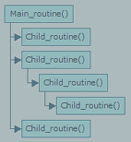
|
|
| |
| # lines: |
648 | | # code: |
648 | | # comment: | 0 | |
# blank: | 0 |
| # Variables: | 93 |
| # Callers: | 0 |
| # Callings: | 9 |
| # Words: | 351 |
| # Keywords: | 213 |
|
|
|
|
|
.. Scalar Arguments ..
     ..
     .. Array Arguments ..
     ..
  Purpose
  =======
  PCGESVD computes the singular value decomposition (SVD) of an
  M-by-N matrix A, optionally computing the left and/or right
  singular vectors. The SVD is written as
       A = U * SIGMA * transpose(V)
  where SIGMA is an M-by-N matrix which is zero except for its
  min(M,N) diagonal elements, U is an M-by-M orthogonal matrix, and
  V is an N-by-N orthogonal matrix. The diagonal elements of SIGMA
  are the singular values of A and the columns of U and V are the
  corresponding right and left singular vectors, respectively. The
  singular values are returned in array S in decreasing order and
  only the first min(M,N) columns of U and rows of VT = V**T are
  computed.
  Notes
  =====
  Each global data object is described by an associated description
  vector. This vector stores the information required to establish
  the mapping between an object element and its corresponding process
  and memory location.
  Let A be a generic term for any 2D block cyclicly distributed array.
  Such a global array has an associated description vector DESCA.
  In the following comments, the character _ should be read as
  "of the global array".
  NOTATION        STORED IN      EXPLANATION
  --------------- -------------- --------------------------------------
  DTYPE_A(global) DESCA( DTYPE_ )The descriptor type.  In this case,
                                 DTYPE_A = 1.
  CTXT_A (global) DESCA( CTXT_ ) The BLACS context handle, indicating
                                 the BLACS process grid A is distribu-
                                 ted over. The context itself is glo-
                                 bal, but the handle (the integer
                                 value) may vary.
  M_A    (global) DESCA( M_ )    The number of rows in the global
                                 array A.
  N_A    (global) DESCA( N_ )    The number of columns in the global
                                 array A.
  MB_A   (global) DESCA( MB_ )   The blocking factor used to distribute
                                 the rows of the array.
  NB_A   (global) DESCA( NB_ )   The blocking factor used to distribute
                                 the columns of the array.
  RSRC_A (global) DESCA( RSRC_ ) The process row over which the first
                                 row of the array A is distributed.
  CSRC_A (global) DESCA( CSRC_ ) The process column over which the
                                 first column of the array A is
                                 distributed.
  LLD_A  (local)  DESCA( LLD_ )  The leading dimension of the local
                                 array.  LLD_A >= MAX(1,LOCr(M_A)).
  Let K be the number of rows or columns of a distributed matrix, and
  assume that its process grid has dimension r x c. LOCr( K ) denotes
  the number of elements of K that a process would receive if K were
  distributed over the r processes of its process column. Similarly,
  LOCc( K ) denotes the number of elements of K that a process would
  receive if K were distributed over the c processes of its process
  row. The values of LOCr() and LOCc() may be determined via a call
  to the ScaLAPACK tool function, NUMROC:
          LOCr( M ) = NUMROC( M, MB_A, MYROW, RSRC_A, NPROW ),
          LOCc( N ) = NUMROC( N, NB_A, MYCOL, CSRC_A, NPCOL ).
  An upper bound for these quantities may be computed by:
          LOCr( M ) <= ceil( ceil(M/MB_A)/NPROW )*MB_A
          LOCc( N ) <= ceil( ceil(N/NB_A)/NPCOL )*NB_A
  Arguments
  =========
          MP = number of local rows in A and U
          NQ = number of local columns in A and VT
          SIZE = min( M, N )
          SIZEQ = number of local columns in U
          SIZEP = number of local rows in VT
  JOBU    (global input) CHARACTER*1
          Specifies options for computing U:
          = 'V':  the first SIZE columns of U (the left singular
                  vectors) are returned in the array U;
          = 'N':  no columns of U (no left singular vectors) are
                  computed.
  JOBVT   (global input) CHARACTER*1
          Specifies options for computing V**T:
          = 'V':  the first SIZE rows of V**T (the right singular
                  vectors) are returned in the array VT;
          = 'N':  no rows of V**T (no right singular vectors) are
                  computed.
  M       (global input) INTEGER
          The number of rows of the input matrix A.  M >= 0.
  N       (global input) INTEGER
          The number of columns of the input matrix A.  N >= 0.
  A       (local input/workspace) block cyclic COMPLEX
          array,
          global dimension (M, N), local dimension (MP, NQ)
          On exit, the contents of A are destroyed.
  IA      (global input) INTEGER
          The row index in the global array A indicating the first
          row of sub( A ).
  JA      (global input) INTEGER
          The column index in the global array A indicating the
          first column of sub( A ).
  DESCA   (global input) INTEGER array of dimension DLEN_
          The array descriptor for the distributed matrix A.
  S       (global output) REAL               array, dimension SIZE
          The singular values of A, sorted so that S(i) >= S(i+1).
  U       (local output) COMPLEX            array, local dimension
          (MP, SIZEQ), global dimension (M, SIZE)
          if JOBU = 'V', U contains the first min(m,n) columns of U
          if JOBU = 'N', U is not referenced.
  IU      (global input) INTEGER
          The row index in the global array U indicating the first
          row of sub( U ).
  JU      (global input) INTEGER
          The column index in the global array U indicating the
          first column of sub( U ).
  DESCU   (global input) INTEGER array of dimension DLEN_
          The array descriptor for the distributed matrix U.
  VT      (local output) COMPLEX            array, local dimension
          (SIZEP, NQ), global dimension (SIZE, N).
          If JOBVT = 'V', VT contains the first SIZE rows of
          V**T. If JOBVT = 'N', VT is not referenced.
  IVT     (global input) INTEGER
          The row index in the global array VT indicating the first
          row of sub( VT ).
  JVT     (global input) INTEGER
          The column index in the global array VT indicating the
          first column of sub( VT ).
  DESCVT   (global input) INTEGER array of dimension DLEN_
          The array descriptor for the distributed matrix VT.
  WORK    (local workspace/output) COMPLEX            array, dimension
          (LWORK)
          On exit, if INFO = 0, WORK(1) returns the optimal LWORK.
  LWORK   (local input) INTEGER
          The dimension of the array WORK.
          LWORK >= 1 + 2*SIZEB + MAX(WATOBD, WBDTOSVD),
          where SIZEB = MAX(M,N), and WATOBD and WBDTOSVD refer,
          respectively, to the workspace required to bidiagonalize
          the matrix A and to go from the bidiagonal matrix to the
          singular value decomposition U*S*VT.
          For WATOBD, the following holds:
          WATOBD = MAX(MAX(WPCLANGE,WPCGEBRD),
                       MAX(WPCLARED2D,WP(pre)LARED1D)),
          where WPCLANGE, WPCLARED1D, WPCLARED2D, WPCGEBRD are the
          workspaces required respectively for the subprograms
          PCLANGE, PSLARED1D, PSLARED2D, PCGEBRD. Using the
          standard notation
          MP = NUMROC( M, MB, MYROW, DESCA( CTXT_ ), NPROW),
          NQ = NUMROC( N, NB, MYCOL, DESCA( LLD_ ), NPCOL),
          the workspaces required for the above subprograms are
          WPCLANGE = MP,
          WPSLARED1D = NQ0,
          WPSLARED2D = MP0,
          WPCGEBRD = NB*(MP + NQ + 1) + NQ,
          where NQ0 and MP0 refer, respectively, to the values obtained
          at MYCOL = 0 and MYROW = 0. In general, the upper limit for
          the workspace is given by a workspace required on
          processor (0,0):
          WATOBD <= NB*(MP0 + NQ0 + 1) + NQ0.
          In case of a homogeneous process grid this upper limit can
          be used as an estimate of the minimum workspace for every
          processor.
          For WBDTOSVD, the following holds:
          WBDTOSVD = SIZE*(WANTU*NRU + WANTVT*NCVT) +
                     MAX(WCBDSQR,
                         MAX(WANTU*WPCORMBRQLN, WANTVT*WPCORMBRPRT)),
          where
                          1, if left(right) singular vectors are wanted
          WANTU(WANTVT) =
                          0, otherwise
          and WCBDSQR, WPCORMBRQLN and WPCORMBRPRT refer respectively
          to the workspace required for the subprograms CBDSQR,
          PCUNMBR(QLN), and PCUNMBR(PRT), where QLN and PRT are the
          values of the arguments VECT, SIDE, and TRANS in the call
          to PCUNMBR. NRU is equal to the local number of rows of
          the matrix U when distributed 1-dimensional "column" of
          processes. Analogously, NCVT is equal to the local number
          of columns of the matrix VT when distributed across
          1-dimensional "row" of processes. Calling the LAPACK
          procedure CBDSQR requires
          WCBDSQR = MAX(1, 4*SIZE )
          on every processor. Finally,
          WPCORMBRQLN = MAX( (NB*(NB-1))/2, (SIZEQ+MP)*NB)+NB*NB,
          WPCORMBRPRT = MAX( (MB*(MB-1))/2, (SIZEP+NQ)*MB )+MB*MB,
          If LWORK = -1, then LWORK is global input and a workspace
          query is assumed; the routine only calculates the minimum
          size for the work array. The required workspace is returned
          as the first element of WORK and no error message is issued
          by PXERBLA.
  RWORK   (workspace) REAL             array, dimension (1+4*SIZEB)
          On exit, if INFO = 0, RWORK(1) returns the necessary size
          for RWORK.
  INFO    (output) INTEGER
          = 0:  successful exit
          < 0:  if INFO = -i, the i-th argument had an illegal value
|
|
|
|
001 SUBROUTINE PCGESVD(JOBU , JOBVT , M , N , A , IA , JA , DESCA , S , U , IU , JU , DESCU ,
002 +VT , IVT , JVT , DESCVT , WORK , LWORK , RWORK , INFO)
003
004 * -- ScaLAPACK routine(version 1.7) --
005 * Univ. of Tennessee , Oak Ridge National Laboratory
006 * and Univ. of California Berkeley.
007 * Jan 2006
008
009 * > 0 : if CBDSQR did not converge
010 * If INFO = MIN(M , N) + 1 , then PCGESVD has detected
011 * heterogeneity by finding that eigenvalues were not
012 * identical across the process grid. In this case , the
013 * accuracy of the results from PCGESVD cannot be
014 * guaranteed.
015
016 * === ==================================================================
017
018 * The results of PCGEBRD , and therefore PCGESVD , may vary slightly
019 * from run to run with the same input data. If repeatability is an
020 * issue , call BLACS_SET with the appropriate option after defining
021 * the process grid.
022
023 * Alignment requirements
024 * === ===================
025
026 * The routine PCGESVD inherits the same alignement requirement as
027 * the routine PCGEBRD , namely :
028
029 * The distributed submatrix sub( A ) must verify some alignment proper -
030 * ties , namely the following expressions should be true :
031 * ( MB_A.EQ.NB_A .AND. IROFFA.EQ.ICOFFA )
032 * where NB = MB_A = NB_A ,
033 * IROFFA = MOD( IA - 1 , NB ) , ICOFFA = MOD( JA - 1 , NB ) ,
034
035 * === ==================================================================
036
037 * .. Parameters ..
038 INTEGER BLOCK_CYCLIC_2D , DLEN_ , DTYPE_ , CTXT_ , M_ , N_ , MB_ , NB_ , RSRC_ ,
039 +CSRC_ , LLD_ , ITHVAL
040 PARAMETER(BLOCK_CYCLIC_2D = 1 , DLEN_ = 9 , DTYPE_ = 1 , CTXT_ = 2 , M_ = 3 , N_ = 4 ,
041 +MB_ = 5 , NB_ = 6 , RSRC_ = 7 , CSRC_ = 8 , LLD_ = 9 , ITHVAL = 10)
042 COMPLEX ZERO , ONE
043 PARAMETER(ZERO =((0.0E + 0 , 0.0E + 0)) , ONE =((1.0E + 0 , 0.0E + 0)))
044 REAL DZERO , DONE
045 PARAMETER(DZERO = 0.0D + 0 , DONE = 1.0D + 0)
046 * ..
047 * .. Local Scalars ..
048 CHARACTER UPLO
049 INTEGER CONTEXTC , CONTEXTR , I , INDD , INDD2 , INDE , INDE2 , INDTAUP , INDTAUQ ,
050 +INDU , INDV , INDWORK , IOFFD , IOFFE , ISCALE , J , K , LDU , LDVT , LLWORK ,
051 +LWMIN , MAXIM , MB , MP , MYPCOL , MYPCOLC , MYPCOLR , MYPROW , MYPROWC ,
052 +MYPROWR , NB , NCVT , NPCOL , NPCOLC , NPCOLR , NPROCS , NPROW , NPROWC ,
053 +NPROWR , NQ , NRU , SIZE , SIZEB , SIZEP , SIZEPOS , SIZEQ , WANTU , WANTVT ,
054 +WATOBD , WBDTOSVD , WCBDSQR , WPCGEBRD , WPCLANGE , WPCORMBRPRT ,
055 +WPCORMBRQLN
056 REAL ANRM , BIGNUM , EPS , RMAX , RMIN , SAFMIN , SIGMA , SMLNUM
057 * ..
058 * .. Local Arrays ..
059 INTEGER DESCTU(DLEN_) , DESCTVT(DLEN_) , IDUM1(3) , IDUM2(3)
060 REAL C(1 , 1)
061 * ..
062 * .. External Functions ..
063 LOGICAL LSAME
064 INTEGER NUMROC
065 REAL PSLAMCH , PCLANGE
066 EXTERNAL LSAME , NUMROC , PDLAMCH , PZLANGE
067 * ..
068 * .. External Subroutines ..
069 EXTERNAL BLACS_GET , BLACS_GRIDEXIT , BLACS_GRIDINFO , BLACS_GRIDINIT ,
070 +CHK1MAT , CBDSQR , DESCINIT , SGAMN2D , SGAMX2D , SSCAL , IGAMX2D ,
071 +IGEBR2D , IGEBS2D , PCHK1MAT , PCGEBRD , PCGEMR2D , PSLARED1D ,
072 +PSLARED2D , PCLASCL , PCLASET , PCUNMBR , PXERBLA
073 * ..
074 * .. Intrinsic Functions ..
075 INTRINSIC MAX , MIN , SQRT , REAL
076 INTRINSIC CMPLX
077 * ..
078 * .. Executable Statements ..
079 * This is just to keep ftnchek happy
080 IF(BLOCK_CYCLIC_2D*DTYPE_*LLD_*MB_*M_*NB_*N_.LT.0) RETURN
081
082 CALL BLACS_GRIDINFO(DESCA(CTXT_) , NPROW , NPCOL , MYPROW , MYPCOL)
083 ISCALE = 0
084 INFO = 0
085
086 IF(NPROW.EQ. - 1) THEN
086   087 INFO = - (800 + CTXT_)
088 ELSE
089
089
090 SIZE =
087 INFO = - (800 + CTXT_)
088 ELSE
089
089
090 SIZE = MIN(M , N)
091 SIZEB = MAX(M , N)
092 NPROCS = NPROW*NPCOL
093 IF(M.GE.N) THEN
093
094 IOFFD = JA - 1
095 IOFFE = IA - 1
096 SIZEPOS = 1
097 ELSE
097
098 IOFFD = IA - 1
099 IOFFE = JA - 1
100 SIZEPOS = 3
101 END IF
102
103 IF(LSAME(JOBU , 'V')) THEN
103
104 WANTU = 1
105 ELSE
105
106 WANTU = 0
107 END IF
108 IF(LSAME(JOBVT , 'V')) THEN
108
109 WANTVT = 1
110 ELSE
110
111 WANTVT = 0
112 END IF
113
114 CALL CHK1MAT(M , 3 , N , 4 , IA , JA , DESCA , 8 , INFO)
115 IF(WANTU.EQ.1) THEN
115
116 CALL CHK1MAT(M , 3 , SIZE , SIZEPOS , IU , JU , DESCU , 13 , INFO)
117 END IF
118 IF(WANTVT.EQ.1) THEN
118
119 CALL CHK1MAT(SIZE , SIZEPOS , N , 4 , IVT , JVT , DESCVT , 17 , INFO)
120 END IF
121 CALL IGAMX2D(DESCA(CTXT_) , 'A' , ' ' , 1 , 1 , INFO , 1 , 1 , 1 ,- 1 ,- 1 , 0)
122
123 IF(INFO.EQ.0) THEN
124
125 * Set up pointers into the WORK array.
126
126
127 INDD = 2
128 INDE = INDD + SIZEB + IOFFD
129 INDD2 = INDE + SIZEB + IOFFE
130 INDE2 = INDD2 + SIZEB + IOFFD
131
132 INDTAUQ = 2
133 INDTAUP = INDTAUQ + SIZEB + JA - 1
134 INDWORK = INDTAUP + SIZEB + IA - 1
135 LLWORK = LWORK - INDWORK + 1
136
137 * Initialize contexts for "column" and "row" process matrices.
138
139 CALL BLACS_GET(DESCA(CTXT_) , 10 , CONTEXTC)
140 CALL BLACS_GRIDINIT(CONTEXTC , 'R' , NPROCS , 1)
141 CALL BLACS_GRIDINFO(CONTEXTC , NPROWC , NPCOLC , MYPROWC ,
142 + MYPCOLC)
143 CALL BLACS_GET(DESCA(CTXT_) , 10 , CONTEXTR)
144 CALL BLACS_GRIDINIT(CONTEXTR , 'R' , 1 , NPROCS)
145 CALL BLACS_GRIDINFO(CONTEXTR , NPROWR , NPCOLR , MYPROWR ,
146 + MYPCOLR)
147
148 * Set local dimensions of matrices(this is for MB = NB = 1).
149
150 NRU = NUMROC(M , 1 , MYPROWC , 0 , NPROCS)
151 NCVT = NUMROC(N , 1 , MYPCOLR , 0 , NPROCS)
152 NB = DESCA(NB_)
153 MB = DESCA(MB_)
154 MP = NUMROC(M , MB , MYPROW , DESCA(RSRC_) , NPROW)
155 NQ = NUMROC(N , NB , MYPCOL , DESCA(CSRC_) , NPCOL)
156 IF(WANTVT.EQ.1) THEN
156
157 SIZEP = NUMROC(SIZE , DESCVT(MB_) , MYPROW , DESCVT(RSRC_) ,
158 + NPROW)
159 ELSE
159
160 SIZEP = 0
161 END IF
162 IF(WANTU.EQ.1) THEN
162
163 SIZEQ = NUMROC(SIZE , DESCU(NB_) , MYPCOL , DESCU(CSRC_) ,
164 + NPCOL)
165 ELSE
165
166 SIZEQ = 0
167 END IF
168
169 * Transmit MAX(NQ0 , MP0).
170
171 IF(MYPROW.EQ.0 .AND. MYPCOL.EQ.0) THEN
171
172 MAXIM = MAX(NQ , MP)
173 CALL IGEBS2D(DESCA(CTXT_) , 'All' , ' ' , 1 , 1 , MAXIM , 1)
174 ELSE
174
175 CALL IGEBR2D(DESCA(CTXT_) , 'All' , ' ' , 1 , 1 , MAXIM , 1 , 0 , 0)
176 END IF
177
178 WPCLANGE = MP
179 WPCGEBRD = NB* (MP + NQ + 1) + NQ
180 WATOBD = MAX(MAX(WPCLANGE , WPCGEBRD) , MAXIM)
181
182 WCBDSQR = MAX(1 , 4*SIZE)
183 WPCORMBRQLN = MAX((NB* (NB - 1)) / 2 ,(SIZEQ + MP)*NB) + NB*NB
184 WPCORMBRPRT = MAX((MB* (MB - 1)) / 2 ,(SIZEP + NQ)*MB) + MB*MB
185 WBDTOSVD = SIZE* (WANTU*NRU + WANTVT*NCVT) +
186 + MAX(WCBDSQR , MAX(WANTU*WPCORMBRQLN ,
187 + WANTVT*WPCORMBRPRT))
188
189 * Finally , calculate required workspace.
190
191 LWMIN = 1 + 2*SIZEB + MAX(WATOBD , WBDTOSVD)
192 WORK(1) = CMPLX(LWMIN , 0D + 00)
193 RWORK(1) = REAL(1 + 4*SIZEB)
194
195 IF(WANTU.NE.1 .AND. .NOT.(LSAME(JOBU , 'N'))) THEN
195
196 INFO = - 1
197 ELSE IF(WANTVT.NE.1 .AND. .NOT.(LSAME(JOBVT , 'N'))) THEN
197
198 INFO = - 2
199 ELSE IF(LWORK.LT.LWMIN .AND. LWORK.NE. - 1) THEN
199
200 INFO = - 19
201 END IF
202
203 END IF
204
205 IDUM1(1) = WANTU
206 IDUM1(2) = WANTVT
207 IF(LWORK.EQ. - 1) THEN
207
208 IDUM1(3) = - 1
209 ELSE
209
210 IDUM1(3) = 1
211 END IF
212 IDUM2(1) = 1
213 IDUM2(2) = 2
214 IDUM2(3) = 19
215 CALL PCHK1MAT(M , 3 , N , 4 , IA , JA , DESCA , 8 , 3 , IDUM1 , IDUM2 , INFO)
216 IF(INFO.EQ.0) THEN
216
217 IF(WANTU.EQ.1) THEN
217
218 CALL PCHK1MAT(M , 3 , SIZE , 4 , IU , JU , DESCU , 13 , 0 , IDUM1 , IDUM2 ,
219 + INFO)
220 END IF
221 IF(WANTVT.EQ.1) THEN
221
222 CALL PCHK1MAT(SIZE , 3 , N , 4 , IVT , JVT , DESCVT , 17 , 0 , IDUM1 ,
223 + IDUM2 , INFO)
224 END IF
225 END IF
226
227 END IF
228
229 IF(INFO.NE.0) THEN
229
230 CALL PXERBLA(DESCA(CTXT_) , 'PCGESVD' ,- INFO)
231 RETURN
232 ELSE IF(LWORK.EQ. - 1) THEN
232
233 GO TO 40
234 END IF
235
236 * Quick return if possible.
237
238 IF(M.LE.0 .OR. N.LE.0) GO TO 40
239
240 * Get machine constants.
241
242 SAFMIN = PSLAMCH(DESCA(CTXT_) , 'Safe minimum')
243 EPS = PSLAMCH(DESCA(CTXT_) , 'Precision')
244 SMLNUM = SAFMIN / EPS
245 BIGNUM = DONE / SMLNUM
246 RMIN = SQRT(SMLNUM)
247 RMAX = MIN(SQRT(BIGNUM) , DONE / SQRT(SQRT(SAFMIN)))
248
249 * Scale matrix to allowable range , if necessary.
250
251 ANRM = PCLANGE('1' , M , N , A , IA , JA , DESCA , WORK(INDWORK))
252 IF(ANRM.GT.DZERO .AND. ANRM.LT.RMIN) THEN
252
253 ISCALE = 1
254 SIGMA = RMIN / ANRM
255 ELSE IF(ANRM.GT.RMAX) THEN
255
256 ISCALE = 1
257 SIGMA = RMAX / ANRM
258 END IF
259
260 IF(ISCALE.EQ.1) THEN
260
261 CALL PCLASCL ('G' , DONE , SIGMA , M , N , A , IA , JA , DESCA , INFO)
262 END IF
263
264 CALL PCGEBRD (M , N , A , IA , JA , DESCA , RWORK(INDD) , RWORK(INDE) ,
265 +WORK(INDTAUQ) , WORK(INDTAUP) , WORK(INDWORK) , LLWORK ,
266 +INFO)
267
268 * Copy D and E to all processes.
269 * Array D is in local array of dimension :
270 * LOCc(JA + MIN(M , N) - 1) if M >= N ; LOCr(IA + MIN(M , N) - 1) otherwise.
271 * Array E is in local array of dimension
272 * LOCr(IA + MIN(M , N) - 1) if M >= N ; LOCc(JA + MIN(M , N) - 2) otherwise.
273
274 IF(M.GE.N) THEN
275 * Distribute D
275
276 CALL PSLARED1D (N + IOFFD , IA , JA , DESCA , RWORK(INDD) , RWORK(INDD2) ,
277 + WORK(INDWORK) , LLWORK)
278 * Distribute E
279 CALL PSLARED2D (M + IOFFE , IA , JA , DESCA , RWORK(INDE) , RWORK(INDE2) ,
280 + WORK(INDWORK) , LLWORK)
281 ELSE
282 * Distribute D
282
283 CALL PSLARED2D (M + IOFFD , IA , JA , DESCA , RWORK(INDD) , RWORK(INDD2) ,
284 + WORK(INDWORK) , LLWORK)
285 * Distribute E
286 CALL PSLARED1D (N + IOFFE , IA , JA , DESCA , RWORK(INDE) , RWORK(INDE2) ,
287 + WORK(INDWORK) , LLWORK)
288 END IF
289
290 * Prepare for calling PCBDSQR.
291
292 IF(M.GE.N) THEN
292
293 UPLO = 'U'
294 ELSE
294
295 UPLO = 'L'
296 END IF
297
298 INDU = INDWORK
299 INDV = INDU + SIZE*NRU*WANTU
300 INDWORK = INDV + SIZE*NCVT*WANTVT
301
302 LDU = MAX(1 , NRU)
303 LDVT = MAX(1 , SIZE)
304
305 CALL DESCINIT(DESCTU , M , SIZE , 1 , 1 , 0 , 0 , CONTEXTC , LDU , INFO)
306 CALL DESCINIT(DESCTVT , SIZE , N , 1 , 1 , 0 , 0 , CONTEXTR , LDVT , INFO)
307
308 IF(WANTU.EQ.1) THEN
308
309 CALL PCLASET ('Full' , M , SIZE , ZERO , ONE , WORK(INDU) , 1 , 1 , DESCTU)
310 ELSE
310
311 NRU = 0
312 END IF
313
314 IF(WANTVT.EQ.1) THEN
314
315 CALL PCLASET ('Full' , SIZE , N , ZERO , ONE , WORK(INDV) , 1 , 1 , DESCTVT)
316 ELSE
316
317 NCVT = 0
318 END IF
319
320 CALL CBDSQR(UPLO , SIZE , NCVT , NRU , 0 , RWORK(INDD2 + IOFFD) ,
321 +RWORK(INDE2 + IOFFE) , WORK(INDV) , SIZE , WORK(INDU) , LDU , C , 1 ,
322 +WORK(INDWORK) , INFO)
323
324 * Redistribute elements of U and VT in the block - cyclic fashion.
325
326 IF(WANTU.EQ.1) CALL PCGEMR2D(M , SIZE , WORK(INDU) , 1 , 1 , DESCTU , U , IU ,
327 +JU , DESCU , DESCU(CTXT_))
328
329 IF(WANTVT.EQ.1) CALL PCGEMR2D(SIZE , N , WORK(INDV) , 1 , 1 , DESCTVT , VT ,
330 +IVT , JVT , DESCVT , DESCVT(CTXT_))
331
332 * Set to ZERO "non-square" elements of the larger matrices U , VT.
333
334 IF(M.GT.N .AND. WANTU.EQ.1) THEN
334
335 CALL PCLASET ('Full' , M - SIZE , SIZE , ZERO , ZERO , U , IA + SIZE , JU , DESCU)
336 ELSE IF(N.GT.M .AND. WANTVT.EQ.1) THEN
336
337 CALL PCLASET ('Full' , SIZE , N - SIZE , ZERO , ZERO , VT , IVT , JVT + SIZE ,
338 + DESCVT)
339 END IF
340
341 * Multiply Householder rotations from bidiagonalized matrix.
342
343 IF(WANTU.EQ.1) CALL PCUNMBR ('Q' , 'L' , 'N' , M , SIZE , N , A , IA , JA , DESCA ,
344 +WORK(INDTAUQ) , U , IU , JU , DESCU ,
345 +WORK(INDWORK) , LLWORK , INFO)
346
347 IF(WANTVT.EQ.1) CALL PCUNMBR ('P' , 'R' , 'C' , SIZE , N , M , A , IA , JA , DESCA ,
348 +WORK(INDTAUP) , VT , IVT , JVT , DESCVT ,
349 +WORK(INDWORK) , LLWORK , INFO)
350
351 * Copy singular values into output array S.
352
353 DO 10 I = 1 , SIZE
353
354 S(I) = RWORK(INDD2 + IOFFD + I - 1)
355 10 CONTINUE
356
357 * If matrix was scaled , then rescale singular values appropriately.
358
359 IF(ISCALE.EQ.1) THEN
359
360 CALL SSCAL(SIZE , ONE / SIGMA , S , 1)
361 END IF
362
363 * Compare every ith eigenvalue , or all if there are only a few ,
364 * across the process grid to check for heterogeneity.
365
366 IF(SIZE.LE.ITHVAL) THEN
366
367 J = SIZE
368 K = 1
369 ELSE
369
370 J = SIZE / ITHVAL
371 K = ITHVAL
372 END IF
373
374 DO 20 I = 1 , J
374
375 RWORK(I + INDE) = S((I - 1)*K + 1)
376 RWORK(I + INDD2) = S((I - 1)*K + 1)
377 20 CONTINUE
378
379 CALL SGAMN2D(DESCA(CTXT_) , 'a' , ' ' , J , 1 , RWORK(1 + INDE) , J , 1 , 1 ,- 1 ,- 1 , 0)
380 CALL SGAMX2D(DESCA(CTXT_) , 'a' , ' ' , J , 1 , RWORK(1 + INDD2) , J , 1 , 1 ,- 1 ,- 1 ,
381 +0)
382
383 DO 30 I = 1 , J
383
384 IF((RWORK(I + INDE) - RWORK(I + INDD2)).NE.DZERO) THEN
384
385 INFO = SIZE + 1
386 END IF
387 30 CONTINUE
388
389 40 CONTINUE
390
391 CALL BLACS_GRIDEXIT(CONTEXTC)
392 CALL BLACS_GRIDEXIT(CONTEXTR)
393
394 * End of PCGESVD
395
396 RETURN
397 END72
47
|
|
Variables in Routine PCGESVD()
| Summary Report |
| Data Type | Quantity | Size(byte) |
| CHARACTER | 1 | 1 |
| COMPLEX | 2 | 8 |
| INTEGER | 73 | 312 |
| LOGICAL | 1 | 1 |
| REAL | 16 | 64 |
| TOTAL | 93 | 386 |
List of Variables
CHARACTER
COMPLEX
INTEGER
| BLOCK_CYCLIC_2D | CONTEXTC | CONTEXTR | CSRC_ | CTXT_ |
| DESCTU(DLEN_) | DESCTVT(DLEN_) | DLEN_ | DTYPE_ | I |
| IDUM1(3) | IDUM2(3) | INDD | INDD2 | INDE |
| INDE2 | INDTAUP | INDTAUQ | INDU | INDV |
| INDWORK | INFO | IOFFD | IOFFE | ISCALE |
| ITHVAL | J | K | LDU | LDVT |
| LLD_ | LLWORK | LWMIN | M_ | MAXIM |
| MB | MB_ | MP | MYPCOL | MYPCOLC |
| MYPCOLR | MYPROW | MYPROWC | MYPROWR | N_ |
| NB | NB_ | NCVT | NPCOL | NPCOLC |
| NPCOLR | NPROCS | NPROW | NPROWC | NPROWR |
| NQ | NRU | NUMROC | RSRC_ | SIZE |
| SIZEB | SIZEP | SIZEPOS | SIZEQ | WANTU |
| WANTVT | WATOBD | WBDTOSVD | WCBDSQR | WPCGEBRD |
| WPCLANGE | WPCORMBRPRT | WPCORMBRQLN | | |
LOGICAL
REAL
| ANRM | BIGNUM | C(1,1) | DONE | DZERO |
| EPS | PCLANGE | PSLAMCH | RMAX | RMIN |
| RWORK | S | SAFMIN | SIGMA | SMLNUM |
| WORK | | | | |
Variables Dependence Graph
Put the mouse over a right hand side variable to display the corresponding line of the dependence | | - | | - | - | | ANRM | <--- | INDWORKANRM = PCLANGE('1',M,N,A,IA,JA,DESCA,WORK(INDWORK)), PCLANGEANRM = PCLANGE('1',M,N,A,IA,JA,DESCA,WORK(INDWORK)), WORKANRM = PCLANGE('1',M,N,A,IA,JA,DESCA,WORK(INDWORK)) |
| BIGNUM | <--- | DONEBIGNUM = DONE/SMLNUM, SMLNUMBIGNUM = DONE/SMLNUM |
| EPS | <--- | PSLAMCHEPS = PSLAMCH(DESCA(CTXT_),'Precision'), CTXT_EPS = PSLAMCH(DESCA(CTXT_),'Precision') |
| I | <--- | JDO 20 I = 1,J{2DO 30 I = 1,J}, SIZEDO 10 I = 1,SIZE |
| IDUM1 | <--- | WANTUIDUM1(1) = WANTU, WANTVTIDUM1(2) = WANTVT |
| INDD2 | <--- | INDEINDD2 = INDE + SIZEB + IOFFE, IOFFEINDD2 = INDE + SIZEB + IOFFE, SIZEBINDD2 = INDE + SIZEB + IOFFE |
| INDE | <--- | INDDINDE = INDD + SIZEB + IOFFD, IOFFDINDE = INDD + SIZEB + IOFFD, SIZEBINDE = INDD + SIZEB + IOFFD |
| INDE2 | <--- | INDD2INDE2 = INDD2 + SIZEB + IOFFD, IOFFDINDE2 = INDD2 + SIZEB + IOFFD, SIZEBINDE2 = INDD2 + SIZEB + IOFFD |
| INDTAUP | <--- | INDTAUQINDTAUP = INDTAUQ + SIZEB + JA - 1, SIZEBINDTAUP = INDTAUQ + SIZEB + JA - 1 |
| INDU | <--- | INDWORKINDU = INDWORK |
| INDV | <--- | INDUINDV = INDU + SIZE*NRU*WANTU, NRUINDV = INDU + SIZE*NRU*WANTU, SIZEINDV = INDU + SIZE*NRU*WANTU, WANTUINDV = INDU + SIZE*NRU*WANTU |
| INDWORK | <--- | INDTAUPINDWORK = INDTAUP + SIZEB + IA - 1, INDVINDWORK = INDV + SIZE*NCVT*WANTVT, NCVTINDWORK = INDV + SIZE*NCVT*WANTVT, SIZEINDWORK = INDV + SIZE*NCVT*WANTVT, SIZEBINDWORK = INDTAUP + SIZEB + IA - 1, WANTVTINDWORK = INDV + SIZE*NCVT*WANTVT |
| INFO | <--- | SIZEINFO = SIZE + 1, CTXT_INFO = - (800+CTXT_) |
| J | <--- | ITHVALJ = SIZE/ITHVAL, SIZEJ = SIZE{2J = SIZE/ITHVAL} |
| K | <--- | ITHVALK = ITHVAL |
| LDU | <--- | NRULDU = MAX(1,NRU) |
| LDVT | <--- | SIZELDVT = MAX(1,SIZE) |
| LLWORK | <--- | INDWORKLLWORK = LWORK - INDWORK + 1 |
| LWMIN | <--- | SIZEBLWMIN = 1 + 2*SIZEB + MAX(WATOBD,WBDTOSVD), WATOBDLWMIN = 1 + 2*SIZEB + MAX(WATOBD,WBDTOSVD), WBDTOSVDLWMIN = 1 + 2*SIZEB + MAX(WATOBD,WBDTOSVD) |
| MAXIM | <--- | MPMAXIM = MAX(NQ,MP), NQMAXIM = MAX(NQ,MP) |
| MB | <--- | MB_MB = DESCA(MB_) |
| MP | <--- | MBMP = NUMROC(M,MB,MYPROW,DESCA(RSRC_),NPROW), MYPROWMP = NUMROC(M,MB,MYPROW,DESCA(RSRC_),NPROW), NPROWMP = NUMROC(M,MB,MYPROW,DESCA(RSRC_),NPROW), NUMROCMP = NUMROC(M,MB,MYPROW,DESCA(RSRC_),NPROW), RSRC_MP = NUMROC(M,MB,MYPROW,DESCA(RSRC_),NPROW) |
| NB | <--- | NB_NB = DESCA(NB_) |
| NCVT | <--- | MYPCOLRNCVT = NUMROC(N,1,MYPCOLR,0,NPROCS), NPROCSNCVT = NUMROC(N,1,MYPCOLR,0,NPROCS), NUMROCNCVT = NUMROC(N,1,MYPCOLR,0,NPROCS) |
| NPROCS | <--- | NPCOLNPROCS = NPROW*NPCOL, NPROWNPROCS = NPROW*NPCOL |
| NQ | <--- | MYPCOLNQ = NUMROC(N,NB,MYPCOL,DESCA(CSRC_),NPCOL), NBNQ = NUMROC(N,NB,MYPCOL,DESCA(CSRC_),NPCOL), NPCOLNQ = NUMROC(N,NB,MYPCOL,DESCA(CSRC_),NPCOL), NUMROCNQ = NUMROC(N,NB,MYPCOL,DESCA(CSRC_),NPCOL), CSRC_NQ = NUMROC(N,NB,MYPCOL,DESCA(CSRC_),NPCOL) |
| NRU | <--- | MYPROWCNRU = NUMROC(M,1,MYPROWC,0,NPROCS), NPROCSNRU = NUMROC(M,1,MYPROWC,0,NPROCS), NUMROCNRU = NUMROC(M,1,MYPROWC,0,NPROCS) |
| RMAX | <--- | DONERMAX = MIN(SQRT(BIGNUM),DONE/SQRT(SQRT(SAFMIN))), BIGNUMRMAX = MIN(SQRT(BIGNUM),DONE/SQRT(SQRT(SAFMIN))), SAFMINRMAX = MIN(SQRT(BIGNUM),DONE/SQRT(SQRT(SAFMIN))) |
| RMIN | <--- | SMLNUMRMIN = SQRT(SMLNUM) |
| RWORK | <--- | IRWORK(I+INDE) = S((I-1)*K+1){2RWORK(I+INDD2) = S((I-1)*K+1)}, KRWORK(I+INDE) = S((I-1)*K+1){2RWORK(I+INDD2) = S((I-1)*K+1)}, SRWORK(I+INDE) = S((I-1)*K+1){2RWORK(I+INDD2) = S((I-1)*K+1)}, SIZEBRWORK(1) = REAL(1+4*SIZEB) |
| S | <--- | IS(I) = RWORK(INDD2+IOFFD+I-1), INDD2S(I) = RWORK(INDD2+IOFFD+I-1), IOFFDS(I) = RWORK(INDD2+IOFFD+I-1), RWORKS(I) = RWORK(INDD2+IOFFD+I-1) |
| SAFMIN | <--- | PSLAMCHSAFMIN = PSLAMCH(DESCA(CTXT_),'Safe minimum'), CTXT_SAFMIN = PSLAMCH(DESCA(CTXT_),'Safe minimum') |
| SIGMA | <--- | ANRMSIGMA = RMIN/ANRM{2SIGMA = RMAX/ANRM}, RMAXSIGMA = RMAX/ANRM, RMINSIGMA = RMIN/ANRM |
| SIZEP | <--- | MB_SIZEP = NUMROC(SIZE,DESCVT(MB_),MYPROW,DESCVT(RSRC_),, MYPROWSIZEP = NUMROC(SIZE,DESCVT(MB_),MYPROW,DESCVT(RSRC_),, NPROWSIZEP = NUMROC(SIZE,DESCVT(MB_),MYPROW,DESCVT(RSRC_),, NUMROCSIZEP = NUMROC(SIZE,DESCVT(MB_),MYPROW,DESCVT(RSRC_),, RSRC_SIZEP = NUMROC(SIZE,DESCVT(MB_),MYPROW,DESCVT(RSRC_),, SIZESIZEP = NUMROC(SIZE,DESCVT(MB_),MYPROW,DESCVT(RSRC_), |
| SIZEQ | <--- | MYPCOLSIZEQ = NUMROC(SIZE,DESCU(NB_),MYPCOL,DESCU(CSRC_),, NB_SIZEQ = NUMROC(SIZE,DESCU(NB_),MYPCOL,DESCU(CSRC_),, NPCOLSIZEQ = NUMROC(SIZE,DESCU(NB_),MYPCOL,DESCU(CSRC_),, NUMROCSIZEQ = NUMROC(SIZE,DESCU(NB_),MYPCOL,DESCU(CSRC_),, CSRC_SIZEQ = NUMROC(SIZE,DESCU(NB_),MYPCOL,DESCU(CSRC_),, SIZESIZEQ = NUMROC(SIZE,DESCU(NB_),MYPCOL,DESCU(CSRC_), |
| SMLNUM | <--- | EPSSMLNUM = SAFMIN/EPS, SAFMINSMLNUM = SAFMIN/EPS |
| WATOBD | <--- | MAXIMWATOBD = MAX(MAX(WPCLANGE,WPCGEBRD),MAXIM), WPCGEBRDWATOBD = MAX(MAX(WPCLANGE,WPCGEBRD),MAXIM), WPCLANGEWATOBD = MAX(MAX(WPCLANGE,WPCGEBRD),MAXIM) |
| WBDTOSVD | <--- | NCVTWBDTOSVD = SIZE* (WANTU*NRU+WANTVT*NCVT) +, NRUWBDTOSVD = SIZE* (WANTU*NRU+WANTVT*NCVT) +, SIZEWBDTOSVD = SIZE* (WANTU*NRU+WANTVT*NCVT) +, WANTUWBDTOSVD = SIZE* (WANTU*NRU+WANTVT*NCVT) +, WANTVTWBDTOSVD = SIZE* (WANTU*NRU+WANTVT*NCVT) +, WCBDSQRWBDTOSVD = SIZE* (WANTU*NRU+WANTVT*NCVT) +, WPCORMBRPRTWBDTOSVD = SIZE* (WANTU*NRU+WANTVT*NCVT) +, WPCORMBRQLNWBDTOSVD = SIZE* (WANTU*NRU+WANTVT*NCVT) + |
| WCBDSQR | <--- | SIZEWCBDSQR = MAX(1,4*SIZE) |
| WORK | <--- | LWMINWORK(1) = CMPLX(LWMIN,0D+00) |
| WPCGEBRD | <--- | MPWPCGEBRD = NB* (MP+NQ+1) + NQ, NBWPCGEBRD = NB* (MP+NQ+1) + NQ, NQWPCGEBRD = NB* (MP+NQ+1) + NQ |
| WPCLANGE | <--- | MPWPCLANGE = MP |
| WPCORMBRPRT | <--- | MBWPCORMBRPRT = MAX((MB* (MB-1))/2, (SIZEP+NQ)*MB) + MB*MB, NQWPCORMBRPRT = MAX((MB* (MB-1))/2, (SIZEP+NQ)*MB) + MB*MB, SIZEPWPCORMBRPRT = MAX((MB* (MB-1))/2, (SIZEP+NQ)*MB) + MB*MB |
| WPCORMBRQLN | <--- | MPWPCORMBRQLN = MAX((NB* (NB-1))/2, (SIZEQ+MP)*NB) + NB*NB, NBWPCORMBRQLN = MAX((NB* (NB-1))/2, (SIZEQ+MP)*NB) + NB*NB, SIZEQWPCORMBRQLN = MAX((NB* (NB-1))/2, (SIZEQ+MP)*NB) + NB*NB |
|
|
Analysis elements of the routine PCGESVD()
Put the mouse over each element to display detailed matching information
 Assigned variables Assigned variables |
| | | ANRM , BIGNUM , BLOCK_CYCLIC_2D , CSRC_ , CTXT_ , DLEN_ , DONE , DTYPE_ , DZERO , EPS , I , IDUM1 , IDUM2 , INDD , INDD2 , INDE , INDE2 , INDTAUP , INDTAUQ , INDU , INDV , INDWORK , INFO , IOFFD , IOFFE , ISCALE , ITHVAL , J , K , LDU , LDVT , LLD_ , LLWORK , LWMIN , M , M_ , MAXIM , MB , MB_ , MP , N_ , NB , NB_ , NCVT , NPROCS , NQ , NRU , ONE , RMAX , RMIN , RSRC_ , RWORK , SAFMIN , SIGMA , SIZE , SIZEB , SIZEP , SIZEPOS , SIZEQ , SMLNUM , UPLO , WANTU , WANTVT , WATOBD , WBDTOSVD , WCBDSQR , WORK , WPCGEBRD , WPCLANGE , WPCORMBRPRT , WPCORMBRQLN , ZERO |
|
| Active variables |
| | | A , ANRM , BIGNUM , BLOCK_CYCLIC_2D , C , CONTEXTC , CONTEXTR , CSRC_ , CTXT_ , DESCA , DESCTU , DESCTVT , DESCU , DESCVT , DLEN_ , DONE , DTYPE_ , DZERO , EPS , I , IA , IDUM1 , IDUM2 , INDD , INDD2 , INDE , INDE2 , INDTAUP , INDTAUQ , INDU , INDV , INDWORK , INFO , IOFFD , IOFFE , ISCALE , ITHVAL , IU , IVT , J , JA , JOBU , JOBVT , JU , JVT , K , LDU , LDVT , LLD_ , LLWORK , LSAME , LWMIN , LWORK , M , M_ , MAXIM , MB , MB_ , MP , MYPCOL , MYPCOLC , MYPCOLR , MYPROW , MYPROWC , MYPROWR , N , N_ , NB , NB_ , NCVT , NPCOL , NPCOLC , NPCOLR , NPROCS , NPROW , NPROWC , NPROWR , NQ , NRU , NUMROC , ONE , PCLANGE , PSLAMCH , RMAX , RMIN , RSRC_ , RWORK , S , SAFMIN , SIGMA , SIZE , SIZEB , SIZEP , SIZEPOS , SIZEQ , SMLNUM , U , UPLO , VT , WANTU , WANTVT , WATOBD , WBDTOSVD , WCBDSQR , WORK , WPCGEBRD , WPCLANGE , WPCORMBRPRT , WPCORMBRQLN , ZERO |
|
| Accessed arrays [ array name : associated index ] |
| |  C C | : 1,1 |
| | DESCA | : CSRC_ , CTXT_ , CTXT_ , CTXT_ , CTXT_ , CTXT_ , CTXT_ , CTXT_ , CTXT_ , CTXT_ , CTXT_ , CTXT_ , MB_ , NB_ , RSRC_ |
| | DESCTU | : DLEN_ |
| | DESCTVT | : DLEN_ |
| | DESCU | : CSRC_ , CTXT_ , NB_ |
| | DESCVT | : CTXT_ , MB_ , RSRC_ |
| | IDUM1 | : 1 , 2 , 3 , 3 , 3 |
| | IDUM2 | : 1 , 2 , 3 , 3 |
| | LSAME | : JOBU,'N' , JOBU,'V' , JOBVT,'N' , JOBVT,'V' |
| | NUMROC | : M,1,MYPROWC,0,NPROCS , M,MB,MYPROW,DESCA(RSRC_),NPROW , N,1,MYPCOLR,0,NPROCS , N,NB,MYPCOL,DESCA(CSRC_),NPCOL |
| | PCLANGE | : '1',M,N,A,IA,JA,DESCA,WORK(INDWORK) |
| | PSLAMCH | : DESCA(CTXT_),'Precision' , DESCA(CTXT_),'Safe minimum' |
| | RWORK | : 1 , 1+INDD2 , 1+INDE , I+INDD2 , I+INDD2 , I+INDE , I+INDE , INDD , INDD , INDD , INDD2 , INDD2 , INDD2+IOFFD , INDD2+IOFFD+I-1 , INDE , INDE , INDE , INDE2 , INDE2 , INDE2+IOFFE |
| | S | : (I-1)*K+1 , (I-1)*K+1 , I |
| | WORK | : 1 , INDTAUP , INDTAUP , INDTAUQ , INDTAUQ , INDU , INDU , INDU , INDV , INDV , INDV , INDWORK , INDWORK , INDWORK , INDWORK , INDWORK , INDWORK , INDWORK , INDWORK , INDWORK |
|
| Conditional statements [ statement : associated predicate ] |
| | do | : ( 10 I = 1 , SIZE ) , ( 20 I = 1 , J ) , ( 30 I = 1 , J ) |
| | for | : ( "column" and "row" process matrices. ) , ( MB=NB=1). ) , ( calling PCBDSQR. ) , ( heterogeneity. ) |
| | if | : ( CBDSQR did not converge ) , ( INFO = MIN(M , N) + 1 , ) , ( repeatability is an ) , ( BLOCK_CYCLIC_2D*DTYPE_*LLD_*MB_*M_*NB_*N_.LT.0 ) , ( NPROW.EQ. - 1 ) , ( M.GE.N ) , ( (LSAME(JOBU , 'V')) ) , ( (LSAME(JOBVT , 'V')) ) , ( WANTU.EQ.1 ) , ( WANTVT.EQ.1 ) , ( INFO.EQ.0 ) , ( WANTVT.EQ.1 ) , ( WANTU.EQ.1 ) , ( MYPROW.EQ.0 .AND. MYPCOL.EQ.0 ) , ( (WANTU.NE.1 .AND. .NOT. (LSAME(JOBU , 'N'))) ) , ( (WANTVT.NE.1 .AND. .NOT. (LSAME(JOBVT , 'N'))) ) , ( LWORK.LT.LWMIN .AND. LWORK.NE. - 1 ) , ( LWORK.EQ. - 1 ) , ( INFO.EQ.0 ) , ( WANTU.EQ.1 ) , ( WANTVT.EQ.1 ) , ( INFO.NE.0 ) , ( LWORK.EQ. - 1 ) , ( possible. ) , ( M.LE.0 .OR. N.LE.0 ) , ( necessary. ) , ( ANRM.GT.DZERO .AND. ANRM.LT.RMIN ) , ( ANRM.GT.RMAX ) , ( ISCALE.EQ.1 ) , ( M >= N ; LOCr(IA + MIN(M , N) - 1) otherwise. ) , ( M >= N ; LOCc(JA + MIN(M , N) - 2) otherwise. ) , ( M.GE.N ) , ( M.GE.N ) , ( WANTU.EQ.1 ) , ( WANTVT.EQ.1 ) , ( (WANTU.EQ.1) CALL PCGEMR2D(M , SIZE , WORK(INDU) , 1 , 1 , DESCTU , U , IU , ) , ( (WANTVT.EQ.1) CALL PCGEMR2D(SIZE , N , WORK(INDV) , 1 , 1 , DESCTVT , VT , ) , ( M.GT.N .AND. WANTU.EQ.1 ) , ( N.GT.M .AND. WANTVT.EQ.1 ) , ( (WANTU.EQ.1) CALL PCUNMBR('Q' , 'L' , 'N' , M , SIZE , N , A , IA , JA , DESCA , ) , ( (WANTVT.EQ.1) CALL PCUNMBR('P' , 'R' , 'C' , SIZE , N , M , A , IA , JA , DESCA , ) , ( matrix was scaled , ) , ( ISCALE.EQ.1 ) , ( there are only a few , ) , ( SIZE.LE.ITHVAL ) , ( ((RWORK(I + INDE) - RWORK(I + INDD2)).NE.DZERO) ) |
|
| List of variables |
ANRM
BIGNUM
BLOCK_CYCLIC_2D
C(1,1)
CONTEXTC
CONTEXTR
CSRC_
| CTXT_
DESCTU(DLEN_)
DESCTVT(DLEN_)
DLEN_
DONE
DTYPE_
DZERO
EPS
| I
IDUM1(3)
IDUM2(3)
INDD
INDD2
INDE
INDE2
INDTAUP
| INDTAUQ
INDU
INDV
INDWORK
INFO
IOFFD
IOFFE
ISCALE
| ITHVAL
J
K
LDU
LDVT
LLD_
LLWORK
LSAME
| LWMIN
M_
MAXIM
MB
MB_
MP
MYPCOL
MYPCOLC
| MYPCOLR
MYPROW
MYPROWC
MYPROWR
N_
NB
NB_
NCVT
| NPCOL
NPCOLC
NPCOLR
NPROCS
NPROW
NPROWC
NPROWR
NQ
| NRU
NUMROC
ONE
PCLANGE
PSLAMCH
RMAX
RMIN
RSRC_
| RWORK
S
SAFMIN
SIGMA
SIZE
SIZEB
SIZEP
SIZEPOS
| SIZEQ
SMLNUM
UPLO
WANTU
WANTVT
WATOBD
WBDTOSVD
WCBDSQR
| WORK
WPCGEBRD
WPCLANGE
WPCORMBRPRT
WPCORMBRQLN
ZERO | | close
| |
ANRM
BIGNUM
BLOCK_CYCLIC_2D
C(1,1)
CONTEXTC
CONTEXTR
CSRC_
CTXT_
DESCTU(DLEN_)
DESCTVT(DLEN_)
DLEN_
DONE
DTYPE_
DZERO
EPS
I
IDUM1(3)
IDUM2(3)
INDD
INDD2
INDE
INDE2
INDTAUP
INDTAUQ
INDU
INDV
INDWORK
INFO
IOFFD
IOFFE
ISCALE
ITHVAL
J
K
LDU
LDVT
LLD_
LLWORK
LSAME
LWMIN
M_
MAXIM
MB
MB_
MP
MYPCOL
MYPCOLC
MYPCOLR
MYPROW
MYPROWC
MYPROWR
N_
NB
NB_
NCVT
NPCOL
NPCOLC
NPCOLR
NPROCS
NPROW
NPROWC
NPROWR
NQ
NRU
NUMROC
ONE
PCLANGE
PSLAMCH
RMAX
RMIN
RSRC_
RWORK
S
SAFMIN
SIGMA
SIZE
SIZEB
SIZEP
SIZEPOS
SIZEQ
SMLNUM
UPLO
WANTU
WANTVT
WATOBD
WBDTOSVD
WCBDSQR
WORK
WPCGEBRD
WPCLANGE
WPCORMBRPRT
WPCORMBRQLN
ZERO
85#522#369#103#38#380#381#105#154
| |