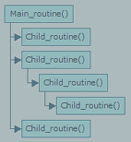
|
|
| |
| # lines: |
428 | | # code: |
428 | | # comment: | 0 | |
# blank: | 0 |
| # Variables: | 52 |
| # Callers: | 2 |
| # Callings: | 2 |
| # Words: | 173 |
| # Keywords: | 94 |
|
|
|
|
|
..
     .. Array Arguments ..
     ..
  Purpose
  =======
  PZHETRD reduces a complex Hermitian matrix sub( A ) to Hermitian
  tridiagonal form T by an unitary similarity transformation:
  Q' * sub( A ) * Q = T, where sub( A ) = A(IA:IA+N-1,JA:JA+N-1).
  Notes
  =====
  Each global data object is described by an associated description
  vector.  This vector stores the information required to establish
  the mapping between an object element and its corresponding process
  and memory location.
  Let A be a generic term for any 2D block cyclicly distributed array.
  Such a global array has an associated description vector DESCA.
  In the following comments, the character _ should be read as
  "of the global array".
  NOTATION        STORED IN      EXPLANATION
  --------------- -------------- --------------------------------------
  DTYPE_A(global) DESCA( DTYPE_ )The descriptor type.  In this case,
                                 DTYPE_A = 1.
  CTXT_A (global) DESCA( CTXT_ ) The BLACS context handle, indicating
                                 the BLACS process grid A is distribu-
                                 ted over. The context itself is glo-
                                 bal, but the handle (the integer
                                 value) may vary.
  M_A    (global) DESCA( M_ )    The number of rows in the global
                                 array A.
  N_A    (global) DESCA( N_ )    The number of columns in the global
                                 array A.
  MB_A   (global) DESCA( MB_ )   The blocking factor used to distribute
                                 the rows of the array.
  NB_A   (global) DESCA( NB_ )   The blocking factor used to distribute
                                 the columns of the array.
  RSRC_A (global) DESCA( RSRC_ ) The process row over which the first
                                 row of the array A is distributed.
  CSRC_A (global) DESCA( CSRC_ ) The process column over which the
                                 first column of the array A is
                                 distributed.
  LLD_A  (local)  DESCA( LLD_ )  The leading dimension of the local
                                 array.  LLD_A >= MAX(1,LOCr(M_A)).
  Let K be the number of rows or columns of a distributed matrix,
  and assume that its process grid has dimension p x q.
  LOCr( K ) denotes the number of elements of K that a process
  would receive if K were distributed over the p processes of its
  process column.
  Similarly, LOCc( K ) denotes the number of elements of K that a
  process would receive if K were distributed over the q processes of
  its process row.
  The values of LOCr() and LOCc() may be determined via a call to the
  ScaLAPACK tool function, NUMROC:
          LOCr( M ) = NUMROC( M, MB_A, MYROW, RSRC_A, NPROW ),
          LOCc( N ) = NUMROC( N, NB_A, MYCOL, CSRC_A, NPCOL ).
  An upper bound for these quantities may be computed by:
          LOCr( M ) <= ceil( ceil(M/MB_A)/NPROW )*MB_A
          LOCc( N ) <= ceil( ceil(N/NB_A)/NPCOL )*NB_A
  Arguments
  =========
  UPLO    (global input) CHARACTER
          Specifies whether the upper or lower triangular part of the
          Hermitian matrix sub( A ) is stored:
          = 'U':  Upper triangular
          = 'L':  Lower triangular
  N       (global input) INTEGER
          The number of rows and columns to be operated on, i.e. the
          order of the distributed submatrix sub( A ). N >= 0.
  A       (local input/local output) COMPLEX*16 pointer into the
          local memory to an array of dimension (LLD_A,LOCc(JA+N-1)).
          On entry, this array contains the local pieces of the
          Hermitian distributed matrix sub( A ).  If UPLO = 'U', the
          leading N-by-N upper triangular part of sub( A ) contains
          the upper triangular part of the matrix, and its strictly
          lower triangular part is not referenced. If UPLO = 'L', the
          leading N-by-N lower triangular part of sub( A ) contains the
          lower triangular part of the matrix, and its strictly upper
          triangular part is not referenced. On exit, if UPLO = 'U',
          the diagonal and first superdiagonal of sub( A ) are over-
          written by the corresponding elements of the tridiagonal
          matrix T, and the elements above the first superdiagonal,
          with the array TAU, represent the unitary matrix Q as a
          product of elementary reflectors; if UPLO = 'L', the diagonal
          and first subdiagonal of sub( A ) are overwritten by the
          corresponding elements of the tridiagonal matrix T, and the
          elements below the first subdiagonal, with the array TAU,
          represent the unitary matrix Q as a product of elementary
          reflectors. See Further Details.
  IA      (global input) INTEGER
          The row index in the global array A indicating the first
          row of sub( A ).
  JA      (global input) INTEGER
          The column index in the global array A indicating the
          first column of sub( A ).
  DESCA   (global and local input) INTEGER array of dimension DLEN_.
          The array descriptor for the distributed matrix A.
  D       (local output) DOUBLE PRECISION array, dimension LOCc(JA+N-1)
          The diagonal elements of the tridiagonal matrix T:
          D(i) = A(i,i). D is tied to the distributed matrix A.
  E       (local output) DOUBLE PRECISION array, dimension LOCc(JA+N-1)
          if UPLO = 'U', LOCc(JA+N-2) otherwise. The off-diagonal
          elements of the tridiagonal matrix T: E(i) = A(i,i+1) if
          UPLO = 'U', E(i) = A(i+1,i) if UPLO = 'L'. E is tied to the
          distributed matrix A.
  TAU     (local output) COMPLEX*16, array, dimension
          LOCc(JA+N-1). This array contains the scalar factors TAU of
          the elementary reflectors. TAU is tied to the distributed
          matrix A.
  WORK    (local workspace/local output) COMPLEX*16 array,
                                                  dimension (LWORK)
          On exit, WORK( 1 ) returns the minimal and optimal LWORK.
  LWORK   (local or global input) INTEGER
          The dimension of the array WORK.
          LWORK is local input and must be at least
          LWORK >= MAX( NB * ( NP +1 ), 3 * NB )
          where NB = MB_A = NB_A,
          NP = NUMROC( N, NB, MYROW, IAROW, NPROW ),
          IAROW = INDXG2P( IA, NB, MYROW, RSRC_A, NPROW ).
          INDXG2P and NUMROC are ScaLAPACK tool functions;
          MYROW, MYCOL, NPROW and NPCOL can be determined by calling
          the subroutine BLACS_GRIDINFO.
          If LWORK = -1, then LWORK is global input and a workspace
          query is assumed; the routine only calculates the minimum
          and optimal size for all work arrays. Each of these
          values is returned in the first entry of the corresponding
          work array, and no error message is issued by PXERBLA.
  INFO    (global output) INTEGER
          = 0:  successful exit
          < 0:  If the i-th argument is an array and the j-entry had
                an illegal value, then INFO = -(i*100+j), if the i-th
                argument is a scalar and had an illegal value, then
                INFO = -i.
  Further Details
  ===============
  If UPLO = 'U', the matrix Q is represented as a product of elementary
  reflectors
     Q = H(n-1) . . . H(2) H(1).
  Each H(i) has the form
     H(i) = I - tau * v * v'
  where tau is a complex scalar, and v is a complex vector with
  v(i+1:n) = 0 and v(i) = 1; v(1:i-1) is stored on exit in
  A(ia:ia+i-2,ja+i), and tau in TAU(ja+i-1).
  If UPLO = 'L', the matrix Q is represented as a product of elementary
  reflectors
     Q = H(1) H(2) . . . H(n-1).
  Each H(i) has the form
     H(i) = I - tau * v * v'
  where tau is a complex scalar, and v is a complex vector with
  v(1:i) = 0 and v(i+1) = 1; v(i+2:n) is stored on exit in
  A(ia+i+1:ia+n-1,ja+i-1), and tau in TAU(ja+i-1).
  The contents of sub( A ) on exit are illustrated by the following
  examples with n = 5:
  if UPLO = 'U':                       if UPLO = 'L':
    (  d   e   v2  v3  v4 )              (  d                  )
    (      d   e   v3  v4 )              (  e   d              )
    (          d   e   v4 )              (  v1  e   d          )
    (              d   e  )              (  v1  v2  e   d      )
    (                  d  )              (  v1  v2  v3  e   d  )
  where d and e denote diagonal and off-diagonal elements of T, and vi
  denotes an element of the vector defining H(i).
  Alignment requirements
  ======================
  The distributed submatrix sub( A ) must verify some alignment proper-
  ties, namely the following expression should be true:
  ( MB_A.EQ.NB_A .AND. IROFFA.EQ.ICOFFA .AND. IROFFA.EQ.0 ) with
  IROFFA = MOD( IA-1, MB_A ) and ICOFFA = MOD( JA-1, NB_A ).
  =====================================================================
     .. Parameters ..
|
|
|
|
001 SUBROUTINE PZHETRD( UPLO , N , A , IA , JA , DESCA , D , E , TAU , WORK ,
002 $LWORK , INFO )
003
004 * -- ScaLAPACK routine(version 1.7) --
005 * University of Tennessee , Knoxville , Oak Ridge National Laboratory ,
006 * and University of California , Berkeley.
007 * May 1 , 1997
008
009 * .. Scalar Arguments ..
010 CHARACTER UPLO
011 INTEGER IA , INFO , JA , LWORK , N
012 INTEGER BLOCK_CYCLIC_2D , CSRC_ , CTXT_ , DLEN_ , DTYPE_ ,
013 $LLD_ , MB_ , M_ , NB_ , N_ , RSRC_
014 PARAMETER( BLOCK_CYCLIC_2D = 1 , DLEN_ = 9 , DTYPE_ = 1 ,
015 $CTXT_ = 2 , M_ = 3 , N_ = 4 , MB_ = 5 , NB_ = 6 ,
016 $RSRC_ = 7 , CSRC_ = 8 , LLD_ = 9 )
017 DOUBLE PRECISION ONE
018 PARAMETER( ONE = 1.0D + 0 )
019 COMPLEX*16 CONE
020 PARAMETER( CONE =( 1.0D + 0 , 0.0D + 0 ) )
021 * ..
022 * .. Local Scalars ..
023 LOGICAL LQUERY , UPPER
024 CHARACTER COLCTOP , ROWCTOP
025 INTEGER I , IACOL , IAROW , ICOFFA , ICTXT , IINFO , IPW ,
026 $IROFFA , J , JB , JX , K , KK , LWMIN , MYCOL , MYROW ,
027 $NB , NP , NPCOL , NPROW , NQ
028 * ..
029 * .. Local Arrays ..
030 INTEGER DESCW( DLEN_ ) , IDUM1( 2 ) , IDUM2( 2 )
031 * ..
032 * .. External Subroutines ..
033 EXTERNAL BLACS_GRIDINFO , CHK1MAT , DESCSET , PCHK1MAT ,
034 $PB_TOPGET , PB_TOPSET , PXERBLA , PZHER2K ,
035 $PZHETD2 , PZLATRD
036 * ..
037 * .. External Functions ..
038 LOGICAL LSAME
039 INTEGER INDXG2L , INDXG2P , NUMROC
040 EXTERNAL LSAME , INDXG2L , INDXG2P , NUMROC
041 * ..
042 * .. Intrinsic Functions ..
043 INTRINSIC DBLE , DCMPLX , ICHAR , MAX , MIN , MOD
044 * ..
045 * .. Executable Statements ..
046
047 * Get grid parameters
048
049 ICTXT = DESCA( CTXT_ )
050 CALL BLACS_GRIDINFO( ICTXT , NPROW , NPCOL , MYROW , MYCOL )
051
052 * Test the input parameters
053
054 INFO = 0
055 IF( NPROW.EQ. - 1 ) THEN
055   056 INFO = - (600 + CTXT_)
057 ELSE
057
058 CALL
056 INFO = - (600 + CTXT_)
057 ELSE
057
058 CALL CHK1MAT( N , 2 , N , 2 , IA , JA , DESCA , 6 , INFO )
059 UPPER = LSAME( UPLO , 'U' )
060 IF( INFO.EQ.0 ) THEN
060
061 NB = DESCA( NB_ )
062 IROFFA = MOD( IA - 1 , DESCA( MB_ ) )
063 ICOFFA = MOD( JA - 1 , DESCA( NB_ ) )
064 IAROW = INDXG2P( IA , NB , MYROW , DESCA( RSRC_ ) , NPROW )
065 IACOL = INDXG2P( JA , NB , MYCOL , DESCA( CSRC_ ) , NPCOL )
066 NP = NUMROC( N , NB , MYROW , IAROW , NPROW )
067 NQ = MAX( 1 , NUMROC( N + JA - 1 , NB , MYCOL , DESCA( CSRC_ ) ,
068 $ NPCOL ) )
069 LWMIN = MAX((NP + 1)*NB , 3*NB )
070
071 WORK( 1 ) = DCMPLX( DBLE( LWMIN ) )
072 LQUERY =( LWORK.EQ. - 1 )
073 IF( .NOT.UPPER .AND. .NOT.LSAME( UPLO , 'L' ) ) THEN
073
074 INFO = - 1
075 ELSE IF( IROFFA.NE.ICOFFA .OR. ICOFFA.NE.0 ) THEN
075
076 INFO = - 5
077 ELSE IF( DESCA( MB_ ).NE.DESCA( NB_ ) ) THEN
077
078 INFO = - (600 + NB_)
079 ELSE IF( LWORK.LT.LWMIN .AND. .NOT.LQUERY ) THEN
079
080 INFO = - 11
081 END IF
082 END IF
083 IF( UPPER ) THEN
083
084 IDUM1( 1 ) = ICHAR( 'U' )
085 ELSE
085
086 IDUM1( 1 ) = ICHAR( 'L' )
087 END IF
088 IDUM2( 1 ) = 1
089 IF( LWORK.EQ. - 1 ) THEN
089
090 IDUM1( 2 ) = - 1
091 ELSE
091
092 IDUM1( 2 ) = 1
093 END IF
094 IDUM2( 2 ) = 11
095 CALL PCHK1MAT( N , 2 , N , 2 , IA , JA , DESCA , 6 , 2 , IDUM1 , IDUM2 ,
096 $ INFO )
097 END IF
098
099 IF( INFO.NE.0 ) THEN
099
100 CALL PXERBLA( ICTXT , 'PZHETRD' , - INFO )
101 RETURN
102 ELSE IF( LQUERY ) THEN
102
103 RETURN
104 END IF
105
106 * Quick return if possible
107
108 IF( N.EQ.0 )
108
109 $ RETURN
110
111 CALL PB_TOPGET( ICTXT , 'Combine' , 'Columnwise' , COLCTOP )
112 CALL PB_TOPGET( ICTXT , 'Combine' , 'Rowwise' , ROWCTOP )
113 CALL PB_TOPSET( ICTXT , 'Combine' , 'Columnwise' , '1 - tree' )
114 CALL PB_TOPSET( ICTXT , 'Combine' , 'Rowwise' , '1 - tree' )
115
116 IPW = NP * NB + 1
117
118 IF( UPPER ) THEN
119
120 * Reduce the upper triangle of sub( A ).
121
121
122 KK = MOD( JA + N - 1 , NB )
123 IF( KK.EQ.0 )
123
124 $ KK = NB
125 CALL DESCSET( DESCW , N , NB , NB , NB , IAROW , INDXG2P( JA + N - KK ,
126 $ NB , MYCOL , DESCA( CSRC_ ) , NPCOL ) , ICTXT ,
127 $ MAX( 1 , NP ) )
128
129 DO 10 K = N - KK + 1 , NB + 1 , - NB
129
130 JB = MIN( N - K + 1 , NB )
131 I = IA + K - 1
132 J = JA + K - 1
133
134 * Reduce columns I : I + NB - 1 to tridiagonal form and form
135 * the matrix W which is needed to update the unreduced part of
136 * the matrix
137
138 CALL PZLATRD ( UPLO , K + JB - 1 , JB , A , IA , JA , DESCA , D , E , TAU ,
139 $ WORK , 1 , 1 , DESCW , WORK( IPW ) )
140
141 * Update the unreduced submatrix A(IA : I - 1 , JA : J - 1) , using an
142 * update of the form :
143 * A(IA : I - 1 , JA : J - 1) := A(IA : I - 1 , JA : J - 1) - V*W' - W*V'
144
145 CALL PZHER2K( UPLO , 'No transpose' , K - 1 , JB , - CONE , A , IA ,
146 $ J , DESCA , WORK , 1 , 1 , DESCW , ONE , A , IA , JA ,
147 $ DESCA )
148
149 * Copy last superdiagonal element back into sub( A )
150
151 JX = MIN( INDXG2L( J , NB , 0 , IACOL , NPCOL ) , NQ )
152 CALL PZELSET( A , I - 1 , J , DESCA , DCMPLX( E( JX ) ) )
153
154 DESCW( CSRC_ ) = MOD( DESCW( CSRC_ ) + NPCOL - 1 , NPCOL )
155
156 10 CONTINUE
157
158 * Use unblocked code to reduce the last or only block
159
159
160 CALL PZHETD2 ( UPLO , MIN( N , NB ) , A , IA , JA , DESCA , D , E ,
161 $ TAU , WORK , LWORK , IINFO )
162
163 ELSE
164
165 * Reduce the lower triangle of sub( A )
166
166
167 KK = MOD( JA + N - 1 , NB )
168 IF( KK.EQ.0 )
168
169 $ KK = NB
170 CALL DESCSET( DESCW , N , NB , NB , NB , IAROW , IACOL , ICTXT ,
171 $ MAX( 1 , NP ) )
172
173 DO 20 K = 1 , N - NB , NB
173
174 I = IA + K - 1
175 J = JA + K - 1
176
177 * Reduce columns I : I + NB - 1 to tridiagonal form and form
178 * the matrix W which is needed to update the unreduced part
179 * of the matrix
180
181 CALL PZLATRD ( UPLO , N - K + 1 , NB , A , I , J , DESCA , D , E , TAU ,
182 $ WORK , K , 1 , DESCW , WORK( IPW ) )
183
184 * Update the unreduced submatrix A(I + NB : IA + N - 1 , I + NB : IA + N - 1) ,
185 * using an update of the form : A(I + NB : IA + N - 1 , I + NB : IA + N - 1) :=
186 * A(I + NB : IA + N - 1 , I + NB : IA + N - 1) - V*W' - W*V'
187
188 CALL PZHER2K( UPLO , 'No transpose' , N - K - NB + 1 , NB , - CONE , A ,
189 $ I + NB , J , DESCA , WORK , K + NB , 1 , DESCW , ONE , A ,
190 $ I + NB , J + NB , DESCA )
191
192 * Copy last subdiagonal element back into sub( A )
193
194 JX = MIN( INDXG2L( J + NB - 1 , NB , 0 , IACOL , NPCOL ) , NQ )
195 CALL PZELSET( A , I + NB , J + NB - 1 , DESCA , DCMPLX( E( JX ) ) )
196
197 DESCW( CSRC_ ) = MOD( DESCW( CSRC_ ) + 1 , NPCOL )
198
199 20 CONTINUE
200
201 * Use unblocked code to reduce the last or only block
202
202
203 CALL PZHETD2 ( UPLO , KK , A , IA + K - 1 , JA + K - 1 , DESCA , D , E ,
204 $ TAU , WORK , LWORK , IINFO )
205 END IF
206
207 CALL PB_TOPSET( ICTXT , 'Combine' , 'Columnwise' , COLCTOP )
208 CALL PB_TOPSET( ICTXT , 'Combine' , 'Rowwise' , ROWCTOP )
209
210 WORK( 1 ) = DCMPLX( DBLE( LWMIN ) )
211
212 RETURN
213
214 * End of PZHETRD
215
216 END45
22
|
|
Variables in Routine PZHETRD()
| Summary Report |
| Data Type | Quantity | Size(byte) |
| CHARACTER | 3 | 3 |
| COMPLEX*16 | 1 | ? |
| DOUBLE PRECISION | 1 | 4 |
| INTEGER | 43 | 184 |
| LOGICAL | 3 | 3 |
| REAL | 1 | 4 |
| TOTAL | 52 | 198 |
List of Variables
CHARACTER
COMPLEX*16
DOUBLE PRECISION
INTEGER
| BLOCK_CYCLIC_2D | CSRC_ | CTXT_ | DESCW( DLEN_ ) | DLEN_ |
| DTYPE_ | I | IA | IACOL | IAROW |
| ICOFFA | ICTXT | IDUM1( 2 ) | IDUM2( 2 ) | IINFO |
| INDXG2L | INDXG2P | INFO | IPW | IROFFA |
| J | JA | JB | JX | K |
| KK | LLD_ | LWMIN | LWORK | M_ |
| MB_ | MYCOL | MYROW | N | N_ |
| NB | NB_ | NP | NPCOL | NPROW |
| NQ | NUMROC | RSRC_ | | |
LOGICAL
REAL
Variables Dependence Graph
Put the mouse over a right hand side variable to display the corresponding line of the dependence | | - | | - | - | | DESCW | <--- | CSRC_DESCW( CSRC_ ) = MOD( DESCW( CSRC_ ) + NPCOL - 1, NPCOL ){2DESCW( CSRC_ ) = MOD( DESCW( CSRC_ ) + 1, NPCOL )}, NPCOLDESCW( CSRC_ ) = MOD( DESCW( CSRC_ ) + NPCOL - 1, NPCOL ){2DESCW( CSRC_ ) = MOD( DESCW( CSRC_ ) + 1, NPCOL )}, DESCWDESCW( CSRC_ ) = MOD( DESCW( CSRC_ ) + NPCOL - 1, NPCOL ){2DESCW( CSRC_ ) = MOD( DESCW( CSRC_ ) + 1, NPCOL )} |
| I | <--- | IAI = IA + K - 1{2I = IA + K - 1}, KI = IA + K - 1{2I = IA + K - 1} |
| IACOL | <--- | INDXG2PIACOL = INDXG2P( JA, NB, MYCOL, DESCA( CSRC_ ), NPCOL ), JAIACOL = INDXG2P( JA, NB, MYCOL, DESCA( CSRC_ ), NPCOL ), MYCOLIACOL = INDXG2P( JA, NB, MYCOL, DESCA( CSRC_ ), NPCOL ), CSRC_IACOL = INDXG2P( JA, NB, MYCOL, DESCA( CSRC_ ), NPCOL ), NBIACOL = INDXG2P( JA, NB, MYCOL, DESCA( CSRC_ ), NPCOL ), NPCOLIACOL = INDXG2P( JA, NB, MYCOL, DESCA( CSRC_ ), NPCOL ) |
| IAROW | <--- | IAIAROW = INDXG2P( IA, NB, MYROW, DESCA( RSRC_ ), NPROW ), INDXG2PIAROW = INDXG2P( IA, NB, MYROW, DESCA( RSRC_ ), NPROW ), MYROWIAROW = INDXG2P( IA, NB, MYROW, DESCA( RSRC_ ), NPROW ), NBIAROW = INDXG2P( IA, NB, MYROW, DESCA( RSRC_ ), NPROW ), NPROWIAROW = INDXG2P( IA, NB, MYROW, DESCA( RSRC_ ), NPROW ), RSRC_IAROW = INDXG2P( IA, NB, MYROW, DESCA( RSRC_ ), NPROW ) |
| ICOFFA | <--- | JAICOFFA = MOD( JA-1, DESCA( NB_ ) ), NB_ICOFFA = MOD( JA-1, DESCA( NB_ ) ) |
| ICTXT | <--- | CTXT_ICTXT = DESCA( CTXT_ ) |
| INFO | <--- | NB_INFO = -(600+NB_), CTXT_INFO = -(600+CTXT_) |
| IPW | <--- | NBIPW = NP * NB + 1, NPIPW = NP * NB + 1 |
| IROFFA | <--- | IAIROFFA = MOD( IA-1, DESCA( MB_ ) ), MB_IROFFA = MOD( IA-1, DESCA( MB_ ) ) |
| J | <--- | JAJ = JA + K - 1{2J = JA + K - 1}, KJ = JA + K - 1{2J = JA + K - 1} |
| JB | <--- | KJB = MIN( N-K+1, NB ), NJB = MIN( N-K+1, NB ), NBJB = MIN( N-K+1, NB ) |
| JX | <--- | IACOLJX = MIN( INDXG2L( J, NB, 0, IACOL, NPCOL ), NQ ){2JX = MIN( INDXG2L( J+NB-1, NB, 0, IACOL, NPCOL ), NQ )}, INDXG2LJX = MIN( INDXG2L( J, NB, 0, IACOL, NPCOL ), NQ ){2JX = MIN( INDXG2L( J+NB-1, NB, 0, IACOL, NPCOL ), NQ )}, JJX = MIN( INDXG2L( J, NB, 0, IACOL, NPCOL ), NQ ){2JX = MIN( INDXG2L( J+NB-1, NB, 0, IACOL, NPCOL ), NQ )}, NBJX = MIN( INDXG2L( J, NB, 0, IACOL, NPCOL ), NQ ){2JX = MIN( INDXG2L( J+NB-1, NB, 0, IACOL, NPCOL ), NQ )}, NPCOLJX = MIN( INDXG2L( J, NB, 0, IACOL, NPCOL ), NQ ){2JX = MIN( INDXG2L( J+NB-1, NB, 0, IACOL, NPCOL ), NQ )}, NQJX = MIN( INDXG2L( J, NB, 0, IACOL, NPCOL ), NQ ){2JX = MIN( INDXG2L( J+NB-1, NB, 0, IACOL, NPCOL ), NQ )} |
| K | <--- | KKDO 10 K = N-KK+1, NB+1, -NB, NDO 10 K = N-KK+1, NB+1, -NB{2DO 20 K = 1, N-NB, NB}, NBDO 10 K = N-KK+1, NB+1, -NB{2DO 20 K = 1, N-NB, NB} |
| KK | <--- | JAKK = MOD( JA+N-1, NB ){2KK = MOD( JA+N-1, NB )}, NKK = MOD( JA+N-1, NB ){2KK = MOD( JA+N-1, NB )}, NBKK = MOD( JA+N-1, NB ){2KK = MOD( JA+N-1, NB )} |
| LWMIN | <--- | NBLWMIN = MAX( (NP+1)*NB, 3*NB ), NPLWMIN = MAX( (NP+1)*NB, 3*NB ) |
| NB | <--- | NB_NB = DESCA( NB_ ) |
| NP | <--- | IAROWNP = NUMROC( N, NB, MYROW, IAROW, NPROW ), MYROWNP = NUMROC( N, NB, MYROW, IAROW, NPROW ), NNP = NUMROC( N, NB, MYROW, IAROW, NPROW ), NBNP = NUMROC( N, NB, MYROW, IAROW, NPROW ), NPROWNP = NUMROC( N, NB, MYROW, IAROW, NPROW ), NUMROCNP = NUMROC( N, NB, MYROW, IAROW, NPROW ) |
| NQ | <--- | JANQ = MAX( 1, NUMROC( N+JA-1, NB, MYCOL, DESCA( CSRC_ ),, MYCOLNQ = MAX( 1, NUMROC( N+JA-1, NB, MYCOL, DESCA( CSRC_ ),, NNQ = MAX( 1, NUMROC( N+JA-1, NB, MYCOL, DESCA( CSRC_ ),, CSRC_NQ = MAX( 1, NUMROC( N+JA-1, NB, MYCOL, DESCA( CSRC_ ),, NBNQ = MAX( 1, NUMROC( N+JA-1, NB, MYCOL, DESCA( CSRC_ ),, NPCOLNQ = MAX( 1, NUMROC( N+JA-1, NB, MYCOL, DESCA( CSRC_ ),, NUMROCNQ = MAX( 1, NUMROC( N+JA-1, NB, MYCOL, DESCA( CSRC_ ), |
| UPPER | <--- | LSAMEUPPER = LSAME( UPLO, 'U' ), UPLOUPPER = LSAME( UPLO, 'U' ) |
| WORK | <--- | LWMINWORK( 1 ) = DCMPLX( DBLE( LWMIN ) ){2WORK( 1 ) = DCMPLX( DBLE( LWMIN ) )} |
|
|
Analysis elements of the routine PZHETRD()
Put the mouse over each element to display detailed matching information
 Assigned variables Assigned variables |
| | | BLOCK_CYCLIC_2D , CONE , CSRC_ , CTXT_ , DLEN_ , DTYPE_ , I , IACOL , IAROW , ICOFFA , ICTXT , IDUM1 , IDUM2 , INFO , IPW , IROFFA , J , JB , JX , K , KK , LLD_ , LQUERY , LWMIN , M_ , MB_ , N , N_ , NB , NB_ , NP , NQ , ONE , RSRC_ , UPPER , WORK |
|
| Active variables |
| | | A , BLOCK_CYCLIC_2D , COLCTOP , CONE , CSRC_ , CTXT_ , D , DESCA , DESCW , DLEN_ , DTYPE_ , E , I , IA , IACOL , IAROW , ICOFFA , ICTXT , IDUM1 , IDUM2 , IINFO , INDXG2L , INDXG2P , INFO , IPW , IROFFA , J , JA , JB , JX , K , KK , LLD_ , LQUERY , LSAME , LWMIN , LWORK , M_ , MB_ , MYCOL , MYROW , N , N_ , NB , NB_ , NP , NPCOL , NPROW , NQ , NUMROC , ONE , ROWCTOP , RSRC_ , TAU , UPLO , UPPER , WORK |
|
| Accessed arrays [ array name : associated index ] |
| |  A A | : I+NB:IA+N-1,I+NB:IA+N-1 , I+NB:IA+N-1,I+NB:IA+N-1 , I+NB:IA+N-1,I+NB:IA+N-1 , IA:I-1,JA:J-1 , IA:I-1,JA:J-1 |
| | DESCA | : CSRC_ , CSRC_ , CSRC_ , CTXT_ , MB_ , MB_ , NB_ , NB_ , NB_ , RSRC_ |
| | DESCW | : CSRC_ , CSRC_ , DLEN_ |
| | E | : JX , JX |
| | IDUM1 | : 1 , 1 , 2 , 2 , 2 |
| | IDUM2 | : 1 , 2 , 2 |
| | INDXG2L | : J, NB, 0, IACOL, NPCOL , J+NB-1, NB, 0, IACOL, NPCOL |
| | INDXG2P | : IA, NB, MYROW, DESCA( RSRC_ ), NPROW , JA, NB, MYCOL, DESCA( CSRC_ ), NPCOL |
| | LSAME | : UPLO, 'L' , UPLO, 'U' |
| | NUMROC | : N, NB, MYROW, IAROW, NPROW |
| | WORK | : 1 , 1 , IPW , IPW |
|
| Conditional statements [ statement : associated predicate ] |
| | do | : ( 10 K = N - KK + 1 , NB + 1 , - NB ) , ( 20 K = 1 , N - NB , NB ) |
| | if | : ( NPROW.EQ. - 1 ) , ( INFO.EQ.0 ) , ( (.NOT.UPPER .AND. .NOT.LSAME( UPLO , 'L' ) ) ) , ( IROFFA.NE.ICOFFA .OR. ICOFFA.NE.0 ) , ( (DESCA( MB_ ).NE.DESCA( NB_ ) ) ) , ( LWORK.LT.LWMIN .AND. .NOT.LQUERY ) , ( UPPER ) , ( LWORK.EQ. - 1 ) , ( INFO.NE.0 ) , ( LQUERY ) , ( possible ) , ( N.EQ.0 ) , ( UPPER ) , ( KK.EQ.0 ) , ( KK.EQ.0 ) |
|
| List of variables |
BLOCK_CYCLIC_2D
COLCTOP
CONE
CSRC_
CTXT_
DESCW( DLEN_ )
DLEN_
| DTYPE_
I
IA
IACOL
IAROW
ICOFFA
ICTXT
IDUM1( 2 )
| IDUM2( 2 )
IINFO
INDXG2L
INDXG2P
INFO
IPW
IROFFA
J
| JA
JB
JX
K
KK
LLD_
LQUERY
LSAME
| LWMIN
LWORK
M_
MB_
MYCOL
MYROW
N
N_
| NB
NB_
NP
NPCOL
NPROW
NQ
NUMROC
ONE
| ROWCTOP
RSRC_
UPLO
UPPER
WORK | | close
| |
BLOCK_CYCLIC_2D
COLCTOP
CONE
CSRC_
CTXT_
DESCW( DLEN_ )
DLEN_
DTYPE_
I
IA
IACOL
IAROW
ICOFFA
ICTXT
IDUM1( 2 )
IDUM2( 2 )
IINFO
INDXG2L
INDXG2P
INFO
IPW
IROFFA
J
JA
JB
JX
K
KK
LLD_
LQUERY
LSAME
LWMIN
LWORK
M_
MB_
MYCOL
MYROW
N
N_
NB
NB_
NP
NPCOL
NPROW
NQ
NUMROC
ONE
ROWCTOP
RSRC_
UPLO
UPPER
WORK
547#508
| |