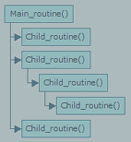
|
|
| |
| # lines: |
1198 | | # code: |
1198 | | # comment: | 0 | |
# blank: | 0 |
| # Variables: | 113 |
| # Callers: | 1 |
| # Callings: | 3 |
| # Words: | 445 |
| # Keywords: | 295 |
|
|
|
|
|
..
     .. Array Arguments ..
     ..
     Purpose
     =======
     PSSYTTRD reduces a complex Hermitian matrix sub( A ) to Hermitian
     tridiagonal form T by an unitary similarity transformation:
     Q' * sub( A ) * Q = T, where sub( A ) = A(IA:IA+N-1,JA:JA+N-1).
     Notes
     =====
     Each global data object is described by an associated description
     vector.  This vector stores the information required to establish
     the mapping between an object element and its corresponding
     process and memory location.
     Let A be a generic term for any 2D block cyclicly distributed
     array.
     Such a global array has an associated description vector DESCA.
     In the following comments, the character _ should be read as
     "of the global array".
     NOTATION        STORED IN      EXPLANATION
     --------------- -------------- -----------------------------------
     DTYPE_A(global) DESCA( DTYPE_ )The descriptor type.  In this case,
     DTYPE_A = 1.
     CTXT_A (global) DESCA( CTXT_ ) The BLACS context handle,
     indicating the BLACS process grid A is distribu-
     ted over. The context itself is glo-
     bal, but the handle (the integer
     value) may vary.
     M_A    (global) DESCA( M_ )    The number of rows in the global
     array A.
     N_A    (global) DESCA( N_ )    The number of columns in the global
     array A.
     MB_A   (global) DESCA( MB_ )   The blocking factor used to
     distribute the rows of the array.
     NB_A   (global) DESCA( NB_ )   The blocking factor used to
     distribute the columns of the array.
     RSRC_A (global) DESCA( RSRC_ ) The process row over which the
     first row of the array A is distributed.
     CSRC_A (global) DESCA( CSRC_ ) The process column over which the
     first column of the array A is
     distributed.
     LLD_A  (local)  DESCA( LLD_ )  The leading dimension of the local
     array.  LLD_A >= MAX(1,LOCp(M_A)).
     Let K be the number of rows or columns of a distributed matrix,
     and assume that its process grid has dimension p x q.
     LOCp( K ) denotes the number of elements of K that a process
     would receive if K were distributed over the p processes of its
     process column.
     Similarly, LOCq( K ) denotes the number of elements of K that a
     process would receive if K were distributed over the q processes
     of its process row.
     The values of LOCp() and LOCq() may be determined via a call to
     the ScaLAPACK tool function, NUMROC:
     LOCp( M ) = NUMROC( M, MB_A, MYROW, RSRC_A, NPROW ),
     LOCq( N ) = NUMROC( N, NB_A, MYCOL, CSRC_A, NPCOL ).
     An upper bound for these quantities may be computed by:
     LOCp( M ) <= ceil( ceil(M/MB_A)/NPROW )*MB_A
     LOCq( N ) <= ceil( ceil(N/NB_A)/NPCOL )*NB_A
     Arguments
     =========
     UPLO    (global input) CHARACTER
     Specifies whether the upper or lower triangular part of the
     Hermitian matrix sub( A ) is stored:
     = 'U':  Upper triangular
     = 'L':  Lower triangular
     N       (global input) INTEGER
     The number of rows and columns to be operated on, i.e. the
     order of the distributed submatrix sub( A ). N >= 0.
     A       (local input/local output) REAL pointer into the
     local memory to an array of dimension (LLD_A,LOCq(JA+N-1)).
     On entry, this array contains the local pieces of the
     Hermitian distributed matrix sub( A ).  If UPLO = 'U', the
     leading N-by-N upper triangular part of sub( A ) contains
     the upper triangular part of the matrix, and its strictly
     lower triangular part is not referenced. If UPLO = 'L', the
     leading N-by-N lower triangular part of sub( A ) contains the
     lower triangular part of the matrix, and its strictly upper
     triangular part is not referenced. On exit, if UPLO = 'U',
     the diagonal and first superdiagonal of sub( A ) are over-
     written by the corresponding elements of the tridiagonal
     matrix T, and the elements above the first superdiagonal,
     with the array TAU, represent the unitary matrix Q as a
     product of elementary reflectors; if UPLO = 'L', the diagonal
     and first subdiagonal of sub( A ) are overwritten by the
     corresponding elements of the tridiagonal matrix T, and the
     elements below the first subdiagonal, with the array TAU,
     represent the unitary matrix Q as a product of elementary
     reflectors. See Further Details.
     IA      (global input) INTEGER
     The row index in the global array A indicating the first
     row of sub( A ).
     JA      (global input) INTEGER
     The column index in the global array A indicating the
     first column of sub( A ).
     DESCA   (global and local input) INTEGER array of dimension DLEN_.
     The array descriptor for the distributed matrix A.
     D       (local output) REAL array, dim LOCq(JA+N-1)
     The diagonal elements of the tridiagonal matrix T:
     D(i) = A(i,i). D is tied to the distributed matrix A.
     E       (local output) REAL array, dim LOCq(JA+N-1)
     if UPLO = 'U', LOCq(JA+N-2) otherwise. The off-diagonal
     elements of the tridiagonal matrix T: E(i) = A(i,i+1) if
     UPLO = 'U', E(i) = A(i+1,i) if UPLO = 'L'. E is tied to the
     distributed matrix A.
     TAU     (local output) REAL, array, dimension
     LOCq(JA+N-1). This array contains the scalar factors TAU of
     the elementary reflectors. TAU is tied to the distributed
     matrix A.
     WORK    (local workspace) REAL array, dimension (LWORK)
     On exit, WORK( 1 ) returns the minimal and optimal workspace
     LWORK   (local input) INTEGER
     The dimension of the array WORK.
     LWORK >= 2*( ANB+1 )*( 4*NPS+2 ) + NPS
     Where:
         NPS = MAX( NUMROC( N, 1, 0, 0, NPROW ), 2*ANB )
         ANB = PJLAENV( DESCA( CTXT_ ), 3, 'PSSYTTRD', 'L', 0, 0,
           0, 0 )
         NUMROC is a ScaLAPACK tool function;
         PJLAENV is a ScaLAPACK envionmental inquiry function
         MYROW, MYCOL, NPROW and NPCOL can be determined by calling
         the subroutine BLACS_GRIDINFO.
     INFO    (global output) INTEGER
     = 0:  successful exit
     < 0:  If the i-th argument is an array and the j-entry had
     an illegal value, then INFO = -(i*100+j), if the i-th
     argument is a scalar and had an illegal value, then
     INFO = -i.
     Further Details
     ===============
     If UPLO = 'U', the matrix Q is represented as a product of
     elementary reflectors
     Q = H(n-1) . . . H(2) H(1).
     Each H(i) has the form
     H(i) = I - tau * v * v'
     where tau is a complex scalar, and v is a complex vector with
     v(i+1:n) = 0 and v(i) = 1; v(1:i-1) is stored on exit in
     A(ia:ia+i-2,ja+i), and tau in TAU(ja+i-1).
     If UPLO = 'L', the matrix Q is represented as a product of
     elementary reflectors
     Q = H(1) H(2) . . . H(n-1).
     Each H(i) has the form
     H(i) = I - tau * v * v'
     where tau is a complex scalar, and v is a complex vector with
     v(1:i) = 0 and v(i+1) = 1; v(i+2:n) is stored on exit in
     A(ia+i+1:ia+n-1,ja+i-1), and tau in TAU(ja+i-1).
     The contents of sub( A ) on exit are illustrated by the following
     examples with n = 5:
     if UPLO = 'U':                       if UPLO = 'L':
     (  d   e   v2  v3  v4 )              (  d                  )
     (      d   e   v3  v4 )              (  e   d              )
     (          d   e   v4 )              (  v1  e   d          )
     (              d   e  )              (  v1  v2  e   d      )
     (                  d  )              (  v1  v2  v3  e   d  )
     where d and e denote diagonal and off-diagonal elements of T, and
     vi denotes an element of the vector defining H(i).
     Data storage requirements
     =========================
     PSSYTTRD is not intended to be called directly.  All users are
     encourage to call PSSYTRD which will then call PSHETTRD if
     appropriate.  A must be in cyclic format (i.e. MB = NB = 1),
     the process grid must be square ( i.e. NPROW = NPCOL ) and
     only lower triangular storage is supported.
     Local variables
     ===============
     PSSYTTRD uses five local arrays:
       WORK ( InV ) dimension ( NP, ANB+1): array V
       WORK ( InH ) dimension ( NP, ANB+1): array H
       WORK ( InVT ) dimension ( NQ, ANB+1): transpose of the array V
       WORK ( InHT ) dimension ( NQ, ANB+1): transpose of the array H
       WORK ( InVTT ) dimension ( NQ, 1): transpose of the array VT
     Arrays V and H are replicated across all processor columns.
     Arrays V^T and H^T are replicated across all processor rows.
         WORK ( InVT ), or V^T, is stored as a tall skinny
         array ( NQ x ANB-1 ) for efficiency.  Since only the lower
         triangular portion of A is updated, Av is computed as:
         tril(A) * v + v^T * tril(A,-1).  This is performed as
         two local triangular matrix-vector multiplications (both in
         MVR2) followed by a transpose and a sum across the columns.
         In the local computation, WORK( InVT ) is used to compute
         tril(A) * v and WORK( InV ) is used to compute
         v^T * tril(A,-1)
     The following variables are global indices into A:
       INDEX:  The current global row and column number.
       MAXINDEX:  The global row and column for the first row and
       column in the trailing block of A.
       LIIB, LIJB:  The first row, column in
     The following variables point into the arrays A, V, H, V^T, H^T:
       BINDEX  =INDEX-MININDEX: The column index in V, H, V^T, H^T.
       LII:  local index I:  The local row number for row INDEX
       LIJ:  local index J:  The local column number for column INDEX
       LIIP1:  local index I+1:  The local row number for row INDEX+1
       LIJP1:  local index J+1:  The local col number for col INDEX+1
       LTLI: lower triangular local index I:  The local row for the
         upper left entry in tril( A(INDEX, INDEX) )
       LTLIP1: lower triangular local index I+1:  The local row for the
         upper left entry in tril( A(INDEX+1, INDEX+1) )
         Details:  The distinction between LII and LTLI (and between
         LIIP1 and LTLIP1) is subtle.  Within the current processor
         column (i.e. MYCOL .eq. CURCOL) they are the same.  However,
         on some processors, A( LII, LIJ ) points to an element
         above the diagonal, on these processors, LTLI = LII+1.
     The following variables give the number of rows and/or columns
     in various matrices:
       NP:  The number of local rows in A( 1:N, 1:N )
       NQ:  The number of local columns in A( 1:N, 1:N )
       NPM0:  The number of local rows in A( INDEX:N, INDEX:N )
       NQM0:  The number of local columns in A( INDEX:N, INDEX:N )
       NPM1:  The number of local rows in A( INDEX+1:N, INDEX:N )
       NQM1:  The number of local columns in A( INDEX+1:N, INDEX:N )
       LTNM0:  The number of local rows & columns in
         tril( A( INDEX:N, INDEX:N ) )
       LTNM1:  The number of local rows & columns in
         tril( A( INDEX+1:N, INDEX+1:N ) )
         NOTE:  LTNM0 == LTNM1 on all processors except the diagonal
         processors, i.e. those where MYCOL == MYROW.
         Invariants:
           NP = NPM0 + LII - 1
           NQ = NQM0 + LIJ - 1
           NP = NPM1 + LIIP1 - 1
           NQ = NQM1 + LIJP1 - 1
           NP = LTLI + LTNM0 - 1
           NP = LTLIP1 + LTNM1 - 1
       Temporary variables.  The following variables are used within
       a few lines after they are set and do hold state from one loop
       iteration to the next:
     The matrix A:
       The matrix A does not hold the same values that it would
       in an unblocked code nor the values that it would hold in
       in a blocked code.
       The value of A is confusing.  It is easiest to state the
       difference between trueA and A at the point that MVR2 is called,
       so we will start there.
       Let trueA be the value that A would
       have at a given point in an unblocked code and A
       be the value that A has in this code at the same point.
       At the time of the call to MVR2,
       trueA = A + V' * H + H' * V
       where H = H( MAXINDEX:N, 1:BINDEX ) and
       V = V( MAXINDEX:N, 1:BINDEX ).
       At the bottom of the inner loop,
       trueA = A +  V' * H + H' * V + v' * h + h' * v
       where H = H( MAXINDEX:N, 1:BINDEX ) and
       V = V( MAXINDEX:N, 1:BINDEX ) and
       v = V( liip1:N, BINDEX+1 ) and
       h = H( liip1:N, BINDEX+1 )
       At the top of the loop, BINDEX gets incremented, hence:
       trueA = A +  V' * H + H' * V + v' * h + h' * v
       where H = H( MAXINDEX:N, 1:BINDEX-1 ) and
       V = V( MAXINDEX:N, 1:BINDEX-1 ) and
       v = V( liip1:N, BINDEX ) and
       h = H( liip1:N, BINDEX )
       A gets updated at the bottom of the outer loop
       After this update, trueA = A + v' * h + h' * v
       where v = V( liip1:N, BINDEX ) and
       h = H( liip1:N, BINDEX ) and BINDEX = 0
       Indeed, the previous loop invariant as stated above for the
       top of the loop still holds, but with BINDEX = 0, H and V
       are null matrices.
       After the current column of A is updated,
         trueA( INDEX, INDEX:N ) = A( INDEX, INDEX:N )
       the rest of A is untouched.
       After the current block column of A is updated,
       trueA = A + V' * H + H' * V
       where H = H( MAXINDEX:N, 1:BINDEX ) and
       V = V( MAXINDEX:N, 1:BINDEX )
       This brings us back to the point at which mvr2 is called.
     Details of the parallelization:
       We delay spreading v across to all processor columns (which
       would naturally happen at the bottom of the loop) in order to
       combine the spread of v( : , i-1 ) with the spread of h( : , i )
       In order to compute h( :, i ), we must update A( :, i )
       which means that the processor column owning A( :, i ) must
       have: c, tau, v( i, i ) and h( i, i ).
       The traditional
       way of computing v (and the one used in pzlatrd.f and
       zlatrd.f) is:
         v = tau * v
         c = v' * h
         alpha = - tau * c / 2
         v = v + alpha * h
       However, the traditional way of computing v requires that tau
       be broadcast to all processors in the current column (to compute
       v = tau * v) and then a sum-to-all is required (to
       compute v' * h ).  We use the following formula instead:
         c = v' * h
         v = tau * ( v - c * tau' * h / 2 )
       The above formula allows tau to be spread down in the
       same call to SGSUM2D which performs the sum-to-all of c.
       The computation of v, which could be performed in any processor
       column (or other procesor subsets), is performed in the
       processor column that owns A( :, i+1 ) so that A( :, i+1 )
       can be updated prior to spreading v across.
       We keep the block column of A up-to-date to minimize the
       work required in updating the current column of A.  Updating
       the block column of A is reasonably load balanced whereas
       updating the current column of A is not (only the current
       processor column is involved).
     In the following overview of the steps performed, M in the
     margin indicates message traffic and C indicates O(n^2 nb/sqrt(p))
     or more flops per processor.
     Inner loop:
       A( index:n, index ) -= ( v * ht(bindex) + h * vt( bindex) )
M      h = house( A(index:n, index) )
M      Spread v, h across
M      vt = v^T; ht = h^T
       A( index+1:n, index+1:maxindex ) -=
         ( v * ht(index+1:maxindex) + h *vt(index+1:maxindex) )
C      v = tril(A) * h; vt = ht * tril(A,-1)
MorC   v = v - H*V*h - V*H*h
M      v = v + vt^T
M      c = v' * h
       v = tau * ( v - c * tau' * h / 2 )
C    A = A - H*V - V*H
     =================================================================
     .. Parameters ..
|
|
|
|
001 SUBROUTINE PSSYTTRD( UPLO , N , A , IA , JA , DESCA , D , E , TAU , WORK ,
002 $LWORK , INFO )
003
004 * -- ScaLAPACK routine(version 1.7) --
005 * University of Tennessee , Knoxville , Oak Ridge National Laboratory ,
006 * and University of California , Berkeley.
007 * October 15 , 1999
008
009 * .. Scalar Arguments ..
010 CHARACTER UPLO
011 INTEGER IA , INFO , JA , LWORK , N
012 INTEGER BLOCK_CYCLIC_2D , DLEN_ , DTYPE_ , CTXT_ , M_ , N_ ,
013 $MB_ , NB_ , RSRC_ , CSRC_ , LLD_
014 PARAMETER( BLOCK_CYCLIC_2D = 1 , DLEN_ = 9 , DTYPE_ = 1 ,
015 $CTXT_ = 2 , M_ = 3 , N_ = 4 , MB_ = 5 , NB_ = 6 ,
016 $RSRC_ = 7 , CSRC_ = 8 , LLD_ = 9 )
017 REAL ONE
018 PARAMETER( ONE = 1.0E0 )
019 REAL Z_ONE , Z_NEGONE , Z_ZERO
020 PARAMETER( Z_ONE = 1.0E0 , Z_NEGONE = - 1.0E0 ,
021 $Z_ZERO = 0.0E0 )
022 REAL ZERO
023 PARAMETER( ZERO = 0.0E + 0 )
024 * ..
025
026 * .. Local Scalars ..
027
028 LOGICAL BALANCED , INTERLEAVE , TWOGEMMS , UPPER
029 INTEGER ANB , BINDEX , CURCOL , CURROW , I , ICTXT , INDEX ,
030 $INDEXA , INDEXINH , INDEXINV , INH , INHB , INHT ,
031 $INHTB , INTMP , INV , INVB , INVT , INVTB , J , LDA ,
032 $LDV , LDZG , LII , LIIB , LIIP1 , LIJ , LIJB , LIJP1 ,
033 $LTLIP1 , LTNM1 , LWMIN , MAXINDEX , MININDEX ,
034 $MYCOL , MYFIRSTROW , MYROW , MYSETNUM , NBZG , NP ,
035 $NPB , NPCOL , NPM0 , NPM1 , NPROW , NPS , NPSET , NQ ,
036 $NQB , NQM1 , NUMROWS , NXTCOL , NXTROW , PBMAX ,
037 $PBMIN , PBSIZE , PNB , ROWSPERPROC
038 REAL ALPHA , BETA , C , NORM , ONEOVERBETA , SAFMAX ,
039 $SAFMIN , TOPH , TOPNV , TOPTAU , TOPV , TTOPH , TTOPV
040 * ..
041 * .. Local Arrays ..
042
043 INTEGER IDUM1( 1 ) , IDUM2( 1 )
044 REAL CC( 3 ) , DTMP( 5 )
045 * ..
046 * .. External Subroutines ..
047 EXTERNAL BLACS_GRIDINFO , CHK1MAT , PCHK1MAT , PSTREECOMB ,
048 $PXERBLA , SCOMBNRM2 , SGEBR2D , SGEBS2D , SGEMM ,
049 $SGEMV , SGERV2D , SGESD2D , SGSUM2D , SLACPY ,
050 $SSCAL , STRMVT
051 * ..
052 * .. External Functions ..
053
054 LOGICAL LSAME
055 INTEGER ICEIL , NUMROC , PJLAENV
056 REAL PSLAMCH , SNRM2
057 EXTERNAL LSAME , ICEIL , NUMROC , PJLAENV , PSLAMCH , SNRM2
058 * ..
059 * .. Intrinsic Functions ..
060 INTRINSIC ICHAR , MAX , MIN , MOD , REAL , SIGN , SQRT
061 * ..
062
063 * .. Executable Statements ..
064 * This is just to keep ftnchek and toolpack / 1 happy
065 IF( BLOCK_CYCLIC_2D*CSRC_*CTXT_*DLEN_*DTYPE_*LLD_*MB_*M_*NB_*N_*
065   066 $ RSRC_.LT.0 )RETURN
067
068 * Further details
069 * ===============
070
071 * At the top of the loop , v and nh have been computed but not
072 * spread across. Hence , A is out - of - date even after the
073 * rank 2k update. Furthermore , we compute the next v before
074 * nh is spread across.
075
076 * I claim that if we used a sum - to - all on NV , by summing CC within
077 * each column , that we could compute NV locally and could avoid
078 * spreading V across. Bruce claims that sum - to - all can be made
079 * to cost no more than sum - to - one on the Paragon. If that is
080 * true , this would be a win. But ,
081 * the BLACS sum - to - all is just a sum - to - one followed by a broadcast ,
082 * and hence the present scheme is better for now.
083
084 * Get grid parameters
085
086 ICTXT = DESCA( CTXT_ )
087 CALL
066 $ RSRC_.LT.0 )RETURN
067
068 * Further details
069 * ===============
070
071 * At the top of the loop , v and nh have been computed but not
072 * spread across. Hence , A is out - of - date even after the
073 * rank 2k update. Furthermore , we compute the next v before
074 * nh is spread across.
075
076 * I claim that if we used a sum - to - all on NV , by summing CC within
077 * each column , that we could compute NV locally and could avoid
078 * spreading V across. Bruce claims that sum - to - all can be made
079 * to cost no more than sum - to - one on the Paragon. If that is
080 * true , this would be a win. But ,
081 * the BLACS sum - to - all is just a sum - to - one followed by a broadcast ,
082 * and hence the present scheme is better for now.
083
084 * Get grid parameters
085
086 ICTXT = DESCA( CTXT_ )
087 CALL BLACS_GRIDINFO( ICTXT , NPROW , NPCOL , MYROW , MYCOL )
088
089 SAFMAX = SQRT( PSLAMCH( ICTXT , 'O' ) ) / N
090 SAFMIN = SQRT( PSLAMCH( ICTXT , 'S' ) )
091
092 * Test the input parameters
093
094 INFO = 0
095 IF( NPROW.EQ. - 1 ) THEN
095
096 INFO = - ( 600 + CTXT_ )
097 ELSE
098
099 * Here we set execution options for PSSYTTRD
100
100
101 PNB = PJLAENV( ICTXT , 2 , 'PSSYTTRD' , 'L' , 0 , 0 , 0 , 0 )
102 ANB = PJLAENV( ICTXT , 3 , 'PSSYTTRD' , 'L' , 0 , 0 , 0 , 0 )
103
104 INTERLEAVE =( PJLAENV( ICTXT , 4 , 'PSSYTTRD' , 'L' , 1 , 0 , 0 ,
105 $ 0 ).EQ.1 )
106 TWOGEMMS =( PJLAENV( ICTXT , 4 , 'PSSYTTRD' , 'L' , 2 , 0 , 0 ,
107 $ 0 ).EQ.1 )
108 BALANCED =( PJLAENV( ICTXT , 4 , 'PSSYTTRD' , 'L' , 3 , 0 , 0 ,
109 $ 0 ).EQ.1 )
110
111 CALL CHK1MAT( N , 2 , N , 2 , IA , JA , DESCA , 6 , INFO )
112
113 UPPER = LSAME( UPLO , 'U' )
114 IF( INFO.EQ.0 .AND. DESCA( NB_ ).NE.1 )
114
115 $ INFO = 600 + NB_
116 IF( INFO.EQ.0 ) THEN
117
118 * Here is the arithmetic :
119 * Let maxnpq = max( np , nq , 2 * ANB )
120 * LDV = 4 * max( np , nq ) + 2
121 * LWMIN = 2 * ( ANB + 1 ) * LDV + MAX( np , 2 * ANB )
122 * = 2 * ( ANB + 1 ) * ( 4 * NPS + 2 ) + NPS
123
124 * This overestimates memory requirements when ANB > NP / 2
125 * Memory requirements are lower when interleave = .false.
126 * Hence , we could have two sets of memory requirements ,
127 * one for interleave and one for
128
128
129 NPS = MAX( NUMROC( N , 1 , 0 , 0 , NPROW ) , 2*ANB )
130 LWMIN = 2*( ANB + 1 )*( 4*NPS + 2 ) + NPS
131
132 WORK( 1 ) = REAL( LWMIN )
133 IF( .NOT.LSAME( UPLO , 'L' ) ) THEN
133
134 INFO = - 1
135 ELSE IF( IA.NE.1 ) THEN
135
136 INFO = - 4
137 ELSE IF( JA.NE.1 ) THEN
137
138 INFO = - 5
139 ELSE IF( NPROW.NE.NPCOL ) THEN
139
140 INFO = - ( 600 + CTXT_ )
141 ELSE IF( DESCA( DTYPE_ ).NE.1 ) THEN
141
142 INFO = - ( 600 + DTYPE_ )
143 ELSE IF( DESCA( MB_ ).NE.1 ) THEN
143
144 INFO = - ( 600 + MB_ )
145 ELSE IF( DESCA( NB_ ).NE.1 ) THEN
145
146 INFO = - ( 600 + NB_ )
147 ELSE IF( DESCA( RSRC_ ).NE.0 ) THEN
147
148 INFO = - ( 600 + RSRC_ )
149 ELSE IF( DESCA( CSRC_ ).NE.0 ) THEN
149
150 INFO = - ( 600 + CSRC_ )
151 ELSE IF( LWORK.LT.LWMIN ) THEN
151
152 INFO = - 11
153 END IF
154 END IF
155 IF( UPPER ) THEN
155
156 IDUM1( 1 ) = ICHAR( 'U' )
157 ELSE
157
158 IDUM1( 1 ) = ICHAR( 'L' )
159 END IF
160 IDUM2( 1 ) = 1
161
162 CALL PCHK1MAT( N , 2 , N , 2 , IA , JA , DESCA , 6 , 1 , IDUM1 , IDUM2 ,
163 $ INFO )
164 END IF
165
166 IF( INFO.NE.0 ) THEN
166
167 CALL PXERBLA( ICTXT , 'PSSYTTRD' , - INFO )
168 RETURN
169 END IF
170
171 * Quick return if possible
172
173 IF( N.EQ.0 )
173
174 $ RETURN
175
176 * Reduce the lower triangle of sub( A )
177 NP = NUMROC( N , 1 , MYROW , 0 , NPROW )
178 NQ = NUMROC( N , 1 , MYCOL , 0 , NPCOL )
179
180 NXTROW = 0
181 NXTCOL = 0
182
183 LIIP1 = 1
184 LIJP1 = 1
185 NPM1 = NP
186 NQM1 = NQ
187
188 LDA = DESCA( LLD_ )
189 ICTXT = DESCA( CTXT_ )
190
191 * Miscellaneous details :
192 * Put tau , D and E in the right places
193 * Check signs
194 * Place all the arrays in WORK , control their placement
195 * in memory.
196
197 * Loop invariants
198 * A(LIIP1 , LIJ) points to the first element of A(I + 1 , J)
199 * NPM1 , NQM1 = the number of rows , cols in A( LII + 1 : N , LIJ + 1 : N )
200 * A(LII : N , LIJ : N) is one step out of date.
201 * proc( CURROW , CURCOL ) owns A(LII , LIJ)
202 * proc( NXTROW , CURCOL ) owns A(LIIP1 , LIJ)
203
204 INH = 1
205
206 IF( INTERLEAVE ) THEN
207
208 * H and V are interleaved to minimize memory movement
209 * LDV has to be twice as large to accomodate interleaving.
210 * In addition , LDV is doubled again to allow v , h and
211 * toptau to be spreaad across and transposed in a
212 * single communication operation with minimum memory
213 * movement.
214
215 * We could reduce LDV back to 2*MAX(NPM1 , NQM1)
216 * by increasing the memory movement required in
217 * the spread and transpose of v , h and toptau.
218 * However , since the non - interleaved path already
219 * provides a mear minimum memory requirement option ,
220 * we did not provide this additional path.
221
221
222 LDV = 4*( MAX( NPM1 , NQM1 ) ) + 2
223
224 INH = 1
225
226 INV = INH + LDV / 2
227 INVT = INH + ( ANB + 1 )*LDV
228
229 INHT = INVT + LDV / 2
230 INTMP = INVT + LDV*( ANB + 1 )
231
232 ELSE
232
233 LDV = MAX( NPM1 , NQM1 )
234
235 INHT = INH + LDV*( ANB + 1 )
236 INV = INHT + LDV*( ANB + 1 )
237
238 * The code works without this + 1 , but only because of a
239 * coincidence. Without the + 1 , WORK(INVT) gets trashed , but
240 * WORK(INVT) is only used once and when it is used , it is
241 * multiplied by WORK( INH ) which is zero. Hence , the fact
242 * that WORK(INVT) is trashed has no effect.
243
244 INVT = INV + LDV*( ANB + 1 ) + 1
245 INTMP = INVT + LDV*( 2*ANB )
246
247 END IF
248
249 IF( INFO.NE.0 ) THEN
249
250 CALL PXERBLA( ICTXT , 'PSSYTTRD' , - INFO )
251 WORK( 1 ) = REAL( LWMIN )
252 RETURN
253 END IF
254
255 * The satisfies the loop invariant : trueA = A - V * HT - H * VT ,
256 * (where V , H , VT and HT all have BINDEX + 1 rows / columns)
257 * the first ANB times through the loop.
258
259 * Setting either( InH and InHT ) or InV to Z_ZERO
260 * is adequate except in the face of NaNs.
261
262 DO 10 I = 1 , NP
262
263 WORK( INH + I - 1 ) = Z_ZERO
264 WORK( INV + I - 1 ) = Z_ZERO
265 10 CONTINUE
265
266 DO 20 I = 1 , NQ
266
267 WORK( INHT + I - 1 ) = Z_ZERO
268 20 CONTINUE
269
269
270 TOPNV = Z_ZERO
271
272 LTLIP1 = LIJP1
273 LTNM1 = NPM1
274 IF( MYCOL.GT.MYROW ) THEN
274
275 LTLIP1 = LTLIP1 + 1
276 LTNM1 = LTNM1 - 1
277 END IF
278
279 DO 210 MININDEX = 1 , N - 1 , ANB
280
280
281 MAXINDEX = MIN( MININDEX + ANB - 1 , N )
282 LIJB = NUMROC( MAXINDEX , 1 , MYCOL , 0 , NPCOL ) + 1
283 LIIB = NUMROC( MAXINDEX , 1 , MYROW , 0 , NPROW ) + 1
284
285 NQB = NQ - LIJB + 1
286 NPB = NP - LIIB + 1
287 INHTB = INHT + LIJB - 1
288 INVTB = INVT + LIJB - 1
289 INHB = INH + LIIB - 1
290 INVB = INV + LIIB - 1
291
292 DO 160 INDEX = MININDEX , MIN( MAXINDEX , N - 1 )
293
293
294 BINDEX = INDEX - MININDEX
295
296 CURROW = NXTROW
297 CURCOL = NXTCOL
298
299 NXTROW = MOD( CURROW + 1 , NPROW )
300 NXTCOL = MOD( CURCOL + 1 , NPCOL )
301
302 LII = LIIP1
303 LIJ = LIJP1
304 NPM0 = NPM1
305
306 IF( MYROW.EQ.CURROW ) THEN
306
307 NPM1 = NPM1 - 1
308 LIIP1 = LIIP1 + 1
309 END IF
310 IF( MYCOL.EQ.CURCOL ) THEN
310
311 NQM1 = NQM1 - 1
312 LIJP1 = LIJP1 + 1
313 LTLIP1 = LTLIP1 + 1
314 LTNM1 = LTNM1 - 1
315 END IF
316
317 * V = NV , VT = NVT , H = NH , HT = NHT
318
319 * Update the current column of A
320
321 IF( MYCOL.EQ.CURCOL ) THEN
322
322
323 INDEXA = LII + ( LIJ - 1 )*LDA
324 INDEXINV = INV + LII - 1 + ( BINDEX - 1 )*LDV
325 INDEXINH = INH + LII - 1 + ( BINDEX - 1 )*LDV
326 TTOPH = WORK( INHT + LIJ - 1 + BINDEX*LDV )
327 TTOPV = TOPNV
328
329 IF( INDEX.GT.1 ) THEN
329
330 DO 30 I = 0 , NPM0 - 1
331 * A( INDEXA + I ) = A( INDEXA + I )
331
332 A( INDEXA + I ) = A( INDEXA + I ) -
333 $ WORK( INDEXINV + LDV + I )*TTOPH -
334 $ WORK( INDEXINH + LDV + I )*TTOPV
335 30 CONTINUE
335
336 END IF
337
338 END IF
339
340 IF( MYCOL.EQ.CURCOL ) THEN
341
342 * Compute the householder vector
343
343
344 IF( MYROW.EQ.CURROW ) THEN
344
345 DTMP( 2 ) = A( LII + ( LIJ - 1 )*LDA )
346 ELSE
346
347 DTMP( 2 ) = ZERO
348 END IF
349 IF( MYROW.EQ.NXTROW ) THEN
349
350 DTMP( 3 ) = A( LIIP1 + ( LIJ - 1 )*LDA )
351 DTMP( 4 ) = ZERO
352 ELSE
352
353 DTMP( 3 ) = ZERO
354 DTMP( 4 ) = ZERO
355 END IF
356
357 NORM = SNRM2( NPM1 , A( LIIP1 + ( LIJ - 1 )*LDA ) , 1 )
358 DTMP( 1 ) = NORM
359
360 * IF DTMP(5) = 1.0 , NORM is too large and might cause
361 * overflow , hence PSTREECOMB must be called. IF DTMP(5)
362 * is zero on output , DTMP(1) can be trusted.
363
364 DTMP( 5 ) = ZERO
365 IF( DTMP( 1 ).GE.SAFMAX .OR. DTMP( 1 ).LT.SAFMIN ) THEN
365
366 DTMP( 5 ) = ONE
367 DTMP( 1 ) = ZERO
368 END IF
369
370 DTMP( 1 ) = DTMP( 1 )*DTMP( 1 )
371 CALL SGSUM2D( ICTXT , 'C' , ' ' , 5 , 1 , DTMP , 5 , - 1 ,
372 $ CURCOL )
373 IF( DTMP( 5 ).EQ.ZERO ) THEN
373
374 DTMP( 1 ) = SQRT( DTMP( 1 ) )
375 ELSE
375
376 DTMP( 1 ) = NORM
377 CALL PSTREECOMB( ICTXT , 'C' , 1 , DTMP , - 1 , MYCOL ,
378 $ SCOMBNRM2 )
379 END IF
380
381 NORM = DTMP( 1 )
382
383 D( LIJ ) = DTMP( 2 )
384 IF( MYROW.EQ.CURROW .AND. MYCOL.EQ.CURCOL ) THEN
384
385 A( LII + ( LIJ - 1 )*LDA ) = D( LIJ )
386 END IF
387
388 ALPHA = DTMP( 3 )
389
390 NORM = SIGN( NORM , ALPHA )
391
392 IF( NORM.EQ.ZERO ) THEN
392
393 TOPTAU = ZERO
394 ELSE
394
395 BETA = NORM + ALPHA
396 TOPTAU = BETA / NORM
397 ONEOVERBETA = 1.0E0 / BETA
398
399 CALL SSCAL( NPM1 , ONEOVERBETA ,
400 $ A( LIIP1 + ( LIJ - 1 )*LDA ) , 1 )
401 END IF
402
403 IF( MYROW.EQ.NXTROW ) THEN
403
404 A( LIIP1 + ( LIJ - 1 )*LDA ) = Z_ONE
405 END IF
406
407 TAU( LIJ ) = TOPTAU
408 E( LIJ ) = - NORM
409
410 END IF
411
412 * Spread v , nh , toptau across
413
414 DO 40 I = 0 , NPM1 - 1
414
415 WORK( INV + LIIP1 - 1 + BINDEX*LDV + NPM1 + I ) = A( LIIP1 + I +
416 $( LIJ - 1 )*LDA )
417 40 CONTINUE
418
418
419 IF( MYCOL.EQ.CURCOL ) THEN
419
420 WORK( INV + LIIP1 - 1 + BINDEX*LDV + NPM1 + NPM1 ) = TOPTAU
421 CALL SGEBS2D( ICTXT , 'R' , ' ' , NPM1 + NPM1 + 1 , 1 ,
422 $ WORK( INV + LIIP1 - 1 + BINDEX*LDV ) ,
423 $ NPM1 + NPM1 + 1 )
424 ELSE
424
425 CALL SGEBR2D( ICTXT , 'R' , ' ' , NPM1 + NPM1 + 1 , 1 ,
426 $ WORK( INV + LIIP1 - 1 + BINDEX*LDV ) ,
427 $ NPM1 + NPM1 + 1 , MYROW , CURCOL )
428 TOPTAU = WORK( INV + LIIP1 - 1 + BINDEX*LDV + NPM1 + NPM1 )
429 END IF
430 DO 50 I = 0 , NPM1 - 1
430
431 WORK( INH + LIIP1 - 1 + ( BINDEX + 1 )*LDV + I ) = WORK( INV + LIIP1 -
432 $ 1 + BINDEX*LDV + NPM1 + I )
433 50 CONTINUE
434
434
435 IF( INDEX.LT.N ) THEN
435
436 IF( MYROW.EQ.NXTROW .AND. MYCOL.EQ.CURCOL )
436
437 $ A( LIIP1 + ( LIJ - 1 )*LDA ) = E( LIJ )
438 END IF
439
440 * Transpose v , nh
441
442 IF( MYROW.EQ.MYCOL ) THEN
442
443 DO 60 I = 0 , NPM1 + NPM1
443
444 WORK( INVT + LIJP1 - 1 + BINDEX*LDV + I ) = WORK( INV + LIIP1 - 1 +
445 $ BINDEX*LDV + I )
446 60 CONTINUE
446
447 ELSE
447
448 CALL SGESD2D( ICTXT , NPM1 + NPM1 , 1 ,
449 $ WORK( INV + LIIP1 - 1 + BINDEX*LDV ) , NPM1 + NPM1 ,
450 $ MYCOL , MYROW )
451 CALL SGERV2D( ICTXT , NQM1 + NQM1 , 1 ,
452 $ WORK( INVT + LIJP1 - 1 + BINDEX*LDV ) , NQM1 + NQM1 ,
453 $ MYCOL , MYROW )
454 END IF
455
456 DO 70 I = 0 , NQM1 - 1
456
457 WORK( INHT + LIJP1 - 1 + ( BINDEX + 1 )*LDV + I ) = WORK( INVT +
458 $ LIJP1 - 1 + BINDEX*LDV + NQM1 + I )
459 70 CONTINUE
460
461 * Update the current block column of A
462
462
463 IF( INDEX.GT.1 ) THEN
463
464 DO 90 J = LIJP1 , LIJB - 1
464
465 DO 80 I = 0 , NPM1 - 1
466
466
467 A( LIIP1 + I + ( J - 1 )*LDA ) = A( LIIP1 + I + ( J - 1 )*LDA )
468 $ - WORK( INV + LIIP1 - 1 + BINDEX*LDV + I )*
469 $ WORK( INHT + J - 1 + BINDEX*LDV ) -
470 $ WORK( INH + LIIP1 - 1 + BINDEX*LDV + I )*
471 $ WORK( INVT + J - 1 + BINDEX*LDV )
472 80 CONTINUE
473 90 CONTINUE
473
474 END IF
475
476 * Compute NV = A * NHT ; NVT = A * NH
477
478 * These two lines are necessary because these elements
479 * are not always involved in the calls to STRMVT
480 * for two reasons :
481 * 1) On diagonal processors , the call to TRMVT
482 * involves only LTNM1 - 1 elements
483 * 2) On some processes , NQM1 < LTM1 or LIIP1 < LTLIP1
484 * and when the results are combined across all processes ,
485 * uninitialized values may be included.
486 WORK( INV + LIIP1 - 1 + ( BINDEX + 1 )*LDV ) = Z_ZERO
487 WORK( INVT + LIJP1 - 1 + ( BINDEX + 1 )*LDV + NQM1 - 1 ) = Z_ZERO
488
489 IF( MYROW.EQ.MYCOL ) THEN
489
490 IF( LTNM1.GT.1 ) THEN
490
491 CALL STRMVT ( 'L' , LTNM1 - 1 ,
492 $ A( LTLIP1 + 1 + ( LIJP1 - 1 )*LDA ) , LDA ,
493 $ WORK( INVT + LIJP1 - 1 + ( BINDEX + 1 )*LDV ) , 1 ,
494 $ WORK( INH + LTLIP1 + 1 - 1 + ( BINDEX + 1 )*LDV ) ,
495 $ 1 , WORK( INV + LTLIP1 + 1 - 1 + ( BINDEX + 1 )*
496 $ LDV ) , 1 , WORK( INHT + LIJP1 - 1 + ( BINDEX +
497 $ 1 )*LDV ) , 1 )
498 END IF
499 DO 100 I = 1 , LTNM1
499
500 WORK( INVT + LIJP1 + I - 1 - 1 + ( BINDEX + 1 )*LDV )
501 $ = WORK( INVT + LIJP1 + I - 1 - 1 + ( BINDEX + 1 )*LDV ) +
502 $ A( LTLIP1 + I - 1 + ( LIJP1 + I - 1 - 1 )*LDA )*
503 $ WORK( INH + LTLIP1 + I - 1 - 1 + ( BINDEX + 1 )*LDV )
504 100 CONTINUE
504
505 ELSE
505
506 IF( LTNM1.GT.0 )
506
507 $ CALL STRMVT ( 'L' , LTNM1 , A( LTLIP1 + ( LIJP1 - 1 )*LDA ) ,
508 $ LDA , WORK( INVT + LIJP1 - 1 + ( BINDEX + 1 )*
509 $ LDV ) , 1 , WORK( INH + LTLIP1 - 1 + ( BINDEX +
510 $ 1 )*LDV ) , 1 , WORK( INV + LTLIP1 - 1 +
511 $( BINDEX + 1 )*LDV ) , 1 ,
511
512 $ WORK( INHT + LIJP1 - 1 + ( BINDEX + 1 )*LDV ) ,
513 $ 1 )
514
515 END IF
516
517 * We take advantage of the fact that :
518 * A * sum( B ) = sum( A * B ) for matrices A , B
519
520 * trueA = A + V * HT + H * VT
521 * hence :(trueA)v = Av' + V * HT * v + H * VT * v
522 * VT * v = sum_p_in_NPROW( VTp * v )
523 * H * VT * v = H * sum(VTp * v) = sum( H * VTp * v )
524
525 * v = v + V * HT * h + H * VT * h
526
527 * tmp = HT * nh1
528 DO 110 I = 1 , 2*( BINDEX + 1 )
528
529 WORK( INTMP - 1 + I ) = 0
530 110 CONTINUE
531
531
532 IF( BALANCED ) THEN
532
533 NPSET = NPROW
534 MYSETNUM = MYROW
535 ROWSPERPROC = ICEIL( NQB , NPSET )
536 MYFIRSTROW = MIN( NQB + 1 , 1 + ROWSPERPROC*MYSETNUM )
537 NUMROWS = MIN( ROWSPERPROC , NQB - MYFIRSTROW + 1 )
538
539 * tmp = HT * v
540
541 CALL SGEMV( 'C' , NUMROWS , BINDEX + 1 , Z_ONE ,
542 $ WORK( INHTB + MYFIRSTROW - 1 ) , LDV ,
543 $ WORK( INHTB + MYFIRSTROW - 1 + ( BINDEX + 1 )*LDV ) ,
544 $ 1 , Z_ZERO , WORK( INTMP ) , 1 )
545 * tmp2 = VT * v
546 CALL SGEMV( 'C' , NUMROWS , BINDEX + 1 , Z_ONE ,
547 $ WORK( INVTB + MYFIRSTROW - 1 ) , LDV ,
548 $ WORK( INHTB + MYFIRSTROW - 1 + ( BINDEX + 1 )*LDV ) ,
549 $ 1 , Z_ZERO , WORK( INTMP + BINDEX + 1 ) , 1 )
550
551 CALL SGSUM2D( ICTXT , 'C' , ' ' , 2*( BINDEX + 1 ) , 1 ,
552 $ WORK( INTMP ) , 2*( BINDEX + 1 ) , - 1 , - 1 )
553 ELSE
554 * tmp = HT * v
555
555
556 CALL SGEMV( 'C' , NQB , BINDEX + 1 , Z_ONE , WORK( INHTB ) ,
557 $ LDV , WORK( INHTB + ( BINDEX + 1 )*LDV ) , 1 ,
558 $ Z_ZERO , WORK( INTMP ) , 1 )
559 * tmp2 = VT * v
560 CALL SGEMV( 'C' , NQB , BINDEX + 1 , Z_ONE , WORK( INVTB ) ,
561 $ LDV , WORK( INHTB + ( BINDEX + 1 )*LDV ) , 1 ,
562 $ Z_ZERO , WORK( INTMP + BINDEX + 1 ) , 1 )
563
564 END IF
565
566 IF( BALANCED ) THEN
566
567 MYSETNUM = MYCOL
568
569 ROWSPERPROC = ICEIL( NPB , NPSET )
570 MYFIRSTROW = MIN( NPB + 1 , 1 + ROWSPERPROC*MYSETNUM )
571 NUMROWS = MIN( ROWSPERPROC , NPB - MYFIRSTROW + 1 )
572
573 CALL SGSUM2D( ICTXT , 'R' , ' ' , 2*( BINDEX + 1 ) , 1 ,
574 $ WORK( INTMP ) , 2*( BINDEX + 1 ) , - 1 , - 1 )
575
576 * v = v + V * tmp
577 IF( INDEX.GT.1. ) THEN
577
578 CALL SGEMV( 'N' , NUMROWS , BINDEX + 1 , Z_NEGONE ,
579 $ WORK( INVB + MYFIRSTROW - 1 ) , LDV ,
580 $ WORK( INTMP ) , 1 , Z_ONE ,
581 $ WORK( INVB + MYFIRSTROW - 1 + ( BINDEX + 1 )*
582 $ LDV ) , 1 )
583
584 * v = v + H * tmp2
585 CALL SGEMV( 'N' , NUMROWS , BINDEX + 1 , Z_NEGONE ,
586 $ WORK( INHB + MYFIRSTROW - 1 ) , LDV ,
587 $ WORK( INTMP + BINDEX + 1 ) , 1 , Z_ONE ,
588 $ WORK( INVB + MYFIRSTROW - 1 + ( BINDEX + 1 )*
589 $ LDV ) , 1 )
590 END IF
591
592 ELSE
593 * v = v + V * tmp
593
594 CALL SGEMV( 'N' , NPB , BINDEX + 1 , Z_NEGONE , WORK( INVB ) ,
595 $ LDV , WORK( INTMP ) , 1 , Z_ONE ,
596 $ WORK( INVB + ( BINDEX + 1 )*LDV ) , 1 )
597
598 * v = v + H * tmp2
599 CALL SGEMV( 'N' , NPB , BINDEX + 1 , Z_NEGONE , WORK( INHB ) ,
600 $ LDV , WORK( INTMP + BINDEX + 1 ) , 1 , Z_ONE ,
601 $ WORK( INVB + ( BINDEX + 1 )*LDV ) , 1 )
602
603 END IF
604
605 * Transpose NV and add it back into NVT
606
607 IF( MYROW.EQ.MYCOL ) THEN
607
608 DO 120 I = 0 , NQM1 - 1
608
609 WORK( INTMP + I ) = WORK( INVT + LIJP1 - 1 + ( BINDEX + 1 )*LDV +
610 $ I )
611 120 CONTINUE
611
612 ELSE
612
613 CALL SGESD2D( ICTXT , NQM1 , 1 ,
614 $ WORK( INVT + LIJP1 - 1 + ( BINDEX + 1 )*LDV ) ,
615 $ NQM1 , MYCOL , MYROW )
616 CALL SGERV2D( ICTXT , NPM1 , 1 , WORK( INTMP ) , NPM1 , MYCOL ,
617 $ MYROW )
618
619 END IF
620 DO 130 I = 0 , NPM1 - 1
620
621 WORK( INV + LIIP1 - 1 + ( BINDEX + 1 )*LDV + I ) = WORK( INV + LIIP1 -
622 $ 1 + ( BINDEX + 1 )*LDV + I ) + WORK( INTMP + I )
623 130 CONTINUE
624
625 * Sum - to - one NV rowwise(within a row)
626
626
627 CALL SGSUM2D( ICTXT , 'R' , ' ' , NPM1 , 1 ,
628 $ WORK( INV + LIIP1 - 1 + ( BINDEX + 1 )*LDV ) , NPM1 ,
629 $ MYROW , NXTCOL )
630
631 * Dot product c = NV * NH
632 * Sum - to - all c within next processor column
633
634 IF( MYCOL.EQ.NXTCOL ) THEN
634
635 CC( 1 ) = Z_ZERO
636 DO 140 I = 0 , NPM1 - 1
636
637 CC( 1 ) = CC( 1 ) + WORK( INV + LIIP1 - 1 + ( BINDEX + 1 )*
638 $ LDV + I )*WORK( INH + LIIP1 - 1 + ( BINDEX + 1 )*LDV +
639 $ I )
640 140 CONTINUE
640
641 IF( MYROW.EQ.NXTROW ) THEN
641
642 CC( 2 ) = WORK( INV + LIIP1 - 1 + ( BINDEX + 1 )*LDV )
643 CC( 3 ) = WORK( INH + LIIP1 - 1 + ( BINDEX + 1 )*LDV )
644 ELSE
644
645 CC( 2 ) = Z_ZERO
646 CC( 3 ) = Z_ZERO
647 END IF
648 CALL SGSUM2D( ICTXT , 'C' , ' ' , 3 , 1 , CC , 3 , - 1 , NXTCOL )
649
650 TOPV = CC( 2 )
651 C = CC( 1 )
652 TOPH = CC( 3 )
653
654 TOPNV = TOPTAU*( TOPV - C*TOPTAU / 2*TOPH )
655
656 * Compute V = Tau * (V - C * Tau' / 2 * H )
657
658 DO 150 I = 0 , NPM1 - 1
658
659 WORK( INV + LIIP1 - 1 + ( BINDEX + 1 )*LDV + I ) = TOPTAU*
660 $( WORK( INV + LIIP1 - 1 + ( BINDEX + 1 )*LDV + I ) - C*TOPTAU /
660
661 $ 2*WORK( INH + LIIP1 - 1 + ( BINDEX + 1 )*LDV + I ) )
662 150 CONTINUE
663
663
664 END IF
665
666 160 CONTINUE
667
668 * Perform the rank2k update
669
669
670 IF( MAXINDEX.LT.N ) THEN
671
671
672 DO 170 I = 0 , NPM1 - 1
672
673 WORK( INTMP + I ) = WORK( INH + LIIP1 - 1 + ANB*LDV + I )
674 170 CONTINUE
675
675
676 IF( .NOT.TWOGEMMS ) THEN
676
677 IF( INTERLEAVE ) THEN
677
678 LDZG = LDV / 2
679 ELSE
679
680 CALL SLACPY( 'A' , LTNM1 , ANB , WORK( INHT + LIJP1 - 1 ) ,
681 $ LDV , WORK( INVT + LIJP1 - 1 + ANB*LDV ) , LDV )
682
683 CALL SLACPY( 'A' , LTNM1 , ANB , WORK( INV + LTLIP1 - 1 ) ,
684 $ LDV , WORK( INH + LTLIP1 - 1 + ANB*LDV ) , LDV )
685 LDZG = LDV
686 END IF
687 NBZG = ANB*2
688 ELSE
688
689 LDZG = LDV
690 NBZG = ANB
691 END IF
692
693 DO 180 PBMIN = 1 , LTNM1 , PNB
694
694
695 PBSIZE = MIN( PNB , LTNM1 - PBMIN + 1 )
696 PBMAX = MIN( LTNM1 , PBMIN + PNB - 1 )
697 CALL SGEMM( 'N' , 'C' , PBSIZE , PBMAX , NBZG , Z_NEGONE ,
698 $ WORK( INH + LTLIP1 - 1 + PBMIN - 1 ) , LDZG ,
699 $ WORK( INVT + LIJP1 - 1 ) , LDZG , Z_ONE ,
700 $ A( LTLIP1 + PBMIN - 1 + ( LIJP1 - 1 )*LDA ) , LDA )
701 IF( TWOGEMMS ) THEN
701
702 CALL SGEMM( 'N' , 'C' , PBSIZE , PBMAX , ANB , Z_NEGONE ,
703 $ WORK( INV + LTLIP1 - 1 + PBMIN - 1 ) , LDZG ,
704 $ WORK( INHT + LIJP1 - 1 ) , LDZG , Z_ONE ,
705 $ A( LTLIP1 + PBMIN - 1 + ( LIJP1 - 1 )*LDA ) , LDA )
706 END IF
707 180 CONTINUE
708
708
709 DO 190 I = 0 , NPM1 - 1
709
710 WORK( INV + LIIP1 - 1 + I ) = WORK( INV + LIIP1 - 1 + ANB*LDV + I )
711 WORK( INH + LIIP1 - 1 + I ) = WORK( INTMP + I )
712 190 CONTINUE
712
713 DO 200 I = 0 , NQM1 - 1
713
714 WORK( INHT + LIJP1 - 1 + I ) = WORK( INHT + LIJP1 - 1 + ANB*LDV + I )
715 200 CONTINUE
716
716
717 END IF
718
719 * End of the update A code
720
721 210 CONTINUE
722
722
723 IF( MYCOL.EQ.NXTCOL ) THEN
723
724 IF( MYROW.EQ.NXTROW ) THEN
725
725
726 D( NQ ) = A( NP + ( NQ - 1 )*LDA )
727
728 CALL SGEBS2D( ICTXT , 'C' , ' ' , 1 , 1 , D( NQ ) , 1 )
729 ELSE
729
730 CALL SGEBR2D( ICTXT , 'C' , ' ' , 1 , 1 , D( NQ ) , 1 , NXTROW ,
731 $ NXTCOL )
732 END IF
733 END IF
734
735 WORK( 1 ) = REAL( LWMIN )
736 RETURN
737
738 * End of PSSYTTRD
739
740 END146
112
|
|
Variables in Routine PSSYTTRD()
| Summary Report |
| Data Type | Quantity | Size(byte) |
| CHARACTER | 1 | 1 |
| INTEGER | 79 | 320 |
| LOGICAL | 5 | 5 |
| REAL | 28 | 140 |
| TOTAL | 113 | 466 |
List of Variables
CHARACTER
INTEGER
| ANB | BINDEX | BLOCK_CYCLIC_2D | CSRC_ | CTXT_ |
| CURCOL | CURROW | DLEN_ | DTYPE_ | I |
| IA | ICEIL | ICTXT | IDUM1( 1 ) | IDUM2( 1 ) |
| INDEX | INDEXA | INDEXINH | INDEXINV | INFO |
| INH | INHB | INHT | INHTB | INTMP |
| INV | INVB | INVT | INVTB | J |
| JA | LDA | LDV | LDZG | LII |
| LIIB | LIIP1 | LIJ | LIJB | LIJP1 |
| LLD_ | LTLIP1 | LTNM1 | LWMIN | LWORK |
| M_ | MAXINDEX | MB_ | MININDEX | MYCOL |
| MYFIRSTROW | MYROW | MYSETNUM | N | N_ |
| NB_ | NBZG | NP | NPB | NPCOL |
| NPM0 | NPM1 | NPROW | NPS | NPSET |
| NQ | NQB | NQM1 | NUMROC | NUMROWS |
| NXTCOL | NXTROW | PBMAX | PBMIN | PBSIZE |
| PJLAENV | PNB | ROWSPERPROC | RSRC_ | |
LOGICAL
| BALANCED | INTERLEAVE | LSAME | TWOGEMMS | UPPER |
REAL
| $ | A | ALPHA | BETA | C |
| CC( 3 ) | D | DTMP( 5 ) | E | NORM |
| ONE | ONEOVERBETA | PSLAMCH | SAFMAX | SAFMIN |
| SNRM2 | TAU | TOPH | TOPNV | TOPTAU |
| TOPV | TTOPH | TTOPV | WORK | Z_NEGONE |
| Z_ONE | Z_ZERO | ZERO | | |
Variables Dependence Graph
Put the mouse over a right hand side variable to display the corresponding line of the dependence | | - | | - | - | | A | <--- | TTOPHA( INDEXA+I ) = A( INDEXA+I ) -, TTOPVA( INDEXA+I ) = A( INDEXA+I ) -, WORKA( INDEXA+I ) = A( INDEXA+I ) -{2A( LIIP1+I+( J-1 )*LDA ) = A( LIIP1+I+( J-1 )*LDA )}, Z_ONEA( LIIP1+( LIJ-1 )*LDA ) = Z_ONE, DA( LII+( LIJ-1 )*LDA ) = D( LIJ ), AA( INDEXA+I ) = A( INDEXA+I ) -{2A( LIIP1+I+( J-1 )*LDA ) = A( LIIP1+I+( J-1 )*LDA )}, IA( INDEXA+I ) = A( INDEXA+I ) -{2A( LIIP1+I+( J-1 )*LDA ) = A( LIIP1+I+( J-1 )*LDA )}, INDEXAA( INDEXA+I ) = A( INDEXA+I ) -, INDEXINHA( INDEXA+I ) = A( INDEXA+I ) -, INDEXINVA( INDEXA+I ) = A( INDEXA+I ) -, INHA( LIIP1+I+( J-1 )*LDA ) = A( LIIP1+I+( J-1 )*LDA ), INHTA( LIIP1+I+( J-1 )*LDA ) = A( LIIP1+I+( J-1 )*LDA ), INVA( LIIP1+I+( J-1 )*LDA ) = A( LIIP1+I+( J-1 )*LDA ), INVTA( LIIP1+I+( J-1 )*LDA ) = A( LIIP1+I+( J-1 )*LDA ), JA( LIIP1+I+( J-1 )*LDA ) = A( LIIP1+I+( J-1 )*LDA ), LDAA( LIIP1+I+( J-1 )*LDA ) = A( LIIP1+I+( J-1 )*LDA ), LDVA( INDEXA+I ) = A( INDEXA+I ) -{2A( LIIP1+I+( J-1 )*LDA ) = A( LIIP1+I+( J-1 )*LDA )}, LIIP1A( LIIP1+I+( J-1 )*LDA ) = A( LIIP1+I+( J-1 )*LDA ), LIJA( LII+( LIJ-1 )*LDA ) = D( LIJ ), BINDEXA( LIIP1+I+( J-1 )*LDA ) = A( LIIP1+I+( J-1 )*LDA ) |
| ALPHA | <--- | DTMPALPHA = DTMP( 3 ) |
| ANB | <--- | ICTXTANB = PJLAENV( ICTXT, 3, 'PSSYTTRD', 'L', 0, 0, 0, 0 ), PJLAENVANB = PJLAENV( ICTXT, 3, 'PSSYTTRD', 'L', 0, 0, 0, 0 ) |
| BALANCED | <--- | ICTXTBALANCED = ( PJLAENV( ICTXT, 4, 'PSSYTTRD', 'L', 3, 0, 0,, PJLAENVBALANCED = ( PJLAENV( ICTXT, 4, 'PSSYTTRD', 'L', 3, 0, 0, |
| BETA | <--- | ALPHABETA = NORM + ALPHA, NORMBETA = NORM + ALPHA |
| BINDEX | <--- | INDEXBINDEX = INDEX - MININDEX, MININDEXBINDEX = INDEX - MININDEX |
| C | <--- | CCC = CC( 1 ) |
| CC | <--- | CCCC( 1 ) = CC( 1 ) + WORK( INV+LIIP1-1+( BINDEX+1 )*, WORKCC( 1 ) = CC( 1 ) + WORK( INV+LIIP1-1+( BINDEX+1 )*{2CC( 2 ) = WORK( INV+LIIP1-1+( BINDEX+1 )*LDV ), 3CC( 3 ) = WORK( INH+LIIP1-1+( BINDEX+1 )*LDV )}, Z_ZEROCC( 1 ) = Z_ZERO{2CC( 2 ) = Z_ZERO, 3CC( 3 ) = Z_ZERO}, ICC( 1 ) = CC( 1 ) + WORK( INV+LIIP1-1+( BINDEX+1 )*, INHCC( 1 ) = CC( 1 ) + WORK( INV+LIIP1-1+( BINDEX+1 )*{2CC( 3 ) = WORK( INH+LIIP1-1+( BINDEX+1 )*LDV )}, INVCC( 1 ) = CC( 1 ) + WORK( INV+LIIP1-1+( BINDEX+1 )*{2CC( 2 ) = WORK( INV+LIIP1-1+( BINDEX+1 )*LDV )}, LDVCC( 1 ) = CC( 1 ) + WORK( INV+LIIP1-1+( BINDEX+1 )*{2CC( 2 ) = WORK( INV+LIIP1-1+( BINDEX+1 )*LDV ), 3CC( 3 ) = WORK( INH+LIIP1-1+( BINDEX+1 )*LDV )}, LIIP1CC( 1 ) = CC( 1 ) + WORK( INV+LIIP1-1+( BINDEX+1 )*{2CC( 2 ) = WORK( INV+LIIP1-1+( BINDEX+1 )*LDV ), 3CC( 3 ) = WORK( INH+LIIP1-1+( BINDEX+1 )*LDV )}, BINDEXCC( 1 ) = CC( 1 ) + WORK( INV+LIIP1-1+( BINDEX+1 )*{2CC( 2 ) = WORK( INV+LIIP1-1+( BINDEX+1 )*LDV ), 3CC( 3 ) = WORK( INH+LIIP1-1+( BINDEX+1 )*LDV )} |
| CURCOL | <--- | NXTCOLCURCOL = NXTCOL |
| CURROW | <--- | NXTROWCURROW = NXTROW |
| D | <--- | DTMPD( LIJ ) = DTMP( 2 ), AD( NQ ) = A( NP+( NQ-1 )*LDA ), LDAD( NQ ) = A( NP+( NQ-1 )*LDA ), NPD( NQ ) = A( NP+( NQ-1 )*LDA ), NQD( NQ ) = A( NP+( NQ-1 )*LDA ) |
| DTMP | <--- | ZERODTMP( 2 ) = ZERO{2DTMP( 4 ) = ZERO, 3DTMP( 3 ) = ZERO, 4DTMP( 4 ) = ZERO, 5DTMP( 5 ) = ZERO, 6DTMP( 1 ) = ZERO}, DTMPDTMP( 1 ) = DTMP( 1 )*DTMP( 1 ){2DTMP( 1 ) = SQRT( DTMP( 1 ) )}, ADTMP( 2 ) = A( LII+( LIJ-1 )*LDA ){2DTMP( 3 ) = A( LIIP1+( LIJ-1 )*LDA )}, LDADTMP( 2 ) = A( LII+( LIJ-1 )*LDA ){2DTMP( 3 ) = A( LIIP1+( LIJ-1 )*LDA )}, LIIDTMP( 2 ) = A( LII+( LIJ-1 )*LDA ), LIIP1DTMP( 3 ) = A( LIIP1+( LIJ-1 )*LDA ), LIJDTMP( 2 ) = A( LII+( LIJ-1 )*LDA ){2DTMP( 3 ) = A( LIIP1+( LIJ-1 )*LDA )}, NORMDTMP( 1 ) = NORM{2DTMP( 1 ) = NORM}, ONEDTMP( 5 ) = ONE |
| E | <--- | NORME( LIJ ) = -NORM |
| I | <--- | LTNM1DO 100 I = 1, LTNM1, BINDEXDO 110 I = 1, 2*( BINDEX+1 ), NPDO 10 I = 1, NP, NPM0DO 30 I = 0, NPM0 - 1, NPM1DO 40 I = 0, NPM1 - 1{2DO 50 I = 0, NPM1 - 1, 3DO 60 I = 0, NPM1 + NPM1, 4DO 80 I = 0, NPM1 - 1, 5DO 130 I = 0, NPM1 - 1, 6DO 140 I = 0, NPM1 - 1, 7DO 150 I = 0, NPM1 - 1, 8DO 170 I = 0, NPM1 - 1, 9DO 190 I = 0, NPM1 - 1}, NQDO 20 I = 1, NQ, NQM1DO 70 I = 0, NQM1 - 1{2DO 120 I = 0, NQM1 - 1, 3DO 200 I = 0, NQM1 - 1} |
| ICTXT | <--- | CTXT_ICTXT = DESCA( CTXT_ ){2ICTXT = DESCA( CTXT_ )} |
| INDEX | <--- | MAXINDEXDO 160 INDEX = MININDEX, MIN( MAXINDEX, N-1 ), MININDEXDO 160 INDEX = MININDEX, MIN( MAXINDEX, N-1 ), NDO 160 INDEX = MININDEX, MIN( MAXINDEX, N-1 ) |
| INDEXA | <--- | LDAINDEXA = LII + ( LIJ-1 )*LDA, LIIINDEXA = LII + ( LIJ-1 )*LDA, LIJINDEXA = LII + ( LIJ-1 )*LDA |
| INDEXINH | <--- | INHINDEXINH = INH + LII - 1 + ( BINDEX-1 )*LDV, LDVINDEXINH = INH + LII - 1 + ( BINDEX-1 )*LDV, LIIINDEXINH = INH + LII - 1 + ( BINDEX-1 )*LDV, BINDEXINDEXINH = INH + LII - 1 + ( BINDEX-1 )*LDV |
| INDEXINV | <--- | INVINDEXINV = INV + LII - 1 + ( BINDEX-1 )*LDV, LDVINDEXINV = INV + LII - 1 + ( BINDEX-1 )*LDV, LIIINDEXINV = INV + LII - 1 + ( BINDEX-1 )*LDV, BINDEXINDEXINV = INV + LII - 1 + ( BINDEX-1 )*LDV |
| INFO | <--- | CSRC_INFO = -( 600+CSRC_ ), CTXT_INFO = -( 600+CTXT_ ){2INFO = -( 600+CTXT_ )}, DTYPE_INFO = -( 600+DTYPE_ ), MB_INFO = -( 600+MB_ ), NB_INFO = -( 600+NB_ ), RSRC_INFO = -( 600+RSRC_ ) |
| INHB | <--- | INHINHB = INH + LIIB - 1, LIIBINHB = INH + LIIB - 1 |
| INHT | <--- | INHINHT = INH + LDV*( ANB+1 ), INVTINHT = INVT + LDV / 2, ANBINHT = INH + LDV*( ANB+1 ), LDVINHT = INVT + LDV / 2{2INHT = INH + LDV*( ANB+1 )} |
| INHTB | <--- | INHTINHTB = INHT + LIJB - 1, LIJBINHTB = INHT + LIJB - 1 |
| INTERLEAVE | <--- | ICTXTINTERLEAVE = ( PJLAENV( ICTXT, 4, 'PSSYTTRD', 'L', 1, 0, 0,, PJLAENVINTERLEAVE = ( PJLAENV( ICTXT, 4, 'PSSYTTRD', 'L', 1, 0, 0, |
| INTMP | <--- | INVTINTMP = INVT + LDV*( ANB+1 ){2INTMP = INVT + LDV*( 2*ANB )}, ANBINTMP = INVT + LDV*( ANB+1 ){2INTMP = INVT + LDV*( 2*ANB )}, LDVINTMP = INVT + LDV*( ANB+1 ){2INTMP = INVT + LDV*( 2*ANB )} |
| INV | <--- | INHINV = INH + LDV / 2, INHTINV = INHT + LDV*( ANB+1 ), ANBINV = INHT + LDV*( ANB+1 ), LDVINV = INH + LDV / 2{2INV = INHT + LDV*( ANB+1 )} |
| INVB | <--- | INVINVB = INV + LIIB - 1, LIIBINVB = INV + LIIB - 1 |
| INVT | <--- | INHINVT = INH + ( ANB+1 )*LDV, INVINVT = INV + LDV*( ANB+1 ) + 1, ANBINVT = INH + ( ANB+1 )*LDV{2INVT = INV + LDV*( ANB+1 ) + 1}, LDVINVT = INH + ( ANB+1 )*LDV{2INVT = INV + LDV*( ANB+1 ) + 1} |
| INVTB | <--- | INVTINVTB = INVT + LIJB - 1, LIJBINVTB = INVT + LIJB - 1 |
| J | <--- | LIJBDO 90 J = LIJP1, LIJB - 1, LIJP1DO 90 J = LIJP1, LIJB - 1 |
| LDA | <--- | LLD_LDA = DESCA( LLD_ ) |
| LDV | <--- | NPM1LDV = 4*( MAX( NPM1, NQM1 ) ) + 2{2LDV = MAX( NPM1, NQM1 )}, NQM1LDV = 4*( MAX( NPM1, NQM1 ) ) + 2{2LDV = MAX( NPM1, NQM1 )} |
| LDZG | <--- | LDVLDZG = LDV / 2{2LDZG = LDV, 3LDZG = LDV} |
| LII | <--- | LIIP1LII = LIIP1 |
| LIIB | <--- | MAXINDEXLIIB = NUMROC( MAXINDEX, 1, MYROW, 0, NPROW ) + 1, MYROWLIIB = NUMROC( MAXINDEX, 1, MYROW, 0, NPROW ) + 1, NPROWLIIB = NUMROC( MAXINDEX, 1, MYROW, 0, NPROW ) + 1, NUMROCLIIB = NUMROC( MAXINDEX, 1, MYROW, 0, NPROW ) + 1 |
| LIIP1 | <--- | LIIP1LIIP1 = LIIP1 + 1 |
| LIJ | <--- | LIJP1LIJ = LIJP1 |
| LIJB | <--- | MAXINDEXLIJB = NUMROC( MAXINDEX, 1, MYCOL, 0, NPCOL ) + 1, MYCOLLIJB = NUMROC( MAXINDEX, 1, MYCOL, 0, NPCOL ) + 1, NPCOLLIJB = NUMROC( MAXINDEX, 1, MYCOL, 0, NPCOL ) + 1, NUMROCLIJB = NUMROC( MAXINDEX, 1, MYCOL, 0, NPCOL ) + 1 |
| LIJP1 | <--- | LIJP1LIJP1 = LIJP1 + 1 |
| LTLIP1 | <--- | LIJP1LTLIP1 = LIJP1, LTLIP1LTLIP1 = LTLIP1 + 1{2LTLIP1 = LTLIP1 + 1} |
| LTNM1 | <--- | LTNM1LTNM1 = LTNM1 - 1{2LTNM1 = LTNM1 - 1}, NPM1LTNM1 = NPM1 |
| LWMIN | <--- | ANBLWMIN = 2*( ANB+1 )*( 4*NPS+2 ) + NPS, NPSLWMIN = 2*( ANB+1 )*( 4*NPS+2 ) + NPS |
| MAXINDEX | <--- | ANBMAXINDEX = MIN( MININDEX+ANB-1, N ), MININDEXMAXINDEX = MIN( MININDEX+ANB-1, N ), NMAXINDEX = MIN( MININDEX+ANB-1, N ) |
| MININDEX | <--- | ANBDO 210 MININDEX = 1, N - 1, ANB, NDO 210 MININDEX = 1, N - 1, ANB |
| MYFIRSTROW | <--- | MYSETNUMMYFIRSTROW = MIN( NQB+1, 1+ROWSPERPROC*MYSETNUM ){2MYFIRSTROW = MIN( NPB+1, 1+ROWSPERPROC*MYSETNUM )}, NPBMYFIRSTROW = MIN( NPB+1, 1+ROWSPERPROC*MYSETNUM ), NQBMYFIRSTROW = MIN( NQB+1, 1+ROWSPERPROC*MYSETNUM ), ROWSPERPROCMYFIRSTROW = MIN( NQB+1, 1+ROWSPERPROC*MYSETNUM ){2MYFIRSTROW = MIN( NPB+1, 1+ROWSPERPROC*MYSETNUM )} |
| MYSETNUM | <--- | MYCOLMYSETNUM = MYCOL, MYROWMYSETNUM = MYROW |
| NBZG | <--- | ANBNBZG = ANB*2{2NBZG = ANB} |
| NORM | <--- | DTMPNORM = DTMP( 1 ), ANORM = SNRM2( NPM1, A( LIIP1+( LIJ-1 )*LDA ), 1 ), ALPHANORM = SIGN( NORM, ALPHA ), LDANORM = SNRM2( NPM1, A( LIIP1+( LIJ-1 )*LDA ), 1 ), LIIP1NORM = SNRM2( NPM1, A( LIIP1+( LIJ-1 )*LDA ), 1 ), LIJNORM = SNRM2( NPM1, A( LIIP1+( LIJ-1 )*LDA ), 1 ), NORMNORM = SIGN( NORM, ALPHA ), NPM1NORM = SNRM2( NPM1, A( LIIP1+( LIJ-1 )*LDA ), 1 ), SNRM2NORM = SNRM2( NPM1, A( LIIP1+( LIJ-1 )*LDA ), 1 ) |
| NP | <--- | MYROWNP = NUMROC( N, 1, MYROW, 0, NPROW ), NNP = NUMROC( N, 1, MYROW, 0, NPROW ), NPROWNP = NUMROC( N, 1, MYROW, 0, NPROW ), NUMROCNP = NUMROC( N, 1, MYROW, 0, NPROW ) |
| NPB | <--- | LIIBNPB = NP - LIIB + 1, NPNPB = NP - LIIB + 1 |
| NPM0 | <--- | NPM1NPM0 = NPM1 |
| NPM1 | <--- | NPNPM1 = NP, NPM1NPM1 = NPM1 - 1 |
| NPS | <--- | ANBNPS = MAX( NUMROC( N, 1, 0, 0, NPROW ), 2*ANB ), NNPS = MAX( NUMROC( N, 1, 0, 0, NPROW ), 2*ANB ), NPROWNPS = MAX( NUMROC( N, 1, 0, 0, NPROW ), 2*ANB ), NUMROCNPS = MAX( NUMROC( N, 1, 0, 0, NPROW ), 2*ANB ) |
| NPSET | <--- | NPROWNPSET = NPROW |
| NQ | <--- | MYCOLNQ = NUMROC( N, 1, MYCOL, 0, NPCOL ), NNQ = NUMROC( N, 1, MYCOL, 0, NPCOL ), NPCOLNQ = NUMROC( N, 1, MYCOL, 0, NPCOL ), NUMROCNQ = NUMROC( N, 1, MYCOL, 0, NPCOL ) |
| NQB | <--- | LIJBNQB = NQ - LIJB + 1, NQNQB = NQ - LIJB + 1 |
| NQM1 | <--- | NQNQM1 = NQ, NQM1NQM1 = NQM1 - 1 |
| NUMROWS | <--- | MYFIRSTROWNUMROWS = MIN( ROWSPERPROC, NQB-MYFIRSTROW+1 ){2NUMROWS = MIN( ROWSPERPROC, NPB-MYFIRSTROW+1 )}, NPBNUMROWS = MIN( ROWSPERPROC, NPB-MYFIRSTROW+1 ), NQBNUMROWS = MIN( ROWSPERPROC, NQB-MYFIRSTROW+1 ), ROWSPERPROCNUMROWS = MIN( ROWSPERPROC, NQB-MYFIRSTROW+1 ){2NUMROWS = MIN( ROWSPERPROC, NPB-MYFIRSTROW+1 )} |
| NXTCOL | <--- | CURCOLNXTCOL = MOD( CURCOL+1, NPCOL ), NPCOLNXTCOL = MOD( CURCOL+1, NPCOL ) |
| NXTROW | <--- | CURROWNXTROW = MOD( CURROW+1, NPROW ), NPROWNXTROW = MOD( CURROW+1, NPROW ) |
| ONEOVERBETA | <--- | BETAONEOVERBETA = 1.0E0 / BETA |
| PBMAX | <--- | LTNM1PBMAX = MIN( LTNM1, PBMIN+PNB-1 ), PBMINPBMAX = MIN( LTNM1, PBMIN+PNB-1 ), PNBPBMAX = MIN( LTNM1, PBMIN+PNB-1 ) |
| PBMIN | <--- | LTNM1DO 180 PBMIN = 1, LTNM1, PNB, PNBDO 180 PBMIN = 1, LTNM1, PNB |
| PBSIZE | <--- | LTNM1PBSIZE = MIN( PNB, LTNM1-PBMIN+1 ), PBMINPBSIZE = MIN( PNB, LTNM1-PBMIN+1 ), PNBPBSIZE = MIN( PNB, LTNM1-PBMIN+1 ) |
| PNB | <--- | ICTXTPNB = PJLAENV( ICTXT, 2, 'PSSYTTRD', 'L', 0, 0, 0, 0 ), PJLAENVPNB = PJLAENV( ICTXT, 2, 'PSSYTTRD', 'L', 0, 0, 0, 0 ) |
| ROWSPERPROC | <--- | ICEILROWSPERPROC = ICEIL( NQB, NPSET ){2ROWSPERPROC = ICEIL( NPB, NPSET )}, NPBROWSPERPROC = ICEIL( NPB, NPSET ), NPSETROWSPERPROC = ICEIL( NQB, NPSET ){2ROWSPERPROC = ICEIL( NPB, NPSET )}, NQBROWSPERPROC = ICEIL( NQB, NPSET ) |
| SAFMAX | <--- | ICTXTSAFMAX = SQRT( PSLAMCH( ICTXT, 'O' ) ) / N, NSAFMAX = SQRT( PSLAMCH( ICTXT, 'O' ) ) / N, PSLAMCHSAFMAX = SQRT( PSLAMCH( ICTXT, 'O' ) ) / N |
| SAFMIN | <--- | ICTXTSAFMIN = SQRT( PSLAMCH( ICTXT, 'S' ) ), PSLAMCHSAFMIN = SQRT( PSLAMCH( ICTXT, 'S' ) ) |
| TAU | <--- | TOPTAUTAU( LIJ ) = TOPTAU |
| TOPH | <--- | CCTOPH = CC( 3 ) |
| TOPNV | <--- | TOPHTOPNV = TOPTAU*( TOPV-C*TOPTAU / 2*TOPH ), TOPTAUTOPNV = TOPTAU*( TOPV-C*TOPTAU / 2*TOPH ), TOPVTOPNV = TOPTAU*( TOPV-C*TOPTAU / 2*TOPH ), Z_ZEROTOPNV = Z_ZERO, CTOPNV = TOPTAU*( TOPV-C*TOPTAU / 2*TOPH ) |
| TOPTAU | <--- | WORKTOPTAU = WORK( INV+LIIP1-1+BINDEX*LDV+NPM1+NPM1 ), ZEROTOPTAU = ZERO, INVTOPTAU = WORK( INV+LIIP1-1+BINDEX*LDV+NPM1+NPM1 ), LDVTOPTAU = WORK( INV+LIIP1-1+BINDEX*LDV+NPM1+NPM1 ), LIIP1TOPTAU = WORK( INV+LIIP1-1+BINDEX*LDV+NPM1+NPM1 ), BETATOPTAU = BETA / NORM, BINDEXTOPTAU = WORK( INV+LIIP1-1+BINDEX*LDV+NPM1+NPM1 ), NORMTOPTAU = BETA / NORM, NPM1TOPTAU = WORK( INV+LIIP1-1+BINDEX*LDV+NPM1+NPM1 ) |
| TOPV | <--- | CCTOPV = CC( 2 ) |
| TTOPH | <--- | WORKTTOPH = WORK( INHT+LIJ-1+BINDEX*LDV ), INHTTTOPH = WORK( INHT+LIJ-1+BINDEX*LDV ), LDVTTOPH = WORK( INHT+LIJ-1+BINDEX*LDV ), LIJTTOPH = WORK( INHT+LIJ-1+BINDEX*LDV ), BINDEXTTOPH = WORK( INHT+LIJ-1+BINDEX*LDV ) |
| TTOPV | <--- | TOPNVTTOPV = TOPNV |
| TWOGEMMS | <--- | ICTXTTWOGEMMS = ( PJLAENV( ICTXT, 4, 'PSSYTTRD', 'L', 2, 0, 0,, PJLAENVTWOGEMMS = ( PJLAENV( ICTXT, 4, 'PSSYTTRD', 'L', 2, 0, 0, |
| UPPER | <--- | UPLOUPPER = LSAME( UPLO, 'U' ), LSAMEUPPER = LSAME( UPLO, 'U' ) |
| WORK | <--- | TOPTAUWORK( INV+LIIP1-1+BINDEX*LDV+NPM1+NPM1 ) = TOPTAU{2WORK( INV+LIIP1-1+( BINDEX+1 )*LDV+I ) = TOPTAU*}, WORKWORK( INH+LIIP1-1+( BINDEX+1 )*LDV+I ) = WORK( INV+LIIP1-{2WORK( INVT+LIJP1-1+BINDEX*LDV+I ) = WORK( INV+LIIP1-1+, 3WORK( INHT+LIJP1-1+( BINDEX+1 )*LDV+I ) = WORK( INVT+, 4WORK( INVT+LIJP1+I-1-1+( BINDEX+1 )*LDV ), 5WORK( INTMP+I ) = WORK( INVT+LIJP1-1+( BINDEX+1 )*LDV+, 6WORK( INV+LIIP1-1+( BINDEX+1 )*LDV+I ) = WORK( INV+LIIP1-, 7WORK( INV+LIIP1-1+( BINDEX+1 )*LDV+I ) = TOPTAU*, 8WORK( INTMP+I ) = WORK( INH+LIIP1-1+ANB*LDV+I ), 9WORK( INV+LIIP1-1+I ) = WORK( INV+LIIP1-1+ANB*LDV+I ), 10WORK( INH+LIIP1-1+I ) = WORK( INTMP+I ), 11WORK( INHT+LIJP1-1+I ) = WORK( INHT+LIJP1-1+ANB*LDV+I )}, Z_ZEROWORK( INH+I-1 ) = Z_ZERO{2WORK( INV+I-1 ) = Z_ZERO, 3WORK( INHT+I-1 ) = Z_ZERO, 4WORK( INV+LIIP1-1+( BINDEX+1 )*LDV ) = Z_ZERO, 5WORK( INVT+LIJP1-1+( BINDEX+1 )*LDV+NQM1-1 ) = Z_ZERO}, AWORK( INV+LIIP1-1+BINDEX*LDV+NPM1+I ) = A( LIIP1+I+{2WORK( INVT+LIJP1+I-1-1+( BINDEX+1 )*LDV )}, IWORK( INV+LIIP1-1+BINDEX*LDV+NPM1+I ) = A( LIIP1+I+{2WORK( INH+LIIP1-1+( BINDEX+1 )*LDV+I ) = WORK( INV+LIIP1-, 3WORK( INVT+LIJP1-1+BINDEX*LDV+I ) = WORK( INV+LIIP1-1+, 4WORK( INHT+LIJP1-1+( BINDEX+1 )*LDV+I ) = WORK( INVT+, 5WORK( INVT+LIJP1+I-1-1+( BINDEX+1 )*LDV ), 6WORK( INTMP+I ) = WORK( INVT+LIJP1-1+( BINDEX+1 )*LDV+, 7WORK( INV+LIIP1-1+( BINDEX+1 )*LDV+I ) = WORK( INV+LIIP1-, 8WORK( INV+LIIP1-1+( BINDEX+1 )*LDV+I ) = TOPTAU*, 9WORK( INTMP+I ) = WORK( INH+LIIP1-1+ANB*LDV+I ), 10WORK( INV+LIIP1-1+I ) = WORK( INV+LIIP1-1+ANB*LDV+I ), 11WORK( INH+LIIP1-1+I ) = WORK( INTMP+I ), 12WORK( INHT+LIJP1-1+I ) = WORK( INHT+LIJP1-1+ANB*LDV+I )}, INHWORK( INVT+LIJP1+I-1-1+( BINDEX+1 )*LDV ){2WORK( INV+LIIP1-1+( BINDEX+1 )*LDV+I ) = TOPTAU*, 3WORK( INTMP+I ) = WORK( INH+LIIP1-1+ANB*LDV+I )}, INHTWORK( INHT+LIJP1-1+I ) = WORK( INHT+LIJP1-1+ANB*LDV+I ), INTMPWORK( INV+LIIP1-1+( BINDEX+1 )*LDV+I ) = WORK( INV+LIIP1-{2WORK( INH+LIIP1-1+I ) = WORK( INTMP+I )}, INVWORK( INH+LIIP1-1+( BINDEX+1 )*LDV+I ) = WORK( INV+LIIP1-{2WORK( INVT+LIJP1-1+BINDEX*LDV+I ) = WORK( INV+LIIP1-1+, 3WORK( INV+LIIP1-1+( BINDEX+1 )*LDV+I ) = WORK( INV+LIIP1-, 4WORK( INV+LIIP1-1+( BINDEX+1 )*LDV+I ) = TOPTAU*, 5WORK( INV+LIIP1-1+I ) = WORK( INV+LIIP1-1+ANB*LDV+I )}, INVTWORK( INHT+LIJP1-1+( BINDEX+1 )*LDV+I ) = WORK( INVT+{2WORK( INVT+LIJP1+I-1-1+( BINDEX+1 )*LDV ), 3WORK( INTMP+I ) = WORK( INVT+LIJP1-1+( BINDEX+1 )*LDV+}, ANBWORK( INTMP+I ) = WORK( INH+LIIP1-1+ANB*LDV+I ){2WORK( INV+LIIP1-1+I ) = WORK( INV+LIIP1-1+ANB*LDV+I ), 3WORK( INHT+LIJP1-1+I ) = WORK( INHT+LIJP1-1+ANB*LDV+I )}, LDAWORK( INV+LIIP1-1+BINDEX*LDV+NPM1+I ) = A( LIIP1+I+{2WORK( INVT+LIJP1+I-1-1+( BINDEX+1 )*LDV )}, LDVWORK( INH+LIIP1-1+( BINDEX+1 )*LDV+I ) = WORK( INV+LIIP1-{2WORK( INVT+LIJP1-1+BINDEX*LDV+I ) = WORK( INV+LIIP1-1+, 3WORK( INHT+LIJP1-1+( BINDEX+1 )*LDV+I ) = WORK( INVT+, 4WORK( INVT+LIJP1+I-1-1+( BINDEX+1 )*LDV ), 5WORK( INTMP+I ) = WORK( INVT+LIJP1-1+( BINDEX+1 )*LDV+, 6WORK( INV+LIIP1-1+( BINDEX+1 )*LDV+I ) = WORK( INV+LIIP1-, 7WORK( INV+LIIP1-1+( BINDEX+1 )*LDV+I ) = TOPTAU*, 8WORK( INTMP+I ) = WORK( INH+LIIP1-1+ANB*LDV+I ), 9WORK( INV+LIIP1-1+I ) = WORK( INV+LIIP1-1+ANB*LDV+I ), 10WORK( INHT+LIJP1-1+I ) = WORK( INHT+LIJP1-1+ANB*LDV+I )}, LIIP1WORK( INV+LIIP1-1+BINDEX*LDV+NPM1+I ) = A( LIIP1+I+{2WORK( INH+LIIP1-1+( BINDEX+1 )*LDV+I ) = WORK( INV+LIIP1-, 3WORK( INVT+LIJP1-1+BINDEX*LDV+I ) = WORK( INV+LIIP1-1+, 4WORK( INV+LIIP1-1+( BINDEX+1 )*LDV+I ) = WORK( INV+LIIP1-, 5WORK( INV+LIIP1-1+( BINDEX+1 )*LDV+I ) = TOPTAU*, 6WORK( INTMP+I ) = WORK( INH+LIIP1-1+ANB*LDV+I ), 7WORK( INV+LIIP1-1+I ) = WORK( INV+LIIP1-1+ANB*LDV+I )}, LIJWORK( INV+LIIP1-1+BINDEX*LDV+NPM1+I ) = A( LIIP1+I+, LIJP1WORK( INHT+LIJP1-1+( BINDEX+1 )*LDV+I ) = WORK( INVT+{2WORK( INVT+LIJP1+I-1-1+( BINDEX+1 )*LDV ), 3WORK( INTMP+I ) = WORK( INVT+LIJP1-1+( BINDEX+1 )*LDV+, 4WORK( INHT+LIJP1-1+I ) = WORK( INHT+LIJP1-1+ANB*LDV+I )}, LTLIP1WORK( INVT+LIJP1+I-1-1+( BINDEX+1 )*LDV ), LWMINWORK( 1 ) = REAL( LWMIN ){2WORK( 1 ) = REAL( LWMIN ), 3WORK( 1 ) = REAL( LWMIN )}, BINDEXWORK( INH+LIIP1-1+( BINDEX+1 )*LDV+I ) = WORK( INV+LIIP1-{2WORK( INVT+LIJP1-1+BINDEX*LDV+I ) = WORK( INV+LIIP1-1+, 3WORK( INHT+LIJP1-1+( BINDEX+1 )*LDV+I ) = WORK( INVT+, 4WORK( INVT+LIJP1+I-1-1+( BINDEX+1 )*LDV ), 5WORK( INTMP+I ) = WORK( INVT+LIJP1-1+( BINDEX+1 )*LDV+, 6WORK( INV+LIIP1-1+( BINDEX+1 )*LDV+I ) = WORK( INV+LIIP1-, 7WORK( INV+LIIP1-1+( BINDEX+1 )*LDV+I ) = TOPTAU*}, NPM1WORK( INH+LIIP1-1+( BINDEX+1 )*LDV+I ) = WORK( INV+LIIP1-, NQM1WORK( INHT+LIJP1-1+( BINDEX+1 )*LDV+I ) = WORK( INVT+, CWORK( INV+LIIP1-1+( BINDEX+1 )*LDV+I ) = TOPTAU* |
|
|
Analysis elements of the routine PSSYTTRD()
Put the mouse over each element to display detailed matching information
 Assigned variables Assigned variables |
| | | ALPHA , ANB , BALANCED , BETA , BINDEX , BLOCK_CYCLIC_2D , c , CC , CSRC_ , CTXT_ , CURCOL , CURROW , DLEN_ , DTMP , DTYPE_ , I , ICTXT , IDUM1 , IDUM2 , INDEX , INDEXA , INDEXINH , INDEXINV , INFO , INH , INHB , INHT , INHTB , INTERLEAVE , INTMP , INV , INVB , INVT , INVTB , J , LDA , LDV , LDZG , LII , LIIB , LIIP1 , LIJ , LIJB , LIJP1 , LLD_ , LTLIP1 , LTNM1 , LWMIN , M_ , MAXINDEX , MB_ , MININDEX , MYFIRSTROW , MYSETNUM , N_ , NB_ , NBZG , NORM , NP , NPB , NPM0 , NPM1 , NPS , NPSET , NQ , NQB , NQM1 , NUMROWS , NXTCOL , NXTROW , ONE , ONEOVERBETA , PBMAX , PBMIN , PBSIZE , PNB , ROWSPERPROC , RSRC_ , SAFMAX , SAFMIN , TOPH , TOPNV , TOPTAU , TOPV , TTOPH , TTOPV , TWOGEMMS , UPPER , WORK , Z_NEGONE , Z_ONE , Z_ZERO , ZERO |
|
| Active variables |
| | | A , ALPHA , ANB , BALANCED , BETA , BINDEX , BLOCK_CYCLIC_2D , C , CC , CSRC_ , CTXT_ , CURCOL , CURROW , D , DESCA , DLEN_ , DTMP , DTYPE_ , E , I , IA , ICEIL , ICTXT , IDUM1 , IDUM2 , INDEX , INDEXA , INDEXINH , INDEXINV , INFO , INH , INHB , INHT , INHTB , INTERLEAVE , INTMP , INV , INVB , INVT , INVTB , J , JA , LDA , LDV , LDZG , LII , LIIB , LIIP1 , LIJ , LIJB , LIJP1 , LLD_ , LSAME , LTLIP1 , LTNM1 , LWMIN , LWORK , M_ , MAXINDEX , MB_ , MININDEX , MYCOL , MYFIRSTROW , MYROW , MYSETNUM , N , N_ , NB_ , NBZG , NORM , NP , NPB , NPCOL , NPM0 , NPM1 , NPROW , NPS , NPSET , NQ , NQB , NQM1 , NUMROC , NUMROWS , NXTCOL , NXTROW , ONE , ONEOVERBETA , PBMAX , PBMIN , PBSIZE , PJLAENV , PNB , PSLAMCH , ROWSPERPROC , RSRC_ , SAFMAX , SAFMIN , SNRM2 , TAU , TOPH , TOPNV , TOPTAU , TOPV , TTOPH , TTOPV , TWOGEMMS , UPLO , UPPER , WORK , Z_NEGONE , Z_ONE , Z_ZERO , ZERO |
|
| Accessed arrays [ array name : associated index ] |
| |  A A | : I+1,J , INDEXA+I , INDEXA+I , LII,LIJ , LII:N,LIJ:N , LII+( LIJ-1 )*LDA , LII+( LIJ-1 )*LDA , LII+1:N,LIJ+1:N , LIIP1, LIJ , LIIP1,LIJ , LIIP1+( LIJ-1 )*LDA , LIIP1+( LIJ-1 )*LDA , LIIP1+( LIJ-1 )*LDA , LIIP1+( LIJ-1 )*LDA , LIIP1+( LIJ-1 )*LDA , LIIP1+I+( J-1 )*LDA , LTLIP1+( LIJP1-1 )*LDA , LTLIP1+1+( LIJP1-1 )*LDA , LTLIP1+I-1+( LIJP1+I-1-1 )*LDA , LTLIP1+PBMIN-1+( LIJP1-1 )*LDA , LTLIP1+PBMIN-1+( LIJP1-1 )*LDA , NP+( NQ-1 )*LDA |
| | CC | : 1 , 1 , 1 , 2 , 2 , 2 , 3 , 3 , 3 , 3 |
| | D | : LIJ , LIJ , NQ , NQ , NQ |
| | DESCA | : CSRC_ , CTXT_ , CTXT_ , DTYPE_ , LLD_ , MB_ , NB_ , NB_ , RSRC_ |
| | DTMP | : 1 , 1 , 1 , 1 , 1 , 1 , 1 , 1 , 2 , 2 , 2 , 3 , 3 , 3 , 4 , 4 , 5 , 5 , 5 , 5 , 5 , 5 |
| | E | : LIJ , LIJ |
| | ICEIL | : NPB, NPSET , NQB, NPSET |
| | IDUM1 | : 1 , 1 , 1 |
| | IDUM2 | : 1 , 1 |
| | LSAME | : UPLO, 'L' , UPLO, 'U' |
| | NUMROC | : MAXINDEX, 1, MYCOL, 0, NPCOL , MAXINDEX, 1, MYROW, 0, NPROW , N, 1, 0, 0, NPROW , N, 1, MYCOL, 0, NPCOL , N, 1, MYROW, 0, NPROW |
| | PJLAENV | : ICTXT, 2, 'PSSYTTRD', 'L', 0, 0, 0, 0 , ICTXT, 3, 'PSSYTTRD', 'L', 0, 0, 0, 0 |
| | PSLAMCH | : ICTXT, 'O' , ICTXT, 'S' |
| | SNRM2 | : NPM1, A( LIIP1+( LIJ-1 )*LDA ), 1 |
| | TAU | : LIJ |
| | WORK | : 1 , 1 , 1 , INDEXINH+LDV+I , INDEXINV+LDV+I , INH , INH+I-1 , INH+LIIP1-1+( BINDEX+1 )*LDV , INH+LIIP1-1+( BINDEX+1 )*LDV+I , INH+LIIP1-1+( BINDEX+1 )*LDV+I , INH+LIIP1-1+ANB*LDV+I , INH+LIIP1-1+BINDEX*LDV+I , INH+LIIP1-1+I , INH+LTLIP1+1-1+( BINDEX+1 )*LDV , INH+LTLIP1+I-1-1+( BINDEX+1 )*LDV , INH+LTLIP1-1+ANB*LDV , INH+LTLIP1-1+PBMIN-1 , INHB , INHB+MYFIRSTROW-1 , INHT+I-1 , INHT+J-1+BINDEX*LDV , INHT+LIJ-1+BINDEX*LDV , INHT+LIJP1-1 , INHT+LIJP1-1 , INHT+LIJP1-1+( BINDEX+1 )*LDV , INHT+LIJP1-1+( BINDEX+1 )*LDV+I , INHT+LIJP1-1+ANB*LDV+I , INHT+LIJP1-1+I , INHTB , INHTB+( BINDEX+1 )*LDV , INHTB+( BINDEX+1 )*LDV , INHTB+MYFIRSTROW-1 , INHTB+MYFIRSTROW-1+( BINDEX+1 )*LDV , INHTB+MYFIRSTROW-1+( BINDEX+1 )*LDV , INTMP , INTMP , INTMP , INTMP , INTMP , INTMP , INTMP , INTMP+BINDEX+1 , INTMP+BINDEX+1 , INTMP+BINDEX+1 , INTMP+BINDEX+1 , INTMP+I , INTMP+I , INTMP+I , INTMP+I , INTMP-1+I , INV+I-1 , INV+LIIP1-1+( BINDEX+1 )*LDV , INV+LIIP1-1+( BINDEX+1 )*LDV , INV+LIIP1-1+( BINDEX+1 )*LDV , INV+LIIP1-1+( BINDEX+1 )*LDV+I , INV+LIIP1-1+( BINDEX+1 )*LDV+I , INV+LIIP1-1+( BINDEX+1 )*LDV+I , INV+LIIP1-1+ANB*LDV+I , INV+LIIP1-1+BINDEX*LDV , INV+LIIP1-1+BINDEX*LDV , INV+LIIP1-1+BINDEX*LDV , INV+LIIP1-1+BINDEX*LDV+I , INV+LIIP1-1+BINDEX*LDV+NPM1+I , INV+LIIP1-1+BINDEX*LDV+NPM1+NPM1 , INV+LIIP1-1+BINDEX*LDV+NPM1+NPM1 , INV+LIIP1-1+I , INV+LTLIP1-1 , INV+LTLIP1-1+PBMIN-1 , INVB , INVB+( BINDEX+1 )*LDV , INVB+( BINDEX+1 )*LDV , INVB+MYFIRSTROW-1 , INVT , INVT , INVT , INVT+J-1+BINDEX*LDV , INVT+LIJP1+I-1-1+( BINDEX+1 )*LDV , INVT+LIJP1+I-1-1+( BINDEX+1 )*LDV , INVT+LIJP1-1 , INVT+LIJP1-1+( BINDEX+1 )*LDV , INVT+LIJP1-1+( BINDEX+1 )*LDV , INVT+LIJP1-1+( BINDEX+1 )*LDV+NQM1-1 , INVT+LIJP1-1+ANB*LDV , INVT+LIJP1-1+BINDEX*LDV , INVT+LIJP1-1+BINDEX*LDV+I , INVTB , INVTB+MYFIRSTROW-1 |
|
| Conditional statements [ statement : associated predicate ] |
| | do | : ( 10 I = 1 , NP ) , ( 20 I = 1 , NQ ) , ( 210 MININDEX = 1 , N - 1 , ANB ) , ( 160 INDEX = MININDEX , MIN( MAXINDEX , N - 1 ) ) , ( 30 I = 0 , NPM0 - 1 ) , ( 40 I = 0 , NPM1 - 1 ) , ( 50 I = 0 , NPM1 - 1 ) , ( 60 I = 0 , NPM1 + NPM1 ) , ( 70 I = 0 , NQM1 - 1 ) , ( 90 J = LIJP1 , LIJB - 1 ) , ( 80 I = 0 , NPM1 - 1 ) , ( 100 I = 1 , LTNM1 ) , ( 110 I = 1 , 2*( BINDEX + 1 ) ) , ( 120 I = 0 , NQM1 - 1 ) , ( 130 I = 0 , NPM1 - 1 ) , ( 140 I = 0 , NPM1 - 1 ) , ( 150 I = 0 , NPM1 - 1 ) , ( 170 I = 0 , NPM1 - 1 ) , ( 180 PBMIN = 1 , LTNM1 , PNB ) , ( 190 I = 0 , NPM1 - 1 ) , ( 200 I = 0 , NQM1 - 1 ) |
| | for | : ( now. ) , ( PSSYTTRD ) , ( interleave and one for ) , ( two reasons : ) , ( matrices A , B ) |
| | if | : ( BLOCK_CYCLIC_2D*CSRC_*CTXT_*DLEN_*DTYPE_*LLD_*MB_*M_*NB_*N_* ) , ( we used a sum - to - all on NV , by summing CC within ) , ( that is ) , ( NPROW.EQ. - 1 ) , ( (INFO.EQ.0 .AND. DESCA( NB_ ).NE.1 ) ) , ( INFO.EQ.0 ) , ( (.NOT.LSAME( UPLO , 'L' ) ) ) , ( IA.NE.1 ) , ( JA.NE.1 ) , ( NPROW.NE.NPCOL ) , ( (DESCA( DTYPE_ ).NE.1 ) ) , ( (DESCA( MB_ ).NE.1 ) ) , ( (DESCA( NB_ ).NE.1 ) ) , ( (DESCA( RSRC_ ).NE.0 ) ) , ( (DESCA( CSRC_ ).NE.0 ) ) , ( LWORK.LT.LWMIN ) , ( UPPER ) , ( INFO.NE.0 ) , ( possible ) , ( N.EQ.0 ) , ( INTERLEAVE ) , ( INFO.NE.0 ) , ( MYCOL.GT.MYROW ) , ( MYROW.EQ.CURROW ) , ( MYCOL.EQ.CURCOL ) , ( MYCOL.EQ.CURCOL ) , ( INDEX.GT.1 ) , ( MYCOL.EQ.CURCOL ) , ( MYROW.EQ.CURROW ) , ( MYROW.EQ.NXTROW ) , ( DTMP(5) = 1.0 , NORM is too large and might cause ) , ( DTMP(5) ) , ( (DTMP( 1 ).GE.SAFMAX .OR. DTMP( 1 ).LT.SAFMIN ) ) , ( (DTMP( 5 ).EQ.ZERO ) ) , ( MYROW.EQ.CURROW .AND. MYCOL.EQ.CURCOL ) , ( NORM.EQ.ZERO ) , ( MYROW.EQ.NXTROW ) , ( MYCOL.EQ.CURCOL ) , ( INDEX.LT.N ) , ( MYROW.EQ.NXTROW .AND. MYCOL.EQ.CURCOL ) , ( MYROW.EQ.MYCOL ) , ( INDEX.GT.1 ) , ( MYROW.EQ.MYCOL ) , ( LTNM1.GT.1 ) , ( LTNM1.GT.0 ) , ( BALANCED ) , ( BALANCED ) , ( INDEX.GT.1. ) , ( MYROW.EQ.MYCOL ) , ( MYCOL.EQ.NXTCOL ) , ( MYROW.EQ.NXTROW ) , ( MAXINDEX.LT.N ) , ( .NOT.TWOGEMMS ) , ( INTERLEAVE ) , ( TWOGEMMS ) , ( MYCOL.EQ.NXTCOL ) , ( MYROW.EQ.NXTROW ) |
|
| List of variables |
$
A
ALPHA
ANB
BALANCED
BETA
BINDEX
| BLOCK_CYCLIC_2D
C
CC( 3 )
CSRC_
CTXT_
CURCOL
CURROW
D
| DLEN_
DTMP( 5 )
DTYPE_
E
I
IA
ICEIL
ICTXT
| IDUM1( 1 )
IDUM2( 1 )
INDEX
INDEXA
INDEXINH
INDEXINV
INFO
INH
| INHB
INHT
INHTB
INTERLEAVE
INTMP
INV
INVB
INVT
| INVTB
J
JA
LDA
LDV
LDZG
LII
LIIB
| LIIP1
LIJ
LIJB
LIJP1
LLD_
LSAME
LTLIP1
LTNM1
| LWMIN
LWORK
M_
MAXINDEX
MB_
MININDEX
MYCOL
MYFIRSTROW
| MYROW
MYSETNUM
N
N_
NB_
NBZG
NORM
NP
| NPB
NPCOL
NPM0
NPM1
NPROW
NPS
NPSET
NQ
| NQB
NQM1
NUMROC
NUMROWS
NXTCOL
NXTROW
ONE
ONEOVERBETA
| PBMAX
PBMIN
PBSIZE
PJLAENV
PNB
PSLAMCH
ROWSPERPROC
RSRC_
| SAFMAX
SAFMIN
SNRM2
TAU
TOPH
TOPNV
TOPTAU
TOPV
| TTOPH
TTOPV
TWOGEMMS
UPLO
UPPER
WORK
Z_NEGONE
Z_ONE
| Z_ZERO
ZERO | | close
| |
$
A
ALPHA
ANB
BALANCED
BETA
BINDEX
BLOCK_CYCLIC_2D
C
CC( 3 )
CSRC_
CTXT_
CURCOL
CURROW
D
DLEN_
DTMP( 5 )
DTYPE_
E
I
IA
ICEIL
ICTXT
IDUM1( 1 )
IDUM2( 1 )
INDEX
INDEXA
INDEXINH
INDEXINV
INFO
INH
INHB
INHT
INHTB
INTERLEAVE
INTMP
INV
INVB
INVT
INVTB
J
JA
LDA
LDV
LDZG
LII
LIIB
LIIP1
LIJ
LIJB
LIJP1
LLD_
LSAME
LTLIP1
LTNM1
LWMIN
LWORK
M_
MAXINDEX
MB_
MININDEX
MYCOL
MYFIRSTROW
MYROW
MYSETNUM
N
N_
NB_
NBZG
NORM
NP
NPB
NPCOL
NPM0
NPM1
NPROW
NPS
NPSET
NQ
NQB
NQM1
NUMROC
NUMROWS
NXTCOL
NXTROW
ONE
ONEOVERBETA
PBMAX
PBMIN
PBSIZE
PJLAENV
PNB
PSLAMCH
ROWSPERPROC
RSRC_
SAFMAX
SAFMIN
SNRM2
TAU
TOPH
TOPNV
TOPTAU
TOPV
TTOPH
TTOPV
TWOGEMMS
UPLO
UPPER
WORK
Z_NEGONE
Z_ONE
Z_ZERO
ZERO
613#313#369
| |