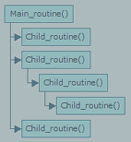
|
|
| |
| # lines: |
976 | | # code: |
976 | | # comment: | 0 | |
# blank: | 0 |
| # Variables: | 121 |
| # Callers: | 1 |
| # Callings: | 9 |
| # Words: | 518 |
| # Keywords: | 322 |
|
|
|
|
|
..
     .. Array Arguments ..
     ..
  Purpose
  =======
  PSSYEVX computes selected eigenvalues and, optionally, eigenvectors
  of a real symmetric matrix A by calling the recommended sequence
  of ScaLAPACK routines.  Eigenvalues/vectors can be selected by
  specifying a range of values or a range of indices for the desired
  eigenvalues.
  Notes
  =====
  Each global data object is described by an associated description
  vector.  This vector stores the information required to establish
  the mapping between an object element and its corresponding process
  and memory location.
  Let A be a generic term for any 2D block cyclicly distributed array.
  Such a global array has an associated description vector DESCA.
  In the following comments, the character _ should be read as
  "of the global array".
  NOTATION        STORED IN      EXPLANATION
  --------------- -------------- --------------------------------------
  DTYPE_A(global) DESCA( DTYPE_ )The descriptor type.  In this case,
                                 DTYPE_A = 1.
  CTXT_A (global) DESCA( CTXT_ ) The BLACS context handle, indicating
                                 the BLACS process grid A is distribu-
                                 ted over. The context itself is glo-
                                 bal, but the handle (the integer
                                 value) may vary.
  M_A    (global) DESCA( M_ )    The number of rows in the global
                                 array A.
  N_A    (global) DESCA( N_ )    The number of columns in the global
                                 array A.
  MB_A   (global) DESCA( MB_ )   The blocking factor used to distribute
                                 the rows of the array.
  NB_A   (global) DESCA( NB_ )   The blocking factor used to distribute
                                 the columns of the array.
  RSRC_A (global) DESCA( RSRC_ ) The process row over which the first
                                 row of the array A is distributed.
  CSRC_A (global) DESCA( CSRC_ ) The process column over which the
                                 first column of the array A is
                                 distributed.
  LLD_A  (local)  DESCA( LLD_ )  The leading dimension of the local
                                 array.  LLD_A >= MAX(1,LOCr(M_A)).
  Let K be the number of rows or columns of a distributed matrix,
  and assume that its process grid has dimension p x q.
  LOCr( K ) denotes the number of elements of K that a process
  would receive if K were distributed over the p processes of its
  process column.
  Similarly, LOCc( K ) denotes the number of elements of K that a
  process would receive if K were distributed over the q processes of
  its process row.
  The values of LOCr() and LOCc() may be determined via a call to the
  ScaLAPACK tool function, NUMROC:
          LOCr( M ) = NUMROC( M, MB_A, MYROW, RSRC_A, NPROW ),
          LOCc( N ) = NUMROC( N, NB_A, MYCOL, CSRC_A, NPCOL ).
  An upper bound for these quantities may be computed by:
          LOCr( M ) <= ceil( ceil(M/MB_A)/NPROW )*MB_A
          LOCc( N ) <= ceil( ceil(N/NB_A)/NPCOL )*NB_A
  PSSYEVX assumes IEEE 754 standard compliant arithmetic.  To port
  to a system which does not have IEEE 754 arithmetic, modify
  the appropriate SLmake.inc file to include the compiler switch
  -DNO_IEEE.  This switch only affects the compilation of pslaiect.c.
  Arguments
  =========
     NP = the number of rows local to a given process.
     NQ = the number of columns local to a given process.
  JOBZ    (global input) CHARACTER*1
          Specifies whether or not to compute the eigenvectors:
          = 'N':  Compute eigenvalues only.
          = 'V':  Compute eigenvalues and eigenvectors.
  RANGE   (global input) CHARACTER*1
          = 'A': all eigenvalues will be found.
          = 'V': all eigenvalues in the interval [VL,VU] will be found.
          = 'I': the IL-th through IU-th eigenvalues will be found.
  UPLO    (global input) CHARACTER*1
          Specifies whether the upper or lower triangular part of the
          symmetric matrix A is stored:
          = 'U':  Upper triangular
          = 'L':  Lower triangular
  N       (global input) INTEGER
          The number of rows and columns of the matrix A.  N >= 0.
  A       (local input/workspace) block cyclic REAL array,
          global dimension (N, N),
          local dimension ( LLD_A, LOCc(JA+N-1) )
          On entry, the symmetric matrix A.  If UPLO = 'U', only the
          upper triangular part of A is used to define the elements of
          the symmetric matrix.  If UPLO = 'L', only the lower
          triangular part of A is used to define the elements of the
          symmetric matrix.
          On exit, the lower triangle (if UPLO='L') or the upper
          triangle (if UPLO='U') of A, including the diagonal, is
          destroyed.
  IA      (global input) INTEGER
          A's global row index, which points to the beginning of the
          submatrix which is to be operated on.
  JA      (global input) INTEGER
          A's global column index, which points to the beginning of
          the submatrix which is to be operated on.
  DESCA   (global and local input) INTEGER array of dimension DLEN_.
          The array descriptor for the distributed matrix A.
          If DESCA( CTXT_ ) is incorrect, PSSYEVX cannot guarantee
          correct error reporting.
  VL      (global input) REAL
          If RANGE='V', the lower bound of the interval to be searched
          for eigenvalues.  Not referenced if RANGE = 'A' or 'I'.
  VU      (global input) REAL
          If RANGE='V', the upper bound of the interval to be searched
          for eigenvalues.  Not referenced if RANGE = 'A' or 'I'.
  IL      (global input) INTEGER
          If RANGE='I', the index (from smallest to largest) of the
          smallest eigenvalue to be returned.  IL >= 1.
          Not referenced if RANGE = 'A' or 'V'.
  IU      (global input) INTEGER
          If RANGE='I', the index (from smallest to largest) of the
          largest eigenvalue to be returned.  min(IL,N) <= IU <= N.
          Not referenced if RANGE = 'A' or 'V'.
  ABSTOL  (global input) REAL
          If JOBZ='V', setting ABSTOL to PSLAMCH( CONTEXT, 'U') yields
          the most orthogonal eigenvectors.
          The absolute error tolerance for the eigenvalues.
          An approximate eigenvalue is accepted as converged
          when it is determined to lie in an interval [a,b]
          of width less than or equal to
                  ABSTOL + EPS *   max( |a|,|b| ) ,
          where EPS is the machine precision.  If ABSTOL is less than
          or equal to zero, then EPS*norm(T) will be used in its place,
          where norm(T) is the 1-norm of the tridiagonal matrix
          obtained by reducing A to tridiagonal form.
          Eigenvalues will be computed most accurately when ABSTOL is
          set to twice the underflow threshold 2*PSLAMCH('S') not zero.
          If this routine returns with ((MOD(INFO,2).NE.0) .OR.
          (MOD(INFO/8,2).NE.0)), indicating that some eigenvalues or
          eigenvectors did not converge, try setting ABSTOL to
          2*PSLAMCH('S').
          See "Computing Small Singular Values of Bidiagonal Matrices
          with Guaranteed High Relative Accuracy," by Demmel and
          Kahan, LAPACK Working Note #3.
          See "On the correctness of Parallel Bisection in Floating
          Point" by Demmel, Dhillon and Ren, LAPACK Working Note #70
  M       (global output) INTEGER
          Total number of eigenvalues found.  0 <= M <= N.
  NZ      (global output) INTEGER
          Total number of eigenvectors computed.  0 <= NZ <= M.
          The number of columns of Z that are filled.
          If JOBZ .NE. 'V', NZ is not referenced.
          If JOBZ .EQ. 'V', NZ = M unless the user supplies
          insufficient space and PSSYEVX is not able to detect this
          before beginning computation.  To get all the eigenvectors
          requested, the user must supply both sufficient
          space to hold the eigenvectors in Z (M .LE. DESCZ(N_))
          and sufficient workspace to compute them.  (See LWORK below.)
          PSSYEVX is always able to detect insufficient space without
          computation unless RANGE .EQ. 'V'.
  W       (global output) REAL array, dimension (N)
          On normal exit, the first M entries contain the selected
          eigenvalues in ascending order.
  ORFAC   (global input) REAL
          Specifies which eigenvectors should be reorthogonalized.
          Eigenvectors that correspond to eigenvalues which are within
          tol=ORFAC*norm(A) of each other are to be reorthogonalized.
          However, if the workspace is insufficient (see LWORK),
          tol may be decreased until all eigenvectors to be
          reorthogonalized can be stored in one process.
          No reorthogonalization will be done if ORFAC equals zero.
          A default value of 10^-3 is used if ORFAC is negative.
          ORFAC should be identical on all processes.
  Z       (local output) REAL array,
          global dimension (N, N),
          local dimension ( LLD_Z, LOCc(JZ+N-1) )
          If JOBZ = 'V', then on normal exit the first M columns of Z
          contain the orthonormal eigenvectors of the matrix
          corresponding to the selected eigenvalues.  If an eigenvector
          fails to converge, then that column of Z contains the latest
          approximation to the eigenvector, and the index of the
          eigenvector is returned in IFAIL.
          If JOBZ = 'N', then Z is not referenced.
  IZ      (global input) INTEGER
          Z's global row index, which points to the beginning of the
          submatrix which is to be operated on.
  JZ      (global input) INTEGER
          Z's global column index, which points to the beginning of
          the submatrix which is to be operated on.
  DESCZ   (global and local input) INTEGER array of dimension DLEN_.
          The array descriptor for the distributed matrix Z.
          DESCZ( CTXT_ ) must equal DESCA( CTXT_ )
  WORK    (local workspace/output) REAL array,
          dimension max(3,LWORK)
          On return, WORK(1) contains the optimal amount of
          workspace required for efficient execution.
          if JOBZ='N' WORK(1) = optimal amount of workspace
             required to compute eigenvalues efficiently
          if JOBZ='V' WORK(1) = optimal amount of workspace
             required to compute eigenvalues and eigenvectors
             efficiently with no guarantee on orthogonality.
             If RANGE='V', it is assumed that all eigenvectors
             may be required.
  LWORK   (local input) INTEGER
          Size of WORK
          See below for definitions of variables used to define LWORK.
          If no eigenvectors are requested (JOBZ = 'N') then
             LWORK >= 5 * N + MAX( 5 * NN, NB * ( NP0 + 1 ) )
          If eigenvectors are requested (JOBZ = 'V' ) then
             the amount of workspace required to guarantee that all
             eigenvectors are computed is:
             LWORK >= 5*N + MAX( 5*NN, NP0 * MQ0 + 2 * NB * NB ) +
               ICEIL( NEIG, NPROW*NPCOL)*NN
             The computed eigenvectors may not be orthogonal if the
             minimal workspace is supplied and ORFAC is too small.
             If you want to guarantee orthogonality (at the cost
             of potentially poor performance) you should add
             the following to LWORK:
                (CLUSTERSIZE-1)*N
             where CLUSTERSIZE is the number of eigenvalues in the
             largest cluster, where a cluster is defined as a set of
             close eigenvalues: { W(K),...,W(K+CLUSTERSIZE-1) |
                                  W(J+1) <= W(J) + ORFAC*2*norm(A) }
          Variable definitions:
             NEIG = number of eigenvectors requested
             NB = DESCA( MB_ ) = DESCA( NB_ ) =
                  DESCZ( MB_ ) = DESCZ( NB_ )
             NN = MAX( N, NB, 2 )
             DESCA( RSRC_ ) = DESCA( NB_ ) = DESCZ( RSRC_ ) =
                              DESCZ( CSRC_ ) = 0
             NP0 = NUMROC( NN, NB, 0, 0, NPROW )
             MQ0 = NUMROC( MAX( NEIG, NB, 2 ), NB, 0, 0, NPCOL )
             ICEIL( X, Y ) is a ScaLAPACK function returning
             ceiling(X/Y)
          When LWORK is too small:
             If LWORK is too small to guarantee orthogonality,
             PSSYEVX attempts to maintain orthogonality in
             the clusters with the smallest
             spacing between the eigenvalues.
             If LWORK is too small to compute all the eigenvectors
             requested, no computation is performed and INFO=-23
             is returned.  Note that when RANGE='V', PSSYEVX does
             not know how many eigenvectors are requested until
             the eigenvalues are computed.  Therefore, when RANGE='V'
             and as long as LWORK is large enough to allow PSSYEVX to
             compute the eigenvalues, PSSYEVX will compute the
             eigenvalues and as many eigenvectors as it can.
          Relationship between workspace, orthogonality & performance:
             Greater performance can be achieved if adequate workspace
             is provided.  On the other hand, in some situations,
             performance can decrease as the workspace provided
             increases above the workspace amount shown below:
             For optimal performance, greater workspace may be
             needed, i.e.
                LWORK >=  MAX( LWORK, 5*N + NSYTRD_LWOPT )
                Where:
                  LWORK, as defined previously, depends upon the number
                     of eigenvectors requested, and
                  NSYTRD_LWOPT = N + 2*( ANB+1 )*( 4*NPS+2 ) +
                    ( NPS + 3 ) *  NPS
                  ANB = PJLAENV( DESCA( CTXT_), 3, 'PSSYTTRD', 'L',
                     0, 0, 0, 0)
                  SQNPC = INT( SQRT( DBLE( NPROW * NPCOL ) ) )
                  NPS = MAX( NUMROC( N, 1, 0, 0, SQNPC ), 2*ANB )
                  NUMROC is a ScaLAPACK tool functions;
                  PJLAENV is a ScaLAPACK envionmental inquiry function
                  MYROW, MYCOL, NPROW and NPCOL can be determined by
                    calling the subroutine BLACS_GRIDINFO.
                For large N, no extra workspace is needed, however the
                biggest boost in performance comes for small N, so it
                is wise to provide the extra workspace (typically less
                than a Megabyte per process).
             If CLUSTERSIZE >= N/SQRT(NPROW*NPCOL), then providing
             enough space to compute all the eigenvectors
             orthogonally will cause serious degradation in
             performance. In the limit (i.e. CLUSTERSIZE = N-1)
             PSSTEIN will perform no better than SSTEIN on 1
             processor.
             For CLUSTERSIZE = N/SQRT(NPROW*NPCOL) reorthogonalizing
             all eigenvectors will increase the total execution time
             by a factor of 2 or more.
             For CLUSTERSIZE > N/SQRT(NPROW*NPCOL) execution time will
             grow as the square of the cluster size, all other factors
             remaining equal and assuming enough workspace.  Less
             workspace means less reorthogonalization but faster
             execution.
          If LWORK = -1, then LWORK is global input and a workspace
          query is assumed; the routine only calculates the size
          required for optimal performance for all work arrays. Each of
          these values is returned in the first entry of the
          corresponding work arrays, and no error message is issued by
          PXERBLA.
  IWORK   (local workspace) INTEGER array
          On return, IWORK(1) contains the amount of integer workspace
          required.
  LIWORK  (local input) INTEGER
          size of IWORK
          LIWORK >= 6 * NNP
          Where:
            NNP = MAX( N, NPROW*NPCOL + 1, 4 )
          If LIWORK = -1, then LIWORK is global input and a workspace
          query is assumed; the routine only calculates the minimum
          and optimal size for all work arrays. Each of these
          values is returned in the first entry of the corresponding
          work array, and no error message is issued by PXERBLA.
  IFAIL   (global output) INTEGER array, dimension (N)
          If JOBZ = 'V', then on normal exit, the first M elements of
          IFAIL are zero.  If (MOD(INFO,2).NE.0) on exit, then
          IFAIL contains the
          indices of the eigenvectors that failed to converge.
          If JOBZ = 'N', then IFAIL is not referenced.
  ICLUSTR (global output) integer array, dimension (2*NPROW*NPCOL)
          This array contains indices of eigenvectors corresponding to
          a cluster of eigenvalues that could not be reorthogonalized
          due to insufficient workspace (see LWORK, ORFAC and INFO).
          Eigenvectors corresponding to clusters of eigenvalues indexed
          ICLUSTR(2*I-1) to ICLUSTR(2*I), could not be
          reorthogonalized due to lack of workspace. Hence the
          eigenvectors corresponding to these clusters may not be
          orthogonal.  ICLUSTR() is a zero terminated array.
          (ICLUSTR(2*K).NE.0 .AND. ICLUSTR(2*K+1).EQ.0) if and only if
          K is the number of clusters
          ICLUSTR is not referenced if JOBZ = 'N'
  GAP     (global output) REAL array,
             dimension (NPROW*NPCOL)
          This array contains the gap between eigenvalues whose
          eigenvectors could not be reorthogonalized. The output
          values in this array correspond to the clusters indicated
          by the array ICLUSTR. As a result, the dot product between
          eigenvectors correspoding to the I^th cluster may be as high
          as ( C * n ) / GAP(I) where C is a small constant.
  INFO    (global output) INTEGER
          = 0:  successful exit
          < 0:  If the i-th argument is an array and the j-entry had
                an illegal value, then INFO = -(i*100+j), if the i-th
                argument is a scalar and had an illegal value, then
                INFO = -i.
          > 0:  if (MOD(INFO,2).NE.0), then one or more eigenvectors
                  failed to converge.  Their indices are stored
                  in IFAIL.  Ensure ABSTOL=2.0*PSLAMCH( 'U' )
                  Send e-mail to scalapack@cs.utk.edu
                if (MOD(INFO/2,2).NE.0),then eigenvectors corresponding
                  to one or more clusters of eigenvalues could not be
                  reorthogonalized because of insufficient workspace.
                  The indices of the clusters are stored in the array
                  ICLUSTR.
                if (MOD(INFO/4,2).NE.0), then space limit prevented
                  PSSYEVX from computing all of the eigenvectors
                  between VL and VU.  The number of eigenvectors
                  computed is returned in NZ.
                if (MOD(INFO/8,2).NE.0), then PSSTEBZ failed to compute
                  eigenvalues.  Ensure ABSTOL=2.0*PSLAMCH( 'U' )
                  Send e-mail to scalapack@cs.utk.edu
  Alignment requirements
  ======================
  The distributed submatrices A(IA:*, JA:*) and C(IC:IC+M-1,JC:JC+N-1)
  must verify some alignment properties, namely the following
  expressions should be true:
  ( MB_A.EQ.NB_A.EQ.MB_Z .AND. IROFFA.EQ.IROFFZ .AND. IROFFA.EQ.0 .AND.
    IAROW.EQ.IZROW )
  where
  IROFFA = MOD( IA-1, MB_A ) and ICOFFA = MOD( JA-1, NB_A ).
  =====================================================================
  Differences between PSSYEVX and SSYEVX
  ======================================
  A, LDA -> A, IA, JA, DESCA
  Z, LDZ -> Z, IZ, JZ, DESCZ
  WORKSPACE needs are larger for PSSYEVX.
  LIWORK parameter added
  ORFAC, ICLUSTER() and GAP() parameters added
  meaning of INFO is changed
  Functional differences:
  PSSYEVX does not promise orthogonality for eigenvectors associated
  with tighly clustered eigenvalues.
  PSSYEVX does not reorthogonalize eigenvectors
  that are on different processes. The extent of reorthogonalization
  is controlled by the input parameter LWORK.
  Version 1.4 limitations:
     DESCA(MB_) = DESCA(NB_)
     DESCA(M_) = DESCZ(M_)
     DESCA(N_) = DESCZ(N_)
     DESCA(MB_) = DESCZ(MB_)
     DESCA(NB_) = DESCZ(NB_)
     DESCA(RSRC_) = DESCZ(RSRC_)
     .. Parameters ..
|
|
|
|
001 SUBROUTINE PSSYEVX( JOBZ , RANGE , UPLO , N , A , IA , JA , DESCA , VL ,
002 $VU , IL , IU , ABSTOL , M , NZ , W , ORFAC , Z , IZ ,
003 $JZ , DESCZ , WORK , LWORK , IWORK , LIWORK , IFAIL ,
004 $ICLUSTR , GAP , INFO )
005
006 * -- ScaLAPACK routine(version 1.7) --
007 * University of Tennessee , Knoxville , Oak Ridge National Laboratory ,
008 * and University of California , Berkeley.
009 * May 25 , 2001
010
011 * .. Scalar Arguments ..
012 CHARACTER JOBZ , RANGE , UPLO
013 INTEGER IA , IL , INFO , IU , IZ , JA , JZ , LIWORK , LWORK , M ,
014 $N , NZ
015 REAL ABSTOL , ORFAC , VL , VU
016 INTEGER BLOCK_CYCLIC_2D , DLEN_ , DTYPE_ , CTXT_ , M_ , N_ ,
017 $MB_ , NB_ , RSRC_ , CSRC_ , LLD_
018 PARAMETER( BLOCK_CYCLIC_2D = 1 , DLEN_ = 9 , DTYPE_ = 1 ,
019 $CTXT_ = 2 , M_ = 3 , N_ = 4 , MB_ = 5 , NB_ = 6 ,
020 $RSRC_ = 7 , CSRC_ = 8 , LLD_ = 9 )
021 REAL ZERO , ONE , TEN , FIVE
022 PARAMETER( ZERO = 0.0E + 0 , ONE = 1.0E + 0 , TEN = 10.0E + 0 ,
023 $FIVE = 5.0E + 0 )
024 INTEGER IERREIN , IERRCLS , IERRSPC , IERREBZ
025 PARAMETER( IERREIN = 1 , IERRCLS = 2 , IERRSPC = 4 ,
026 $IERREBZ = 8 )
027 * ..
028 * .. Local Scalars ..
029 LOGICAL ALLEIG , INDEIG , LOWER , LQUERY , QUICKRETURN ,
030 $VALEIG , WANTZ
031 CHARACTER ORDER
032 INTEGER ANB , CSRC_A , I , IAROW , ICOFFA , ICTXT , IINFO ,
033 $INDD , INDD2 , INDE , INDE2 , INDIBL , INDISP ,
034 $INDTAU , INDWORK , IROFFA , IROFFZ , ISCALE ,
035 $ISIZESTEBZ , ISIZESTEIN , IZROW , LALLWORK ,
036 $LIWMIN , LLWORK , LWMIN , LWOPT , MAXEIGS , MB_A ,
037 $MQ0 , MYCOL , MYROW , NB , NB_A , NEIG , NN , NNP ,
038 $NP0 , NPCOL , NPROCS , NPROW , NPS , NSPLIT ,
039 $NSYTRD_LWOPT , NZZ , OFFSET , RSRC_A , RSRC_Z ,
040 $SIZEORMTR , SIZESTEIN , SIZESYEVX , SQNPC
041 REAL ABSTLL , ANRM , BIGNUM , EPS , RMAX , RMIN , SAFMIN ,
042 $SIGMA , SMLNUM , VLL , VUU
043 * ..
044 * .. Local Arrays ..
045 INTEGER IDUM1( 4 ) , IDUM2( 4 )
046 * ..
047 * .. External Functions ..
048 LOGICAL LSAME
049 INTEGER ICEIL , INDXG2P , NUMROC , PJLAENV
050 REAL PSLAMCH , PSLANSY
051 EXTERNAL LSAME , ICEIL , INDXG2P , NUMROC , PJLAENV ,
052 $PSLAMCH , PSLANSY
053 * ..
054 * .. External Subroutines ..
055 EXTERNAL BLACS_GRIDINFO , CHK1MAT , IGAMN2D , PCHK1MAT ,
056 $PCHK2MAT , PSELGET , PSLARED1D , PSLASCL , PSORMTR ,
057 $PSSTEBZ , PSSTEIN , PSSYNTRD , PXERBLA , SGEBR2D ,
058 $SGEBS2D , SLASRT , SSCAL
059 * ..
060 * .. Intrinsic Functions ..
061 INTRINSIC ABS , DBLE , ICHAR , INT , MAX , MIN , MOD , REAL ,
062 $SQRT
063 * ..
064 * .. Executable Statements ..
065 * This is just to keep ftnchek and toolpack / 1 happy
066 IF( BLOCK_CYCLIC_2D*CSRC_*CTXT_*DLEN_*DTYPE_*LLD_*MB_*M_*NB_*N_*
066   067 $ RSRC_.LT.0 )RETURN
068
069 QUICKRETURN =( N.EQ.0 )
070
071 * Test the input arguments.
072
073 ICTXT = DESCA( CTXT_ )
074 CALL
067 $ RSRC_.LT.0 )RETURN
068
069 QUICKRETURN =( N.EQ.0 )
070
071 * Test the input arguments.
072
073 ICTXT = DESCA( CTXT_ )
074 CALL BLACS_GRIDINFO( ICTXT , NPROW , NPCOL , MYROW , MYCOL )
075 INFO = 0
076
077 WANTZ = LSAME( JOBZ , 'V' )
078 IF( NPROW.EQ. - 1 ) THEN
078
079 INFO = - ( 800 + CTXT_ )
080 ELSE IF( WANTZ ) THEN
080
081 IF( ICTXT.NE.DESCZ( CTXT_ ) ) THEN
081
082 INFO = - ( 2100 + CTXT_ )
083 END IF
084 END IF
085 IF( INFO.EQ.0 ) THEN
085
086 CALL CHK1MAT( N , 4 , N , 4 , IA , JA , DESCA , 8 , INFO )
087 IF( WANTZ )
087
088 $ CALL CHK1MAT( N , 4 , N , 4 , IZ , JZ , DESCZ , 21 , INFO )
089
090 IF( INFO.EQ.0 ) THEN
091
092 * Get machine constants.
093
093
094 SAFMIN = PSLAMCH( ICTXT , 'Safe minimum' )
095 EPS = PSLAMCH( ICTXT , 'Precision' )
096 SMLNUM = SAFMIN / EPS
097 BIGNUM = ONE / SMLNUM
098 RMIN = SQRT( SMLNUM )
099 RMAX = MIN( SQRT( BIGNUM ) , ONE / SQRT( SQRT( SAFMIN ) ) )
100
101 NPROCS = NPROW*NPCOL
102 LOWER = LSAME( UPLO , 'L' )
103 ALLEIG = LSAME( RANGE , 'A' )
104 VALEIG = LSAME( RANGE , 'V' )
105 INDEIG = LSAME( RANGE , 'I' )
106
107 * Set up pointers into the WORK array
108
109 INDTAU = 1
110 INDE = INDTAU + N
111 INDD = INDE + N
112 INDD2 = INDD + N
113 INDE2 = INDD2 + N
114 INDWORK = INDE2 + N
115 LLWORK = LWORK - INDWORK + 1
116
117 * Set up pointers into the IWORK array
118
119 ISIZESTEIN = 3*N + NPROCS + 1
120 ISIZESTEBZ = MAX( 4*N , 14 , NPROCS )
121 INDIBL =( MAX( ISIZESTEIN , ISIZESTEBZ ) ) + 1
122 INDISP = INDIBL + N
123
124 * Compute the total amount of space needed
125
126 LQUERY = .FALSE.
127 IF( LWORK.EQ. - 1 .OR. LIWORK.EQ. - 1 )
127
128 $ LQUERY = .TRUE.
129
130 NNP = MAX( N , NPROCS + 1 , 4 )
131 LIWMIN = 6*NNP
132
133 NPROCS = NPROW*NPCOL
134 NB_A = DESCA( NB_ )
135 MB_A = DESCA( MB_ )
136 NB = NB_A
137 NN = MAX( N , NB , 2 )
138
139 RSRC_A = DESCA( RSRC_ )
140 CSRC_A = DESCA( CSRC_ )
141 IROFFA = MOD( IA - 1 , MB_A )
142 ICOFFA = MOD( JA - 1 , NB_A )
143 IAROW = INDXG2P( 1 , NB_A , MYROW , RSRC_A , NPROW )
144 NP0 = NUMROC( N + IROFFA , NB , 0 , 0 , NPROW )
145 MQ0 = NUMROC( N + ICOFFA , NB , 0 , 0 , NPCOL )
146 IF( WANTZ ) THEN
146
147 RSRC_Z = DESCZ( RSRC_ )
148 IROFFZ = MOD( IZ - 1 , MB_A )
149 IZROW = INDXG2P( 1 , NB_A , MYROW , RSRC_Z , NPROW )
150 END IF
151
152 IF(( .NOT.WANTZ ) .OR.( VALEIG .AND.( .NOT.LQUERY ) ) )
152
153 $ THEN
154 LWMIN = 5*N + MAX( 5*NN , NB*( NP0 + 1 ) )
155 IF( WANTZ ) THEN
155
156 MQ0 = NUMROC( MAX( N , NB , 2 ) , NB , 0 , 0 , NPCOL )
157 LWOPT = 5*N + MAX( 5*NN , NP0*MQ0 + 2*NB*NB )
158 ELSE
158
159 LWOPT = LWMIN
160 END IF
161 NEIG = 0
162 ELSE
162
163 IF( ALLEIG .OR. VALEIG ) THEN
163
164 NEIG = N
165 ELSE IF( INDEIG ) THEN
165
166 NEIG = IU - IL + 1
167 END IF
168 MQ0 = NUMROC( MAX( NEIG , NB , 2 ) , NB , 0 , 0 , NPCOL )
169 LWMIN = 5*N + MAX( 5*NN , NP0*MQ0 + 2*NB*NB ) +
170 $ ICEIL( NEIG , NPROW*NPCOL )*NN
171 LWOPT = LWMIN
172
173 END IF
174
175 * Compute how much workspace is needed to use the
176 * new TRD code
177
178 ANB = PJLAENV( ICTXT , 3 , 'PSSYTTRD' , 'L' , 0 , 0 , 0 , 0 )
179 SQNPC = INT( SQRT( DBLE( NPROW*NPCOL ) ) )
180 NPS = MAX( NUMROC( N , 1 , 0 , 0 , SQNPC ) , 2*ANB )
181 NSYTRD_LWOPT = 2*( ANB + 1 )*( 4*NPS + 2 ) + ( NPS + 4 )*NPS
182 LWOPT = MAX( LWOPT , 5*N + NSYTRD_LWOPT )
183
184 END IF
185 IF( INFO.EQ.0 ) THEN
185
186 IF( MYROW.EQ.0 .AND. MYCOL.EQ.0 ) THEN
186
187 WORK( 1 ) = ABSTOL
188 IF( VALEIG ) THEN
188
189 WORK( 2 ) = VL
190 WORK( 3 ) = VU
191 ELSE
191
192 WORK( 2 ) = ZERO
193 WORK( 3 ) = ZERO
194 END IF
195 CALL SGEBS2D( ICTXT , 'ALL' , ' ' , 3 , 1 , WORK , 3 )
196 ELSE
196
197 CALL SGEBR2D( ICTXT , 'ALL' , ' ' , 3 , 1 , WORK , 3 , 0 , 0 )
198 END IF
199 IF( .NOT.( WANTZ .OR. LSAME( JOBZ , 'N' ) ) ) THEN
199
200 INFO = - 1
201 ELSE IF( .NOT.( ALLEIG .OR. VALEIG .OR. INDEIG ) ) THEN
201
202 INFO = - 2
203 ELSE IF( .NOT.( LOWER .OR. LSAME( UPLO , 'U' ) ) ) THEN
203
204 INFO = - 3
205 ELSE IF( VALEIG .AND. N.GT.0 .AND. VU.LE.VL ) THEN
205
206 INFO = - 10
207 ELSE IF( INDEIG .AND.( IL.LT.1 .OR. IL.GT.MAX( 1 , N ) ) )
207
208 $ THEN
209 INFO = - 11
210 ELSE IF( INDEIG .AND.( IU.LT.MIN( N , IL ) .OR. IU.GT.N ) )
210
211 $ THEN
212 INFO = - 12
213 ELSE IF( LWORK.LT.LWMIN .AND. LWORK.NE. - 1 ) THEN
213
214 INFO = - 23
215 ELSE IF( LIWORK.LT.LIWMIN .AND. LIWORK.NE. - 1 ) THEN
215
216 INFO = - 25
217 ELSE IF( VALEIG .AND.( ABS( WORK( 2 ) - VL ).GT.FIVE*EPS*
217
218 $ ABS( VL ) ) ) THEN
219 INFO = - 9
220 ELSE IF( VALEIG .AND.( ABS( WORK( 3 ) - VU ).GT.FIVE*EPS*
220
221 $ ABS( VU ) ) ) THEN
222 INFO = - 10
223 ELSE IF( ABS( WORK( 1 ) - ABSTOL ).GT.FIVE*EPS*ABS( ABSTOL ) )
223
224 $ THEN
225 INFO = - 13
226 ELSE IF( IROFFA.NE.0 ) THEN
226
227 INFO = - 6
228 ELSE IF( DESCA( MB_ ).NE.DESCA( NB_ ) ) THEN
228
229 INFO = - ( 800 + NB_ )
230 END IF
231 IF( WANTZ ) THEN
231
232 IF( IROFFA.NE.IROFFZ ) THEN
232
233 INFO = - 19
234 ELSE IF( IAROW.NE.IZROW ) THEN
234
235 INFO = - 19
236 ELSE IF( DESCA( M_ ).NE.DESCZ( M_ ) ) THEN
236
237 INFO = - ( 2100 + M_ )
238 ELSE IF( DESCA( N_ ).NE.DESCZ( N_ ) ) THEN
238
239 INFO = - ( 2100 + N_ )
240 ELSE IF( DESCA( MB_ ).NE.DESCZ( MB_ ) ) THEN
240
241 INFO = - ( 2100 + MB_ )
242 ELSE IF( DESCA( NB_ ).NE.DESCZ( NB_ ) ) THEN
242
243 INFO = - ( 2100 + NB_ )
244 ELSE IF( DESCA( RSRC_ ).NE.DESCZ( RSRC_ ) ) THEN
244
245 INFO = - ( 2100 + RSRC_ )
246 ELSE IF( DESCA( CSRC_ ).NE.DESCZ( CSRC_ ) ) THEN
246
247 INFO = - ( 2100 + CSRC_ )
248 ELSE IF( ICTXT.NE.DESCZ( CTXT_ ) ) THEN
248
249 INFO = - ( 2100 + CTXT_ )
250 END IF
251 END IF
252 END IF
253 IF( WANTZ ) THEN
253
254 IDUM1( 1 ) = ICHAR( 'V' )
255 ELSE
255
256 IDUM1( 1 ) = ICHAR( 'N' )
257 END IF
258 IDUM2( 1 ) = 1
259 IF( LOWER ) THEN
259
260 IDUM1( 2 ) = ICHAR( 'L' )
261 ELSE
261
262 IDUM1( 2 ) = ICHAR( 'U' )
263 END IF
264 IDUM2( 2 ) = 2
265 IF( ALLEIG ) THEN
265
266 IDUM1( 3 ) = ICHAR( 'A' )
267 ELSE IF( INDEIG ) THEN
267
268 IDUM1( 3 ) = ICHAR( 'I' )
269 ELSE
269
270 IDUM1( 3 ) = ICHAR( 'V' )
271 END IF
272 IDUM2( 3 ) = 3
273 IF( LQUERY ) THEN
273
274 IDUM1( 4 ) = - 1
275 ELSE
275
276 IDUM1( 4 ) = 1
277 END IF
278 IDUM2( 4 ) = 4
279 IF( WANTZ ) THEN
279
280 CALL PCHK2MAT( N , 4 , N , 4 , IA , JA , DESCA , 8 , N , 4 , N , 4 , IZ ,
281 $ JZ , DESCZ , 21 , 4 , IDUM1 , IDUM2 , INFO )
282 ELSE
282
283 CALL PCHK1MAT( N , 4 , N , 4 , IA , JA , DESCA , 8 , 4 , IDUM1 ,
284 $ IDUM2 , INFO )
285 END IF
286 WORK( 1 ) = REAL( LWOPT )
287 IWORK( 1 ) = LIWMIN
288 END IF
289
290 IF( INFO.NE.0 ) THEN
290
291 CALL PXERBLA( ICTXT , 'PSSYEVX' , - INFO )
292 RETURN
293 ELSE IF( LQUERY ) THEN
293
294 RETURN
295 END IF
296
297 * Quick return if possible
298
299 IF( QUICKRETURN ) THEN
299
300 IF( WANTZ ) THEN
300
301 NZ = 0
302 ICLUSTR( 1 ) = 0
303 END IF
304 M = 0
305 WORK( 1 ) = REAL( LWOPT )
306 IWORK( 1 ) = LIWMIN
307 RETURN
308 END IF
309
310 * Scale matrix to allowable range , if necessary.
311
312 ABSTLL = ABSTOL
313 ISCALE = 0
314 IF( VALEIG ) THEN
314
315 VLL = VL
316 VUU = VU
317 ELSE
317
318 VLL = ZERO
319 VUU = ZERO
320 END IF
321
322 ANRM = PSLANSY( 'M' , UPLO , N , A , IA , JA , DESCA , WORK( INDWORK ) )
323
324 IF( ANRM.GT.ZERO .AND. ANRM.LT.RMIN ) THEN
324
325 ISCALE = 1
326 SIGMA = RMIN / ANRM
327 ANRM = ANRM*SIGMA
328 ELSE IF( ANRM.GT.RMAX ) THEN
328
329 ISCALE = 1
330 SIGMA = RMAX / ANRM
331 ANRM = ANRM*SIGMA
332 END IF
333
334 IF( ISCALE.EQ.1 ) THEN
334
335 CALL PSLASCL ( UPLO , ONE , SIGMA , N , N , A , IA , JA , DESCA , IINFO )
336 IF( ABSTOL.GT.0 )
336
337 $ ABSTLL = ABSTOL*SIGMA
338 IF( VALEIG ) THEN
338
339 VLL = VL*SIGMA
340 VUU = VU*SIGMA
341 IF( VUU.EQ.VLL ) THEN
341
342 VUU = VUU + 2*MAX( ABS( VUU )*EPS , SAFMIN )
343 END IF
344 END IF
345 END IF
346
347 * Call PSSYNTRD to reduce symmetric matrix to tridiagonal form.
348
349 LALLWORK = LLWORK
350
351 CALL PSSYNTRD ( UPLO , N , A , IA , JA , DESCA , WORK( INDD ) ,
352 $ WORK( INDE ) , WORK( INDTAU ) , WORK( INDWORK ) ,
353 $ LLWORK , IINFO )
354
355 * Copy the values of D , E to all processes
356
357 * Here PxLARED1D is used to redistribute the tridiagonal matrix.
358 * PxLARED1D , however , doesn't yet work with arbritary matrix
359 * distributions so we have PxELGET as a backup.
360
361 OFFSET = 0
362 IF( IA.EQ.1 .AND. JA.EQ.1 .AND. RSRC_A.EQ.0 .AND. CSRC_A.EQ.0 )
362
363 $ THEN
364 CALL PSLARED1D ( N , IA , JA , DESCA , WORK( INDD ) , WORK( INDD2 ) ,
365 $ WORK( INDWORK ) , LLWORK )
366
367 CALL PSLARED1D ( N , IA , JA , DESCA , WORK( INDE ) , WORK( INDE2 ) ,
368 $ WORK( INDWORK ) , LLWORK )
369 IF( .NOT.LOWER )
369
370 $ OFFSET = 1
371 ELSE
371
372 DO 10 I = 1 , N
372
373 CALL PSELGET( 'A' , ' ' , WORK( INDD2 + I - 1 ) , A , I + IA - 1 ,
374 $ I + JA - 1 , DESCA )
375 10 CONTINUE
375
376 IF( LSAME( UPLO , 'U' ) ) THEN
376
377 DO 20 I = 1 , N - 1
377
378 CALL PSELGET( 'A' , ' ' , WORK( INDE2 + I - 1 ) , A , I + IA - 1 ,
379 $ I + JA , DESCA )
380 20 CONTINUE
380
381 ELSE
381
382 DO 30 I = 1 , N - 1
382
383 CALL PSELGET( 'A' , ' ' , WORK( INDE2 + I - 1 ) , A , I + IA ,
384 $ I + JA - 1 , DESCA )
385 30 CONTINUE
385
386 END IF
387 END IF
388
389 * Call PSSTEBZ and , if eigenvectors are desired , PSSTEIN.
390
391 IF( WANTZ ) THEN
391
392 ORDER = 'B'
393 ELSE
393
394 ORDER = 'E'
395 END IF
396
397 CALL PSSTEBZ ( ICTXT , RANGE , ORDER , N , VLL , VUU , IL , IU , ABSTLL ,
398 $ WORK( INDD2 ) , WORK( INDE2 + OFFSET ) , M , NSPLIT , W ,
399 $ IWORK( INDIBL ) , IWORK( INDISP ) , WORK( INDWORK ) ,
400 $ LLWORK , IWORK( 1 ) , ISIZESTEBZ , IINFO )
401
402 * IF PSSTEBZ fails , the error propogates to INFO , but
403 * we do not propogate the eigenvalue(s) which failed because :
404 * 1) This should never happen if the user specifies
405 * ABSTOL = 2 * PSLAMCH( 'U' )
406 * 2) PSSTEIN will confirm / deny whether the eigenvalues are
407 * close enough.
408
409 IF( IINFO.NE.0 ) THEN
409
410 INFO = INFO + IERREBZ
411 DO 40 I = 1 , M
411
412 IWORK( INDIBL + I - 1 ) = ABS( IWORK( INDIBL + I - 1 ) )
413 40 CONTINUE
413
414 END IF
415 IF( WANTZ ) THEN
416
416
417 IF( VALEIG ) THEN
418
419 * Compute the maximum number of eigenvalues that we can
420 * compute in the
421 * workspace that we have , and that we can store in Z.
422
423 * Loop through the possibilities looking for the largest
424 * NZ that we can feed to PSSTEIN and PSORMTR
425
426 * Since all processes must end up with the same value
427 * of NZ , we first compute the minimum of LALLWORK
428
428
429 CALL IGAMN2D( ICTXT , 'A' , ' ' , 1 , 1 , LALLWORK , 1 , 1 , 1 , - 1 ,
430 $ - 1 , - 1 )
431
432 MAXEIGS = DESCZ( N_ )
433
434 DO 50 NZ = MIN( MAXEIGS , M ) , 0 , - 1
434
435 MQ0 = NUMROC( NZ , NB , 0 , 0 , NPCOL )
436 SIZESTEIN = ICEIL( NZ , NPROCS )*N + MAX( 5*N , NP0*MQ0 )
437 SIZEORMTR = MAX(( NB*( NB - 1 ) ) / 2 ,( MQ0 + NP0 )*NB ) +
438 $ NB*NB
439
440 SIZESYEVX = MAX( SIZESTEIN , SIZEORMTR )
441 IF( SIZESYEVX.LE.LALLWORK )
441
442 $ GO TO 60
443 50 CONTINUE
444 60 CONTINUE
445 ELSE
445
446 NZ = M
447 END IF
448 NZ = MAX( NZ , 0 )
449 IF( NZ.NE.M ) THEN
449
450 INFO = INFO + IERRSPC
451
452 DO 70 I = 1 , M
452
453 IFAIL( I ) = 0
454 70 CONTINUE
455
456 * The following code handles a rare special case
457 * - NZ .NE. M means that we don't have enough room to store
458 * all the vectors.
459 * - NSPLIT .GT. 1 means that the matrix split
460 * In this case , we cannot simply take the first NZ eigenvalues
461 * because PSSTEBZ sorts the eigenvalues by block when
462 * a split occurs. So , we have to make another call to
463 * PSSTEBZ with a new upper limit - VUU.
464
464
465 IF( NSPLIT.GT.1 ) THEN
465
466 CALL SLASRT( 'I' , M , W , IINFO )
467 NZZ = 0
468 IF( NZ.GT.0 ) THEN
469
469
470 VUU = W( NZ ) - TEN*( EPS*ANRM + SAFMIN )
471 IF( VLL.GE.VUU ) THEN
471
472 NZZ = 0
473 ELSE
473
474 CALL PSSTEBZ ( ICTXT , RANGE , ORDER , N , VLL , VUU , IL ,
475 $ IU , ABSTLL , WORK( INDD2 ) ,
476 $ WORK( INDE2 + OFFSET ) , NZZ , NSPLIT , W ,
477 $ IWORK( INDIBL ) , IWORK( INDISP ) ,
478 $ WORK( INDWORK ) , LLWORK , IWORK( 1 ) ,
479 $ ISIZESTEBZ , IINFO )
480 END IF
481
482 IF( MOD( INFO / IERREBZ , 1 ).EQ.0 ) THEN
482
483 IF( NZZ.GT.NZ .OR. IINFO.NE.0 ) THEN
483
484 INFO = INFO + IERREBZ
485 END IF
486 END IF
487 END IF
488 NZ = MIN( NZ , NZZ )
489
490 END IF
491 END IF
492 CALL PSSTEIN ( N , WORK( INDD2 ) , WORK( INDE2 + OFFSET ) , NZ , W ,
493 $IWORK( INDIBL ) , IWORK( INDISP ) , ORFAC , Z , IZ ,
494 $JZ , DESCZ , WORK( INDWORK ) , LALLWORK , IWORK( 1 ) ,
495 $ISIZESTEIN , IFAIL , ICLUSTR , GAP , IINFO )
496
497 IF( IINFO.GE.NZ + 1 )
497
498 $ INFO = INFO + IERRCLS
499 IF( MOD( IINFO , NZ + 1 ).NE.0 )
499
500 $ INFO = INFO + IERREIN
501
502 * Z = Q * Z
503
504 IF( NZ.GT.0 ) THEN
504
505 CALL PSORMTR ( 'L' , UPLO , 'N' , N , NZ , A , IA , JA , DESCA ,
506 $ WORK( INDTAU ) , Z , IZ , JZ , DESCZ ,
507 $ WORK( INDWORK ) , LLWORK , IINFO )
508 END IF
509
510 END IF
511
512 * If matrix was scaled , then rescale eigenvalues appropriately.
513
514 IF( ISCALE.EQ.1 ) THEN
514
515 CALL SSCAL( M , ONE / SIGMA , W , 1 )
516 END IF
517
518 WORK( 1 ) = REAL( LWOPT )
519 IWORK( 1 ) = LIWMIN
520
521 RETURN
522
523 * End of PSSYEVX
524
525 END68
100
|
|
Variables in Routine PSSYEVX()
| Summary Report |
| Data Type | Quantity | Size(byte) |
| CHARACTER | 4 | 4 |
| INTEGER | 87 | 376 |
| LOGICAL | 8 | 8 |
| REAL | 22 | 88 |
| TOTAL | 121 | 476 |
List of Variables
CHARACTER
INTEGER
| ANB | BLOCK_CYCLIC_2D | CSRC_ | CSRC_A | CTXT_ |
| DLEN_ | DTYPE_ | I | IA | IAROW |
| ICEIL | ICLUSTR | ICOFFA | ICTXT | IDUM1( 4 ) |
| IDUM2( 4 ) | IERRCLS | IERREBZ | IERREIN | IERRSPC |
| IFAIL | IINFO | IL | INDD | INDD2 |
| INDE | INDE2 | INDIBL | INDISP | INDTAU |
| INDWORK | INDXG2P | INFO | IROFFA | IROFFZ |
| ISCALE | ISIZESTEBZ | ISIZESTEIN | IU | IWORK |
| IZ | IZROW | JA | JZ | LALLWORK |
| LIWMIN | LIWORK | LLD_ | LLWORK | LWMIN |
| LWOPT | LWORK | M | M_ | MAXEIGS |
| MB_ | MB_A | MQ0 | MYCOL | MYROW |
| N | N_ | NB | NB_ | NB_A |
| NEIG | NN | NNP | NP0 | NPCOL |
| NPROCS | NPROW | NPS | NSPLIT | NSYTRD_LWOPT |
| NUMROC | NZ | NZZ | OFFSET | PJLAENV |
| RSRC_ | RSRC_A | RSRC_Z | SIZEORMTR | SIZESTEIN |
| SIZESYEVX | SQNPC | | | |
LOGICAL
| ALLEIG | INDEIG | LOWER | LQUERY | LSAME |
| QUICKRETURN | VALEIG | WANTZ | | |
REAL
| ABSTLL | ABSTOL | ANRM | BIGNUM | EPS |
| FIVE | ONE | ORFAC | PSLAMCH | PSLANSY |
| RMAX | RMIN | SAFMIN | SIGMA | SMLNUM |
| TEN | VL | VLL | VU | VUU |
| WORK | ZERO | | | |
Variables Dependence Graph
Put the mouse over a right hand side variable to display the corresponding line of the dependence | | - | | - | - | | ABSTLL | <--- | ABSTOLABSTLL = ABSTOL |
| ALLEIG | <--- | LSAMEALLEIG = LSAME( RANGE, 'A' ), RANGEALLEIG = LSAME( RANGE, 'A' ) |
| ANB | <--- | ICTXTANB = PJLAENV( ICTXT, 3, 'PSSYTTRD', 'L', 0, 0, 0, 0 ), PJLAENVANB = PJLAENV( ICTXT, 3, 'PSSYTTRD', 'L', 0, 0, 0, 0 ) |
| ANRM | <--- | SIGMAANRM = ANRM*SIGMA{2ANRM = ANRM*SIGMA}, UPLOANRM = PSLANSY( 'M', UPLO, N, A, IA, JA, DESCA, WORK( INDWORK ) ), WORKANRM = PSLANSY( 'M', UPLO, N, A, IA, JA, DESCA, WORK( INDWORK ) ), IAANRM = PSLANSY( 'M', UPLO, N, A, IA, JA, DESCA, WORK( INDWORK ) ), INDWORKANRM = PSLANSY( 'M', UPLO, N, A, IA, JA, DESCA, WORK( INDWORK ) ), ANRMANRM = ANRM*SIGMA{2ANRM = ANRM*SIGMA}, JAANRM = PSLANSY( 'M', UPLO, N, A, IA, JA, DESCA, WORK( INDWORK ) ), MANRM = PSLANSY( 'M', UPLO, N, A, IA, JA, DESCA, WORK( INDWORK ) ), NANRM = PSLANSY( 'M', UPLO, N, A, IA, JA, DESCA, WORK( INDWORK ) ), PSLANSYANRM = PSLANSY( 'M', UPLO, N, A, IA, JA, DESCA, WORK( INDWORK ) ) |
| BIGNUM | <--- | SMLNUMBIGNUM = ONE / SMLNUM, ONEBIGNUM = ONE / SMLNUM |
| CSRC_A | <--- | CSRC_CSRC_A = DESCA( CSRC_ ) |
| EPS | <--- | ICTXTEPS = PSLAMCH( ICTXT, 'Precision' ), PSLAMCHEPS = PSLAMCH( ICTXT, 'Precision' ) |
| I | <--- | MDO 40 I = 1, M{2DO 70 I = 1, M}, NDO 10 I = 1, N{2DO 20 I = 1, N - 1, 3DO 30 I = 1, N - 1} |
| IAROW | <--- | RSRC_AIAROW = INDXG2P( 1, NB_A, MYROW, RSRC_A, NPROW ), INDXG2PIAROW = INDXG2P( 1, NB_A, MYROW, RSRC_A, NPROW ), MYROWIAROW = INDXG2P( 1, NB_A, MYROW, RSRC_A, NPROW ), NB_AIAROW = INDXG2P( 1, NB_A, MYROW, RSRC_A, NPROW ), NPROWIAROW = INDXG2P( 1, NB_A, MYROW, RSRC_A, NPROW ) |
| ICOFFA | <--- | JAICOFFA = MOD( JA-1, NB_A ), NB_AICOFFA = MOD( JA-1, NB_A ) |
| ICTXT | <--- | CTXT_ICTXT = DESCA( CTXT_ ) |
| IDUM1 | <--- | IIDUM1( 3 ) = ICHAR( 'I' ), NIDUM1( 1 ) = ICHAR( 'N' ) |
| INDD | <--- | INDEINDD = INDE + N, NINDD = INDE + N |
| INDD2 | <--- | INDDINDD2 = INDD + N, NINDD2 = INDD + N |
| INDE | <--- | INDTAUINDE = INDTAU + N, NINDE = INDTAU + N |
| INDE2 | <--- | INDD2INDE2 = INDD2 + N, NINDE2 = INDD2 + N |
| INDEIG | <--- | IINDEIG = LSAME( RANGE, 'I' ), LSAMEINDEIG = LSAME( RANGE, 'I' ), RANGEINDEIG = LSAME( RANGE, 'I' ) |
| INDIBL | <--- | ISIZESTEBZINDIBL = ( MAX( ISIZESTEIN, ISIZESTEBZ ) ) + 1, ISIZESTEININDIBL = ( MAX( ISIZESTEIN, ISIZESTEBZ ) ) + 1 |
| INDISP | <--- | INDIBLINDISP = INDIBL + N, NINDISP = INDIBL + N |
| INDWORK | <--- | INDE2INDWORK = INDE2 + N, NINDWORK = INDE2 + N |
| INFO | <--- | CTXT_INFO = -( 2100+CTXT_ ){2INFO = -( 800+CTXT_ ), 3INFO = -( 2100+CTXT_ )}, RSRC_INFO = -( 2100+RSRC_ ), IERREBZINFO = INFO + IERREBZ{2INFO = INFO + IERREBZ}, IERRSPCINFO = INFO + IERRSPC, INFOINFO = INFO + IERREBZ{2INFO = INFO + IERRSPC, 3INFO = INFO + IERREBZ}, M_INFO = -( 2100+M_ ), MB_INFO = -( 2100+MB_ ), N_INFO = -( 2100+N_ ), NB_INFO = -( 800+NB_ ){2INFO = -( 2100+NB_ )}, CSRC_INFO = -( 2100+CSRC_ ) |
| IROFFA | <--- | IAIROFFA = MOD( IA-1, MB_A ), MB_AIROFFA = MOD( IA-1, MB_A ) |
| IROFFZ | <--- | IZIROFFZ = MOD( IZ-1, MB_A ), MB_AIROFFZ = MOD( IZ-1, MB_A ) |
| ISIZESTEBZ | <--- | NISIZESTEBZ = MAX( 4*N, 14, NPROCS ), NPROCSISIZESTEBZ = MAX( 4*N, 14, NPROCS ) |
| ISIZESTEIN | <--- | NISIZESTEIN = 3*N + NPROCS + 1, NPROCSISIZESTEIN = 3*N + NPROCS + 1 |
| IWORK | <--- | IIWORK( INDIBL+I-1 ) = ABS( IWORK( INDIBL+I-1 ) ), INDIBLIWORK( INDIBL+I-1 ) = ABS( IWORK( INDIBL+I-1 ) ), IWORKIWORK( INDIBL+I-1 ) = ABS( IWORK( INDIBL+I-1 ) ), LIWMINIWORK( 1 ) = LIWMIN{2IWORK( 1 ) = LIWMIN, 3IWORK( 1 ) = LIWMIN} |
| IZROW | <--- | RSRC_ZIZROW = INDXG2P( 1, NB_A, MYROW, RSRC_Z, NPROW ), INDXG2PIZROW = INDXG2P( 1, NB_A, MYROW, RSRC_Z, NPROW ), MYROWIZROW = INDXG2P( 1, NB_A, MYROW, RSRC_Z, NPROW ), NB_AIZROW = INDXG2P( 1, NB_A, MYROW, RSRC_Z, NPROW ), NPROWIZROW = INDXG2P( 1, NB_A, MYROW, RSRC_Z, NPROW ) |
| LALLWORK | <--- | LLWORKLALLWORK = LLWORK |
| LIWMIN | <--- | NNPLIWMIN = 6*NNP |
| LLWORK | <--- | INDWORKLLWORK = LWORK - INDWORK + 1, LWORKLLWORK = LWORK - INDWORK + 1 |
| LOWER | <--- | UPLOLOWER = LSAME( UPLO, 'L' ), LSAMELOWER = LSAME( UPLO, 'L' ) |
| LWMIN | <--- | ICEILLWMIN = 5*N + MAX( 5*NN, NP0*MQ0+2*NB*NB ) +, MQ0LWMIN = 5*N + MAX( 5*NN, NP0*MQ0+2*NB*NB ) +, NLWMIN = 5*N + MAX( 5*NN, NB*( NP0+1 ) ){2LWMIN = 5*N + MAX( 5*NN, NP0*MQ0+2*NB*NB ) +}, NBLWMIN = 5*N + MAX( 5*NN, NB*( NP0+1 ) ){2LWMIN = 5*N + MAX( 5*NN, NP0*MQ0+2*NB*NB ) +}, NEIGLWMIN = 5*N + MAX( 5*NN, NP0*MQ0+2*NB*NB ) +, NNLWMIN = 5*N + MAX( 5*NN, NB*( NP0+1 ) ){2LWMIN = 5*N + MAX( 5*NN, NP0*MQ0+2*NB*NB ) +}, NP0LWMIN = 5*N + MAX( 5*NN, NB*( NP0+1 ) ){2LWMIN = 5*N + MAX( 5*NN, NP0*MQ0+2*NB*NB ) +}, NPCOLLWMIN = 5*N + MAX( 5*NN, NP0*MQ0+2*NB*NB ) +, NPROWLWMIN = 5*N + MAX( 5*NN, NP0*MQ0+2*NB*NB ) + |
| LWOPT | <--- | LWMINLWOPT = LWMIN{2LWOPT = LWMIN}, LWOPTLWOPT = MAX( LWOPT, 5*N+NSYTRD_LWOPT ), MQ0LWOPT = 5*N + MAX( 5*NN, NP0*MQ0+2*NB*NB ), NLWOPT = 5*N + MAX( 5*NN, NP0*MQ0+2*NB*NB ){2LWOPT = MAX( LWOPT, 5*N+NSYTRD_LWOPT )}, NBLWOPT = 5*N + MAX( 5*NN, NP0*MQ0+2*NB*NB ), NNLWOPT = 5*N + MAX( 5*NN, NP0*MQ0+2*NB*NB ), NP0LWOPT = 5*N + MAX( 5*NN, NP0*MQ0+2*NB*NB ), NSYTRD_LWOPTLWOPT = MAX( LWOPT, 5*N+NSYTRD_LWOPT ) |
| MAXEIGS | <--- | N_MAXEIGS = DESCZ( N_ ) |
| MB_A | <--- | MB_MB_A = DESCA( MB_ ) |
| MQ0 | <--- | ICOFFAMQ0 = NUMROC( N+ICOFFA, NB, 0, 0, NPCOL ), NMQ0 = NUMROC( N+ICOFFA, NB, 0, 0, NPCOL ){2MQ0 = NUMROC( MAX( N, NB, 2 ), NB, 0, 0, NPCOL )}, NBMQ0 = NUMROC( N+ICOFFA, NB, 0, 0, NPCOL ){2MQ0 = NUMROC( MAX( N, NB, 2 ), NB, 0, 0, NPCOL ), 3MQ0 = NUMROC( MAX( NEIG, NB, 2 ), NB, 0, 0, NPCOL ), 4MQ0 = NUMROC( NZ, NB, 0, 0, NPCOL )}, NEIGMQ0 = NUMROC( MAX( NEIG, NB, 2 ), NB, 0, 0, NPCOL ), NPCOLMQ0 = NUMROC( N+ICOFFA, NB, 0, 0, NPCOL ){2MQ0 = NUMROC( MAX( N, NB, 2 ), NB, 0, 0, NPCOL ), 3MQ0 = NUMROC( MAX( NEIG, NB, 2 ), NB, 0, 0, NPCOL ), 4MQ0 = NUMROC( NZ, NB, 0, 0, NPCOL )}, NUMROCMQ0 = NUMROC( N+ICOFFA, NB, 0, 0, NPCOL ){2MQ0 = NUMROC( MAX( N, NB, 2 ), NB, 0, 0, NPCOL ), 3MQ0 = NUMROC( MAX( NEIG, NB, 2 ), NB, 0, 0, NPCOL ), 4MQ0 = NUMROC( NZ, NB, 0, 0, NPCOL )}, NZMQ0 = NUMROC( NZ, NB, 0, 0, NPCOL ) |
| NB | <--- | NB_ANB = NB_A |
| NB_A | <--- | NB_NB_A = DESCA( NB_ ) |
| NEIG | <--- | ILNEIG = IU - IL + 1, IUNEIG = IU - IL + 1, NNEIG = N |
| NN | <--- | NNN = MAX( N, NB, 2 ), NBNN = MAX( N, NB, 2 ) |
| NNP | <--- | NNNP = MAX( N, NPROCS+1, 4 ), NPROCSNNP = MAX( N, NPROCS+1, 4 ) |
| NP0 | <--- | IROFFANP0 = NUMROC( N+IROFFA, NB, 0, 0, NPROW ), NNP0 = NUMROC( N+IROFFA, NB, 0, 0, NPROW ), NBNP0 = NUMROC( N+IROFFA, NB, 0, 0, NPROW ), NPROWNP0 = NUMROC( N+IROFFA, NB, 0, 0, NPROW ), NUMROCNP0 = NUMROC( N+IROFFA, NB, 0, 0, NPROW ) |
| NPROCS | <--- | NPCOLNPROCS = NPROW*NPCOL{2NPROCS = NPROW*NPCOL}, NPROWNPROCS = NPROW*NPCOL{2NPROCS = NPROW*NPCOL} |
| NPS | <--- | SQNPCNPS = MAX( NUMROC( N, 1, 0, 0, SQNPC ), 2*ANB ), ANBNPS = MAX( NUMROC( N, 1, 0, 0, SQNPC ), 2*ANB ), NNPS = MAX( NUMROC( N, 1, 0, 0, SQNPC ), 2*ANB ), NUMROCNPS = MAX( NUMROC( N, 1, 0, 0, SQNPC ), 2*ANB ) |
| NSYTRD_LWOPT | <--- | ANBNSYTRD_LWOPT = 2*( ANB+1 )*( 4*NPS+2 ) + ( NPS+4 )*NPS, NPSNSYTRD_LWOPT = 2*( ANB+1 )*( 4*NPS+2 ) + ( NPS+4 )*NPS |
| NZ | <--- | MDO 50 NZ = MIN( MAXEIGS, M ), 0, -1{2NZ = M}, MAXEIGSDO 50 NZ = MIN( MAXEIGS, M ), 0, -1, NZNZ = MAX( NZ, 0 ){2NZ = MIN( NZ, NZZ )}, NZZNZ = MIN( NZ, NZZ ) |
| RMAX | <--- | SAFMINRMAX = MIN( SQRT( BIGNUM ), ONE / SQRT( SQRT( SAFMIN ) ) ), BIGNUMRMAX = MIN( SQRT( BIGNUM ), ONE / SQRT( SQRT( SAFMIN ) ) ), ONERMAX = MIN( SQRT( BIGNUM ), ONE / SQRT( SQRT( SAFMIN ) ) ) |
| RMIN | <--- | SMLNUMRMIN = SQRT( SMLNUM ) |
| RSRC_A | <--- | RSRC_RSRC_A = DESCA( RSRC_ ) |
| RSRC_Z | <--- | RSRC_RSRC_Z = DESCZ( RSRC_ ) |
| SAFMIN | <--- | ICTXTSAFMIN = PSLAMCH( ICTXT, 'Safe minimum' ), PSLAMCHSAFMIN = PSLAMCH( ICTXT, 'Safe minimum' ) |
| SIGMA | <--- | RMAXSIGMA = RMAX / ANRM, RMINSIGMA = RMIN / ANRM, ANRMSIGMA = RMIN / ANRM{2SIGMA = RMAX / ANRM} |
| SIZEORMTR | <--- | MQ0SIZEORMTR = MAX( ( NB*( NB-1 ) ) / 2, ( MQ0+NP0 )*NB ) +, NBSIZEORMTR = MAX( ( NB*( NB-1 ) ) / 2, ( MQ0+NP0 )*NB ) +, NP0SIZEORMTR = MAX( ( NB*( NB-1 ) ) / 2, ( MQ0+NP0 )*NB ) + |
| SIZESTEIN | <--- | ICEILSIZESTEIN = ICEIL( NZ, NPROCS )*N + MAX( 5*N, NP0*MQ0 ), MQ0SIZESTEIN = ICEIL( NZ, NPROCS )*N + MAX( 5*N, NP0*MQ0 ), NSIZESTEIN = ICEIL( NZ, NPROCS )*N + MAX( 5*N, NP0*MQ0 ), NP0SIZESTEIN = ICEIL( NZ, NPROCS )*N + MAX( 5*N, NP0*MQ0 ), NPROCSSIZESTEIN = ICEIL( NZ, NPROCS )*N + MAX( 5*N, NP0*MQ0 ), NZSIZESTEIN = ICEIL( NZ, NPROCS )*N + MAX( 5*N, NP0*MQ0 ) |
| SIZESYEVX | <--- | SIZEORMTRSIZESYEVX = MAX( SIZESTEIN, SIZEORMTR ), SIZESTEINSIZESYEVX = MAX( SIZESTEIN, SIZEORMTR ) |
| SMLNUM | <--- | SAFMINSMLNUM = SAFMIN / EPS, EPSSMLNUM = SAFMIN / EPS |
| SQNPC | <--- | NPCOLSQNPC = INT( SQRT( DBLE( NPROW*NPCOL ) ) ), NPROWSQNPC = INT( SQRT( DBLE( NPROW*NPCOL ) ) ) |
| VALEIG | <--- | LSAMEVALEIG = LSAME( RANGE, 'V' ), RANGEVALEIG = LSAME( RANGE, 'V' ) |
| VLL | <--- | SIGMAVLL = VL*SIGMA, VLVLL = VL{2VLL = VL*SIGMA}, ZEROVLL = ZERO |
| VUU | <--- | SAFMINVUU = VUU + 2*MAX( ABS( VUU )*EPS, SAFMIN ){2VUU = W( NZ ) - TEN*( EPS*ANRM+SAFMIN )}, SIGMAVUU = VU*SIGMA, TENVUU = W( NZ ) - TEN*( EPS*ANRM+SAFMIN ), VUVUU = VU{2VUU = VU*SIGMA}, VUUVUU = VUU + 2*MAX( ABS( VUU )*EPS, SAFMIN ), ZEROVUU = ZERO, EPSVUU = VUU + 2*MAX( ABS( VUU )*EPS, SAFMIN ){2VUU = W( NZ ) - TEN*( EPS*ANRM+SAFMIN )}, ANRMVUU = W( NZ ) - TEN*( EPS*ANRM+SAFMIN ), NZVUU = W( NZ ) - TEN*( EPS*ANRM+SAFMIN ) |
| WANTZ | <--- | JOBZWANTZ = LSAME( JOBZ, 'V' ), LSAMEWANTZ = LSAME( JOBZ, 'V' ) |
| WORK | <--- | VLWORK( 2 ) = VL, VUWORK( 3 ) = VU, ZEROWORK( 2 ) = ZERO{2WORK( 3 ) = ZERO}, ABSTOLWORK( 1 ) = ABSTOL, LWOPTWORK( 1 ) = REAL( LWOPT ){2WORK( 1 ) = REAL( LWOPT ), 3WORK( 1 ) = REAL( LWOPT )} |
|
|
Analysis elements of the routine PSSYEVX()
Put the mouse over each element to display detailed matching information
 Assigned variables Assigned variables |
| | | ABSTLL , ABSTOL , ALLEIG , ANB , ANRM , BIGNUM , BLOCK_CYCLIC_2D , CSRC_ , CSRC_A , CTXT_ , DLEN_ , DTYPE_ , EPS , FIVE , I , IAROW , ICLUSTR , ICOFFA , ICTXT , IDUM1 , IDUM2 , IERRCLS , IERREBZ , IERREIN , IERRSPC , INDD , INDD2 , INDE , INDE2 , INDEIG , INDIBL , INDISP , INDTAU , INDWORK , INFO , IROFFA , IROFFZ , ISCALE , ISIZESTEBZ , ISIZESTEIN , IWORK , IZROW , LALLWORK , LIWMIN , LLD_ , LLWORK , LOWER , LQUERY , LWMIN , LWOPT , M , M_ , MAXEIGS , MB_ , MB_A , MQ0 , N_ , NB , NB_ , NB_A , NEIG , NN , NNP , NP0 , NPROCS , NPS , NSYTRD_LWOPT , NZ , NZZ , OFFSET , ONE , ORDER , QUICKRETURN , RMAX , RMIN , RSRC_ , RSRC_A , RSRC_Z , SAFMIN , SIGMA , SIZEORMTR , SIZESTEIN , SIZESYEVX , SMLNUM , SQNPC , TEN , VALEIG , VLL , VUU , WANTZ , WORK , Z , ZERO |
|
| Active variables |
| | | A , ABSTLL , ABSTOL , ALLEIG , ANB , ANRM , BIGNUM , BLOCK_CYCLIC_2D , CSRC_ , CSRC_A , CTXT_ , DESCA , DESCZ , DLEN_ , DTYPE_ , EPS , FIVE , GAP , I , IA , IAROW , ICEIL , ICLUSTR , ICOFFA , ICTXT , IDUM1 , IDUM2 , IERRCLS , IERREBZ , IERREIN , IERRSPC , IFAIL , IINFO , IL , INDD , INDD2 , INDE , INDE2 , INDEIG , INDIBL , INDISP , INDTAU , INDWORK , INDXG2P , INFO , IROFFA , IROFFZ , ISCALE , ISIZESTEBZ , ISIZESTEIN , IU , IWORK , IZ , IZROW , JA , JOBZ , JZ , LALLWORK , LIWMIN , LIWORK , LLD_ , LLWORK , LOWER , LQUERY , LSAME , LWMIN , LWOPT , LWORK , M , M_ , MAXEIGS , MB_ , MB_A , MQ0 , MYCOL , MYROW , N , N_ , NB , NB_ , NB_A , NEIG , NN , NNP , NP0 , NPCOL , NPROCS , NPROW , NPS , NSPLIT , NSYTRD_LWOPT , NUMROC , NZ , NZZ , OFFSET , ONE , ORDER , ORFAC , PJLAENV , PSLAMCH , PSLANSY , QUICKRETURN , RANGE , RMAX , RMIN , RSRC_ , RSRC_A , RSRC_Z , SAFMIN , SIGMA , SIZEORMTR , SIZESTEIN , SIZESYEVX , SMLNUM , SQNPC , TEN , UPLO , VALEIG , VL , VLL , VU , VUU , W , WANTZ , WORK , Z , ZERO |
|
| Allocated variables [ statement : associated variable ] |
| |  new new | : a |
|
| Accessed arrays [ array name : associated index ] |
| | DESCA | : CSRC_ , CSRC_ , CTXT_ , M_ , MB_ , MB_ , MB_ , N_ , NB_ , NB_ , NB_ , RSRC_ , RSRC_ |
| | DESCZ | : CSRC_ , CTXT_ , CTXT_ , M_ , MB_ , N_ , N_ , NB_ , RSRC_ , RSRC_ |
| | ICEIL | : NEIG, NPROW*NPCOL , NZ, NPROCS |
| | ICLUSTR | : 1 |
| | IDUM1 | : 1 , 1 , 2 , 2 , 3 , 3 , 3 , 4 , 4 , 4 |
| | IDUM2 | : 1 , 2 , 3 , 4 , 4 |
| | IFAIL | : I |
| | INDXG2P | : 1, NB_A, MYROW, RSRC_A, NPROW , 1, NB_A, MYROW, RSRC_Z, NPROW |
| | IWORK | : 1 , 1 , 1 , 1 , 1 , 1 , INDIBL , INDIBL , INDIBL , INDIBL+I-1 , INDISP , INDISP , INDISP |
| | LSAME | : JOBZ, 'N' , JOBZ, 'V' , RANGE, 'A' , RANGE, 'I' , RANGE, 'V' , UPLO, 'L' , UPLO, 'U' , UPLO, 'U' |
| | NUMROC | : MAX( N, NB, 2 ), NB, 0, 0, NPCOL , MAX( NEIG, NB, 2 ), NB, 0, 0, NPCOL , N, 1, 0, 0, SQNPC , N+ICOFFA, NB, 0, 0, NPCOL , N+IROFFA, NB, 0, 0, NPROW , NZ, NB, 0, 0, NPCOL |
| | PJLAENV | : ICTXT, 3, 'PSSYTTRD', 'L', 0, 0, 0, 0 |
| | PSLAMCH | : ICTXT, 'Precision' , ICTXT, 'Safe minimum' , 'U' |
| | PSLANSY | : 'M', UPLO, N, A, IA, JA, DESCA, WORK( INDWORK ) |
| | W | : NZ |
| | WORK | : 1 , 1 , 1 , 1 , 1 , 2 , 2 , 2 , 3 , 3 , 3 , INDD , INDD , INDD2 , INDD2 , INDD2 , INDD2 , INDD2+I-1 , INDE , INDE , INDE2 , INDE2+I-1 , INDE2+I-1 , INDE2+OFFSET , INDE2+OFFSET , INDE2+OFFSET , INDTAU , INDTAU , INDWORK , INDWORK , INDWORK , INDWORK , INDWORK , INDWORK , INDWORK , INDWORK |
|
| Conditional statements [ statement : associated predicate ] |
| | do | : ( 10 I = 1 , N ) , ( 20 I = 1 , N - 1 ) , ( 30 I = 1 , N - 1 ) , ( not propogate the eigenvalue(s) which failed because : ) , ( 40 I = 1 , M ) , ( 50 NZ = MIN( MAXEIGS , M ) , 0 , - 1 ) , ( 70 I = 1 , M ) |
| | for | : ( the largest ) |
| | if | : ( BLOCK_CYCLIC_2D*CSRC_*CTXT_*DLEN_*DTYPE_*LLD_*MB_*M_*NB_*N_* ) , ( NPROW.EQ. - 1 ) , ( WANTZ ) , ( (ICTXT.NE.DESCZ( CTXT_ ) ) ) , ( INFO.EQ.0 ) , ( WANTZ ) , ( INFO.EQ.0 ) , ( LWORK.EQ. - 1 .OR. LIWORK.EQ. - 1 ) , ( WANTZ ) , ( (( .NOT.WANTZ ) .OR. ( VALEIG .AND. ( .NOT.LQUERY ) ) ) ) , ( WANTZ ) , ( ALLEIG .OR. VALEIG ) , ( INDEIG ) , ( INFO.EQ.0 ) , ( MYROW.EQ.0 .AND. MYCOL.EQ.0 ) , ( VALEIG ) , ( (.NOT.( WANTZ .OR. LSAME( JOBZ , 'N' ) ) ) ) , ( (.NOT.( ALLEIG .OR. VALEIG .OR. INDEIG ) ) ) , ( (.NOT.( LOWER .OR. LSAME( UPLO , 'U' ) ) ) ) , ( VALEIG .AND. N.GT.0 .AND. VU.LE.VL ) , ( (INDEIG .AND. ( IL.LT.1 .OR. IL.GT.MAX( 1 , N ) ) ) ) , ( (INDEIG .AND. ( IU.LT.MIN( N , IL ) .OR. IU.GT.N ) ) ) , ( LWORK.LT.LWMIN .AND. LWORK.NE. - 1 ) , ( LIWORK.LT.LIWMIN .AND. LIWORK.NE. - 1 ) , ( (VALEIG .AND. ( ABS( WORK( 2 ) - VL ).GT.FIVE*EPS* ) , ( (VALEIG .AND. ( ABS( WORK( 3 ) - VU ).GT.FIVE*EPS* ) , ( (ABS( WORK( 1 ) - ABSTOL ).GT.FIVE*EPS*ABS( ABSTOL ) ) ) , ( IROFFA.NE.0 ) , ( (DESCA( MB_ ).NE.DESCA( NB_ ) ) ) , ( WANTZ ) , ( IROFFA.NE.IROFFZ ) , ( IAROW.NE.IZROW ) , ( (DESCA( M_ ).NE.DESCZ( M_ ) ) ) , ( (DESCA( N_ ).NE.DESCZ( N_ ) ) ) , ( (DESCA( MB_ ).NE.DESCZ( MB_ ) ) ) , ( (DESCA( NB_ ).NE.DESCZ( NB_ ) ) ) , ( (DESCA( RSRC_ ).NE.DESCZ( RSRC_ ) ) ) , ( (DESCA( CSRC_ ).NE.DESCZ( CSRC_ ) ) ) , ( (ICTXT.NE.DESCZ( CTXT_ ) ) ) , ( WANTZ ) , ( LOWER ) , ( ALLEIG ) , ( INDEIG ) , ( LQUERY ) , ( WANTZ ) , ( INFO.NE.0 ) , ( LQUERY ) , ( possible ) , ( QUICKRETURN ) , ( WANTZ ) , ( necessary. ) , ( VALEIG ) , ( ANRM.GT.ZERO .AND. ANRM.LT.RMIN ) , ( ANRM.GT.RMAX ) , ( ISCALE.EQ.1 ) , ( ABSTOL.GT.0 ) , ( VALEIG ) , ( VUU.EQ.VLL ) , ( IA.EQ.1 .AND. JA.EQ.1 .AND. RSRC_A.EQ.0 .AND. CSRC_A.EQ.0 ) , ( .NOT.LOWER ) , ( (LSAME( UPLO , 'U' ) ) ) , ( eigenvectors are desired , PSSTEIN. ) , ( WANTZ ) , ( PSSTEBZ fails , the error propogates to INFO , but ) , ( the user specifies ) , ( IINFO.NE.0 ) , ( WANTZ ) , ( VALEIG ) , ( SIZESYEVX.LE.LALLWORK ) , ( NZ.NE.M ) , ( NSPLIT.GT.1 ) , ( NZ.GT.0 ) , ( VLL.GE.VUU ) , ( (MOD( INFO / IERREBZ , 1 ).EQ.0 ) ) , ( NZZ.GT.NZ .OR. IINFO.NE.0 ) , ( IINFO.GE.NZ + 1 ) , ( (MOD( IINFO , NZ + 1 ).NE.0 ) ) , ( NZ.GT.0 ) , ( matrix was scaled , ) , ( ISCALE.EQ.1 ) |
|
| List of variables |
ABSTLL
ABSTOL
ALLEIG
ANB
ANRM
BIGNUM
BLOCK_CYCLIC_2D
| CSRC_
CSRC_A
CTXT_
DLEN_
DTYPE_
EPS
FIVE
I
| IA
IAROW
ICEIL
ICLUSTR
ICOFFA
ICTXT
IDUM1( 4 )
IDUM2( 4 )
| IERRCLS
IERREBZ
IERREIN
IERRSPC
IFAIL
IINFO
IL
INDD
| INDD2
INDE
INDE2
INDEIG
INDIBL
INDISP
INDTAU
INDWORK
| INDXG2P
INFO
IROFFA
IROFFZ
ISCALE
ISIZESTEBZ
ISIZESTEIN
IU
| IWORK
IZ
IZROW
JA
JOBZ
JZ
LALLWORK
LIWMIN
| LIWORK
LLD_
LLWORK
LOWER
LQUERY
LSAME
LWMIN
LWOPT
| LWORK
M
M_
MAXEIGS
MB_
MB_A
MQ0
MYCOL
| MYROW
N
N_
NB
NB_
NB_A
NEIG
NN
| NNP
NP0
NPCOL
NPROCS
NPROW
NPS
NSPLIT
NSYTRD_LWOPT
| NUMROC
NZ
NZZ
OFFSET
ONE
ORDER
ORFAC
PJLAENV
| PSLAMCH
PSLANSY
QUICKRETURN
RANGE
RMAX
RMIN
RSRC_
RSRC_A
| RSRC_Z
SAFMIN
SIGMA
SIZEORMTR
SIZESTEIN
SIZESYEVX
SMLNUM
SQNPC
| TEN
UPLO
VALEIG
VL
VLL
VU
VUU
WANTZ
| WORK
ZERO | | close
| |
ABSTLL
ABSTOL
ALLEIG
ANB
ANRM
BIGNUM
BLOCK_CYCLIC_2D
CSRC_
CSRC_A
CTXT_
DLEN_
DTYPE_
EPS
FIVE
I
IA
IAROW
ICEIL
ICLUSTR
ICOFFA
ICTXT
IDUM1( 4 )
IDUM2( 4 )
IERRCLS
IERREBZ
IERREIN
IERRSPC
IFAIL
IINFO
IL
INDD
INDD2
INDE
INDE2
INDEIG
INDIBL
INDISP
INDTAU
INDWORK
INDXG2P
INFO
IROFFA
IROFFZ
ISCALE
ISIZESTEBZ
ISIZESTEIN
IU
IWORK
IZ
IZROW
JA
JOBZ
JZ
LALLWORK
LIWMIN
LIWORK
LLD_
LLWORK
LOWER
LQUERY
LSAME
LWMIN
LWOPT
LWORK
M
M_
MAXEIGS
MB_
MB_A
MQ0
MYCOL
MYROW
N
N_
NB
NB_
NB_A
NEIG
NN
NNP
NP0
NPCOL
NPROCS
NPROW
NPS
NSPLIT
NSYTRD_LWOPT
NUMROC
NZ
NZZ
OFFSET
ONE
ORDER
ORFAC
PJLAENV
PSLAMCH
PSLANSY
QUICKRETURN
RANGE
RMAX
RMIN
RSRC_
RSRC_A
RSRC_Z
SAFMIN
SIGMA
SIZEORMTR
SIZESTEIN
SIZESYEVX
SMLNUM
SQNPC
TEN
UPLO
VALEIG
VL
VLL
VU
VUU
WANTZ
WORK
ZERO
313#373#369#389#452#380#442#444#423
| |