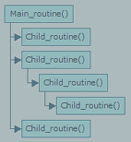
|
|
| |
| # lines: |
326 | | # code: |
326 | | # comment: | 0 | |
# blank: | 0 |
| # Variables: | 35 |
| # Callers: | 1 |
| # Callings: | 2 |
| # Words: | 177 |
| # Keywords: | 106 |
|
|
|
|
|
..
     .. Array Arguments ..
     ..
  Purpose
  =======
  PSLAEBZ contains the iteration loop which computes the eigenvalues
  contained in the input intervals [ INTVL(2*j-1), INTVL(2*j) ] where
  j = 1,...,MINP. It uses and computes the function N(w), which is
  the count of eigenvalues of a symmetric tridiagonal matrix less than
  or equal to its argument w.
  This is a ScaLAPACK internal subroutine and arguments are not
  checked for unreasonable values.
  Arguments
  =========
  IJOB    (input) INTEGER
          Specifies the computation done by PSLAEBZ
          = 0 : Find an interval with desired values of N(w) at the
                endpoints of the interval.
          = 1 : Find a floating point number contained in the initial
                interval with a desired value of N(w).
          = 2 : Perform bisection iteration to find eigenvalues of T.
  N       (input) INTEGER
          The order of the tridiagonal matrix T. N >= 1.
  MMAX    (input) INTEGER
          The maximum number of intervals that may be generated. If
          more than MMAX intervals are generated, then PSLAEBZ will
          quit with INFO = MMAX+1.
  MINP    (input) INTEGER
          The initial number of intervals. MINP <= MMAX.
  ABSTOL  (input) REAL
          The minimum (absolute) width of an interval. When an interval
          is narrower than ABSTOL, or than RELTOL times the larger (in
          magnitude) endpoint, then it is considered to be sufficiently
          small, i.e., converged.
          This must be at least zero.
  RELTOL  (input) REAL
          The minimum relative width of an interval. When an interval
          is narrower than ABSTOL, or than RELTOL times the larger (in
          magnitude) endpoint, then it is considered to be sufficiently
          small, i.e., converged.
          Note : This should be at least radix*machine epsilon.
  PIVMIN  (input) REAL
          The minimum absolute of a "pivot" in the "paranoid"
          implementation of the Sturm sequence loop. This must be at
          least max_j |e(j)^2| *safe_min, and at least safe_min, where
          safe_min is at least the smallest number that can divide 1.0
          without overflow.
          See PSLAPDCT for the "paranoid" implementation of the Sturm
          sequence loop.
  D       (input) REAL array, dimension (2*N - 1)
          Contains the diagonals and the squares of the off-diagonal
          elements of the tridiagonal matrix T. These elements are
          assumed to be interleaved in memory for better cache
          performance. The diagonal entries of T are in the entries
          D(1),D(3),...,D(2*N-1), while the squares of the off-diagonal
          entries are D(2),D(4),...,D(2*N-2). To avoid overflow, the
          matrix must be scaled so that its largest entry is no greater
          than overflow**(1/2) * underflow**(1/4) in absolute value,
          and for greatest accuracy, it should not be much smaller
          than that.
  NVAL    (input/output) INTEGER array, dimension (4)
          If IJOB = 0, the desired values of N(w) are in NVAL(1) and
                       NVAL(2).
          If IJOB = 1, NVAL(2) is the desired value of N(w).
          If IJOB = 2, not referenced.
          This array will, in general, be reordered on output.
  INTVL   (input/output) REAL array, dimension (2*MMAX)
          The endpoints of the intervals. INTVL(2*j-1) is the left
          endpoint of the j-th interval, and INTVL(2*j) is the right
          endpoint of the j-th interval. The input intervals will,
          in general, be modified, split and reordered by the
          calculation.
          On input, INTVL contains the MINP input intervals.
          On output, INTVL contains the converged intervals.
  INTVLCT (input/output) INTEGER array, dimension (2*MMAX)
          The counts at the endpoints of the intervals. INTVLCT(2*j-1)
          is the count at the left endpoint of the j-th interval, i.e.,
          the function value N(INTVL(2*j-1)), and INTVLCT(2*j) is the
          count at the right endpoint of the j-th interval.
          On input, INTVLCT contains the counts at the endpoints of
          the MINP input intervals.
          On output, INTVLCT contains the counts at the endpoints of
          the converged intervals.
  MOUT    (output) INTEGER
          The number of intervals output.
  LSAVE   (output) REAL
          If IJOB = 0 or 2, not referenced.
          If IJOB = 1, this is the largest floating point number
          encountered which has count N(w) = NVAL(1).
  IEFLAG  (input) INTEGER
          A flag which indicates whether N(w) should be speeded up by
          exploiting IEEE Arithmetic.
  INFO    (output) INTEGER
          = 0        : All intervals converged.
          = 1 - MMAX : The last INFO intervals did not converge.
          = MMAX + 1 : More than MMAX intervals were generated.
  =====================================================================
     .. Intrinsic Functions ..
|
|
|
|
001 SUBROUTINE PSLAEBZ( IJOB , N , MMAX , MINP , ABSTOL , RELTOL , PIVMIN ,
002 $D , NVAL , INTVL , INTVLCT , MOUT , LSAVE , IEFLAG ,
003 $INFO )
004
005 * -- ScaLAPACK routine(version 1.7) --
006 * University of Tennessee , Knoxville , Oak Ridge National Laboratory ,
007 * and University of California , Berkeley.
008 * November 15 , 1997
009
010 * .. Scalar Arguments ..
011 INTEGER IEFLAG , IJOB , INFO , MINP , MMAX , MOUT , N
012 REAL ABSTOL , LSAVE , PIVMIN , RELTOL
013 INTRINSIC ABS , INT , LOG , MAX , MIN
014 * ..
015 * .. External Subroutines ..
016 EXTERNAL PSLAECV , PSLAIECT , PSLAPDCT
017 * ..
018 * .. Parameters ..
019 REAL ZERO , TWO , HALF
020 PARAMETER( ZERO = 0.0E + 0 , TWO = 2.0E + 0 ,
021 $HALF = 1.0E + 0 / TWO )
022 * ..
023 * .. Local Scalars ..
024 INTEGER I , ITMAX , J , K , KF , KL , KLNEW , L , LCNT , LREQ ,
025 $NALPHA , NBETA , NMID , RCNT , RREQ
026 REAL ALPHA , BETA , MID
027 * ..
028 * .. Executable Statements ..
029
030 KF = 1
031 KL = MINP + 1
032 INFO = 0
033 IF( INTVL( 2 ) - INTVL( 1 ).LE.ZERO ) THEN
033   034 INFO = MINP
035 MOUT = KF
036 RETURN
037 END IF
038 IF( IJOB.EQ.0 ) THEN
039
040 * Check if some input intervals have "converged"
041
041
042 CALL PSLAECV ( 0 , KF , KL , INTVL , INTVLCT , NVAL ,
043 $
034 INFO = MINP
035 MOUT = KF
036 RETURN
037 END IF
038 IF( IJOB.EQ.0 ) THEN
039
040 * Check if some input intervals have "converged"
041
041
042 CALL PSLAECV ( 0 , KF , KL , INTVL , INTVLCT , NVAL ,
043 $ MAX( ABSTOL , PIVMIN ) , RELTOL )
044 IF( KF.GE.KL )
044
045 $ GO TO 60
046
047 * Compute upper bound on number of iterations needed
048
049 ITMAX = INT(( LOG( INTVL( 2 ) - INTVL( 1 ) + PIVMIN ) -
050 $ LOG( PIVMIN ) ) / LOG( TWO ) ) + 2
051
052 * Iteration Loop
053
054 DO 20 I = 1 , ITMAX
054
055 KLNEW = KL
056 DO 10 J = KF , KL - 1
056
057 K = 2*J
058
059 * Bisect the interval and find the count at that point
060
061 MID = HALF*( INTVL( K - 1 ) + INTVL( K ) )
062 IF( IEFLAG.EQ.0 ) THEN
062
063 CALL PSLAPDCT ( MID , N , D , PIVMIN , NMID )
064 ELSE
064
065 CALL PSLAIECT( MID , N , D , NMID )
066 END IF
067 LREQ = NVAL( K - 1 )
068 RREQ = NVAL( K )
069 IF( KL.EQ.1 )
069
070 $ NMID = MIN( INTVLCT( K ) ,
071 $ MAX( INTVLCT( K - 1 ) , NMID ) )
072 IF( NMID.LE.NVAL( K - 1 ) ) THEN
072
073 INTVL( K - 1 ) = MID
074 INTVLCT( K - 1 ) = NMID
075 END IF
076 IF( NMID.GE.NVAL( K ) ) THEN
076
077 INTVL( K ) = MID
078 INTVLCT( K ) = NMID
079 END IF
080 IF( NMID.GT.LREQ .AND. NMID.LT.RREQ ) THEN
080
081 L = 2*KLNEW
082 INTVL( L - 1 ) = MID
083 INTVL( L ) = INTVL( K )
084 INTVLCT( L - 1 ) = NVAL( K )
085 INTVLCT( L ) = INTVLCT( K )
086 INTVL( K ) = MID
087 INTVLCT( K ) = NVAL( K - 1 )
088 NVAL( L - 1 ) = NVAL( K )
089 NVAL( L ) = NVAL( L - 1 )
090 NVAL( K ) = NVAL( K - 1 )
091 KLNEW = KLNEW + 1
092 END IF
093 10 CONTINUE
093
094 KL = KLNEW
095 CALL PSLAECV ( 0 , KF , KL , INTVL , INTVLCT , NVAL ,
096 $ MAX( ABSTOL , PIVMIN ) , RELTOL )
097 IF( KF.GE.KL )
097
098 $ GO TO 60
099 20 CONTINUE
099
100 ELSE IF( IJOB.EQ.1 ) THEN
100
101 ALPHA = INTVL( 1 )
102 BETA = INTVL( 2 )
103 NALPHA = INTVLCT( 1 )
104 NBETA = INTVLCT( 2 )
105 LSAVE = ALPHA
106 LREQ = NVAL( 1 )
107 RREQ = NVAL( 2 )
108 30 CONTINUE
109 IF( NBETA.NE.RREQ .AND. BETA - ALPHA.GT.
109
110 $ MAX( ABSTOL , RELTOL*MAX( ABS( ALPHA ) , ABS( BETA ) ) ) )
111 $ THEN
112
113 * Bisect the interval and find the count at that point
114
115 MID = HALF*( ALPHA + BETA )
116 IF( IEFLAG.EQ.0 ) THEN
116
117 CALL PSLAPDCT ( MID , N , D , PIVMIN , NMID )
118 ELSE
118
119 CALL PSLAIECT( MID , N , D , NMID )
120 END IF
121 NMID = MIN( NBETA , MAX( NALPHA , NMID ) )
122 IF( NMID.GE.RREQ ) THEN
122
123 BETA = MID
124 NBETA = NMID
125 ELSE
125
126 ALPHA = MID
127 NALPHA = NMID
128 IF( NMID.EQ.LREQ )
128
129 $ LSAVE = ALPHA
130 END IF
131 GO TO 30
132 END IF
133 KL = KF
134 INTVL( 1 ) = ALPHA
135 INTVL( 2 ) = BETA
136 INTVLCT( 1 ) = NALPHA
137 INTVLCT( 2 ) = NBETA
138 ELSE IF( IJOB.EQ.2 ) THEN
139
140 * Check if some input intervals have "converged"
141
141
142 CALL PSLAECV ( 1 , KF , KL , INTVL , INTVLCT , NVAL ,
143 $ MAX( ABSTOL , PIVMIN ) , RELTOL )
144 IF( KF.GE.KL )
144
145 $ GO TO 60
146
147 * Compute upper bound on number of iterations needed
148
149 ITMAX = INT(( LOG( INTVL( 2 ) - INTVL( 1 ) + PIVMIN ) -
150 $ LOG( PIVMIN ) ) / LOG( TWO ) ) + 2
151
152 * Iteration Loop
153
154 DO 50 I = 1 , ITMAX
154
155 KLNEW = KL
156 DO 40 J = KF , KL - 1
156
157 K = 2*J
158 MID = HALF*( INTVL( K - 1 ) + INTVL( K ) )
159 IF( IEFLAG.EQ.0 ) THEN
159
160 CALL PSLAPDCT ( MID , N , D , PIVMIN , NMID )
161 ELSE
161
162 CALL PSLAIECT( MID , N , D , NMID )
163 END IF
164 LCNT = INTVLCT( K - 1 )
165 RCNT = INTVLCT( K )
166 NMID = MIN( RCNT , MAX( LCNT , NMID ) )
167
168 * Form New Interval(s)
169
170 IF( NMID.EQ.LCNT ) THEN
170
171 INTVL( K - 1 ) = MID
172 ELSE IF( NMID.EQ.RCNT ) THEN
172
173 INTVL( K ) = MID
174 ELSE IF( KLNEW.LT.MMAX + 1 ) THEN
174
175 L = 2*KLNEW
176 INTVL( L - 1 ) = MID
177 INTVL( L ) = INTVL( K )
178 INTVLCT( L - 1 ) = NMID
179 INTVLCT( L ) = INTVLCT( K )
180 INTVL( K ) = MID
181 INTVLCT( K ) = NMID
182 KLNEW = KLNEW + 1
183 ELSE
183
184 INFO = MMAX + 1
185 RETURN
186 END IF
187 40 CONTINUE
187
188 KL = KLNEW
189 CALL PSLAECV ( 1 , KF , KL , INTVL , INTVLCT , NVAL ,
190 $ MAX( ABSTOL , PIVMIN ) , RELTOL )
191 IF( KF.GE.KL )
191
192 $ GO TO 60
193 50 CONTINUE
193
194 END IF
195 60 CONTINUE
196 INFO = MAX( KL - KF , 0 )
197 MOUT = KL - 1
198 RETURN
199
200 * End of PSLAEBZ
201
202 END
203 23
34
|
|
Variables in Routine PSLAEBZ()
| Summary Report |
| Data Type | Quantity | Size(byte) |
| INTEGER | 25 | 100 |
| REAL | 10 | 40 |
| TOTAL | 35 | 140 |
List of Variables
INTEGER
| I | IEFLAG | IJOB | INFO | INTVL |
| INTVLCT | ITMAX | J | K | KF |
| KL | KLNEW | L | LCNT | LREQ |
| MINP | MMAX | MOUT | N | NALPHA |
| NBETA | NMID | NVAL | RCNT | RREQ |
REAL
| ABSTOL | ALPHA | BETA | HALF | LSAVE |
| MID | PIVMIN | RELTOL | TWO | ZERO |
Variables Dependence Graph
Put the mouse over a right hand side variable to display the corresponding line of the dependence | | - | | - | - | | ALPHA | <--- | MIDALPHA = MID, INTVLALPHA = INTVL( 1 ) |
| BETA | <--- | MIDBETA = MID, INTVLBETA = INTVL( 2 ) |
| I | <--- | ITMAXDO 50 I = 1, ITMAX{2DO 20 I = 1, ITMAX} |
| INFO | <--- | KFINFO = MAX( KL-KF, 0 ), KLINFO = MAX( KL-KF, 0 ), MINPINFO = MINP, MMAXINFO = MMAX + 1 |
| INTVL | <--- | KINTVL( L ) = INTVL( K ){2INTVL( L ) = INTVL( K )}, ALPHAINTVL( 1 ) = ALPHA, MIDINTVL( K-1 ) = MID{2INTVL( K ) = MID, 3INTVL( L-1 ) = MID, 4INTVL( K ) = MID, 5INTVL( K-1 ) = MID, 6INTVL( K ) = MID, 7INTVL( L-1 ) = MID, 8INTVL( K ) = MID}, BETAINTVL( 2 ) = BETA, INTVLINTVL( L ) = INTVL( K ){2INTVL( L ) = INTVL( K )} |
| INTVLCT | <--- | INTVLCTINTVLCT( L ) = INTVLCT( K ){2INTVLCT( L ) = INTVLCT( K )}, KINTVLCT( L ) = INTVLCT( K ){2INTVLCT( L-1 ) = NVAL( K ), 3INTVLCT( L ) = INTVLCT( K ), 4INTVLCT( K ) = NVAL( K-1 )}, NALPHAINTVLCT( 1 ) = NALPHA, NBETAINTVLCT( 2 ) = NBETA, NMIDINTVLCT( L-1 ) = NMID{2INTVLCT( K ) = NMID, 3INTVLCT( K-1 ) = NMID, 4INTVLCT( K ) = NMID}, NVALINTVLCT( L-1 ) = NVAL( K ){2INTVLCT( K ) = NVAL( K-1 )} |
| ITMAX | <--- | PIVMINITMAX = INT( ( LOG( INTVL( 2 )-INTVL( 1 )+PIVMIN )-{2ITMAX = INT( ( LOG( INTVL( 2 )-INTVL( 1 )+PIVMIN )-}, TWOITMAX = INT( ( LOG( INTVL( 2 )-INTVL( 1 )+PIVMIN )-{2ITMAX = INT( ( LOG( INTVL( 2 )-INTVL( 1 )+PIVMIN )-}, INTVLITMAX = INT( ( LOG( INTVL( 2 )-INTVL( 1 )+PIVMIN )-{2ITMAX = INT( ( LOG( INTVL( 2 )-INTVL( 1 )+PIVMIN )-} |
| J | <--- | KFDO 40 J = KF, KL - 1{2DO 10 J = KF, KL - 1}, KLDO 40 J = KF, KL - 1{2DO 10 J = KF, KL - 1} |
| K | <--- | JK = 2*J{2K = 2*J} |
| KL | <--- | KFKL = KF, KLNEWKL = KLNEW{2KL = KLNEW}, MINPKL = MINP + 1 |
| KLNEW | <--- | KLKLNEW = KL{2KLNEW = KL}, KLNEWKLNEW = KLNEW + 1{2KLNEW = KLNEW + 1} |
| L | <--- | KLNEWL = 2*KLNEW{2L = 2*KLNEW} |
| LCNT | <--- | INTVLCTLCNT = INTVLCT( K-1 ), KLCNT = INTVLCT( K-1 ) |
| LREQ | <--- | KLREQ = NVAL( K-1 ), NVALLREQ = NVAL( 1 ){2LREQ = NVAL( K-1 )} |
| LSAVE | <--- | ALPHALSAVE = ALPHA |
| MID | <--- | KMID = HALF*( INTVL( K-1 )+INTVL( K ) ){2MID = HALF*( INTVL( K-1 )+INTVL( K ) )}, ALPHAMID = HALF*( ALPHA+BETA ), BETAMID = HALF*( ALPHA+BETA ), HALFMID = HALF*( ALPHA+BETA ){2MID = HALF*( INTVL( K-1 )+INTVL( K ) ), 3MID = HALF*( INTVL( K-1 )+INTVL( K ) )}, INTVLMID = HALF*( INTVL( K-1 )+INTVL( K ) ){2MID = HALF*( INTVL( K-1 )+INTVL( K ) )} |
| MOUT | <--- | KFMOUT = KF, KLMOUT = KL - 1 |
| NALPHA | <--- | INTVLCTNALPHA = INTVLCT( 1 ), NMIDNALPHA = NMID |
| NBETA | <--- | INTVLCTNBETA = INTVLCT( 2 ), NMIDNBETA = NMID |
| NMID | <--- | LCNTNMID = MIN( RCNT, MAX( LCNT, NMID ) ), NALPHANMID = MIN( NBETA, MAX( NALPHA, NMID ) ), NBETANMID = MIN( NBETA, MAX( NALPHA, NMID ) ), NMIDNMID = MIN( NBETA, MAX( NALPHA, NMID ) ){2NMID = MIN( RCNT, MAX( LCNT, NMID ) )}, RCNTNMID = MIN( RCNT, MAX( LCNT, NMID ) ) |
| NVAL | <--- | KNVAL( L-1 ) = NVAL( K ){2NVAL( K ) = NVAL( K-1 )}, LNVAL( L ) = NVAL( L-1 ), NVALNVAL( L-1 ) = NVAL( K ){2NVAL( L ) = NVAL( L-1 ), 3NVAL( K ) = NVAL( K-1 )} |
| RCNT | <--- | INTVLCTRCNT = INTVLCT( K ), KRCNT = INTVLCT( K ) |
| RREQ | <--- | KRREQ = NVAL( K ), NVALRREQ = NVAL( 2 ){2RREQ = NVAL( K )} |
|
|
Analysis elements of the routine PSLAEBZ()
Put the mouse over each element to display detailed matching information
 Assigned variables Assigned variables |
| | | ALPHA , BETA , HALF , I , INFO , INTVL , INTVLCT , ITMAX , J , K , KF , KL , KLNEW , L , LCNT , LREQ , LSAVE , MID , MOUT , NALPHA , NBETA , NMID , RCNT , RREQ , TWO , ZERO |
|
| Active variables |
| | | ABSTOL , ALPHA , BETA , D , HALF , I , IEFLAG , IJOB , INFO , INTVL , INTVLCT , ITMAX , J , K , KF , KL , KLNEW , L , LCNT , LREQ , LSAVE , MID , MINP , MMAX , MOUT , N , NALPHA , NBETA , NMID , NVAL , PIVMIN , RCNT , RELTOL , RREQ , TWO , ZERO |
|
| Allocated variables [ statement : associated variable ] |
| |  new new | : Form |
|
| Accessed arrays [ array name : associated index ] |
| | INTVL | : 1 , 1 , 1 , 1 , 1 , 2 , 2 , 2 , 2 , 2 , K , K , K , K , K , K , K , K , K-1 , K-1 , K-1 , K-1 , L , L , L-1 , L-1 |
| | INTVLCT | : 1 , 1 , 2 , 2 , K , K , K , K , K , K , K , K-1 , K-1 , K-1 , L , L , L-1 , L-1 |
| | NVAL | : 1 , 2 , K , K , K , K , K , K-1 , K-1 , K-1 , K-1 , L , L-1 , L-1 |
|
| Conditional statements [ statement : associated predicate ] |
| | do | : ( 20 I = 1 , ITMAX ) , ( 10 J = KF , KL - 1 ) , ( 50 I = 1 , ITMAX ) , ( 40 J = KF , KL - 1 ) |
| | if | : ( (INTVL( 2 ) - INTVL( 1 ).LE.ZERO ) ) , ( IJOB.EQ.0 ) , ( some input intervals have "converged" ) , ( KF.GE.KL ) , ( IEFLAG.EQ.0 ) , ( KL.EQ.1 ) , ( (NMID.LE.NVAL( K - 1 ) ) ) , ( (NMID.GE.NVAL( K ) ) ) , ( NMID.GT.LREQ .AND. NMID.LT.RREQ ) , ( KF.GE.KL ) , ( IJOB.EQ.1 ) , ( NBETA.NE.RREQ .AND. BETA - ALPHA.GT. ) , ( IEFLAG.EQ.0 ) , ( NMID.GE.RREQ ) , ( NMID.EQ.LREQ ) , ( IJOB.EQ.2 ) , ( some input intervals have "converged" ) , ( KF.GE.KL ) , ( IEFLAG.EQ.0 ) , ( NMID.EQ.LCNT ) , ( NMID.EQ.RCNT ) , ( KLNEW.LT.MMAX + 1 ) , ( KF.GE.KL ) |
|
| List of variables |
ABSTOL
ALPHA
BETA
HALF
I
IEFLAG
IJOB
| INFO
INTVL
INTVLCT
ITMAX
J
K
KF
KL
| KLNEW
L
LCNT
LREQ
LSAVE
MID
MINP
MMAX
| MOUT
N
NALPHA
NBETA
NMID
NVAL
PIVMIN
RCNT
| RELTOL
RREQ
TWO
ZERO | | close
| |
ABSTOL
ALPHA
BETA
HALF
I
IEFLAG
IJOB
INFO
INTVL
INTVLCT
ITMAX
J
K
KF
KL
KLNEW
L
LCNT
LREQ
LSAVE
MID
MINP
MMAX
MOUT
N
NALPHA
NBETA
NMID
NVAL
PIVMIN
RCNT
RELTOL
RREQ
TWO
ZERO
375#360
| |