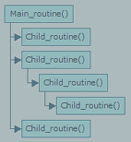
|
|
| |
| # lines: |
1490 | | # code: |
1490 | | # comment: | 0 | |
# blank: | 0 |
| # Variables: | 36 |
| # Callers: | 1 |
| # Callings: | 1 |
| # Words: | 335 |
| # Keywords: | 147 |
|
|
|
|
|
..
     .. Local Scalars ..
     ..
     .. Local Arrays ..
     ..
     .. External Subroutines ..
     ..
     .. External Functions ..
     ..
     .. Intrinsic Functions ..
     ..
     .. Executable Statements ..
     Test the input parameters
     Convert descriptor into standard form for easy access to
        parameters, check that grid is of right shape.
        Temporarily set the descriptor type to 1xP type
     Consistency checks for DESCA and DESCB.
     Context must be the same
        These are alignment restrictions that may or may not be removed
        in future releases. -Andy Cleary, April 14, 1996.
     Block sizes must be the same
     Source processor must be the same
     Get values out of descriptor for use in code.
     Get grid parameters
     Current alignment restriction
     Argument checking that is specific to Divide & Conquer routine
     Pack params and positions into arrays for global consistency check
     Want to find errors with MIN( ), so if no error, set it to a big
     number. If there already is an error, multiply by the the
     descriptor multiplier.
     Check consistency across processors
     Prepare output: set info = 0 if no error, and divide by DESCMULT
     if error is not in a descriptor entry.
     Quick return if possible
     Adjust addressing into matrix space to properly get into
        the beginning part of the relevant data
     Form a new BLACS grid (the "standard form" grid) with only procs
        holding part of the matrix, of size 1xNP where NP is adjusted,
        starting at csrc=0, with JA modified to reflect dropped procs.
     First processor to hold part of the matrix:
     Calculate new JA one while dropping off unused processors.
     Save and compute new value of NP
     Call utility routine that forms "standard-form" grid
     Use new context from standard grid as context.
     Get information about new grid.
     Drop out processors that do not have part of the matrix.
     ********************************
     Values reused throughout routine
     User-input value of partition size
     Number of columns in each processor
     Offset in columns to beginning of main partition in each proc
     Size of main (or odd) partition in each processor
     Offset to workspace for Upper triangular factor
     Begin main code
        Frontsolve
*****************************************
       Local computation phase
*****************************************
       Use main partition in each processor to solve locally
         Use factorization of odd-even connection block to modify
           locally stored portion of right hand side(s)
         Use the "spike" fillin to calculate contribution to previous
           processor's righthand-side.
***********************************************
       Formation and solution of reduced system
***********************************************
       Send modifications to prior processor's right hand sides
       Receive modifications to processor's right hand sides
         Combine contribution to locally stored right hand sides
       The last processor does not participate in the solution of the
       reduced system, having sent its contribution already.
       *************************************
       Modification Loop
       The distance for sending and receiving for each level starts
         at 1 for the first level.
       Do until this proc is needed to modify other procs' equations
         Receive and add contribution to righthand sides from left
         Receive and add contribution to righthand sides from right
       [End of GOTO Loop]
       *********************************
       Calculate and use this proc's blocks to modify other procs
       Solve with diagonal block
       *********
         Calculate contribution from this block to next diagonal block
         Send contribution to diagonal block's owning processor.
       End of "if( mycol/level_dist .le. (npcol-1)/level_dist-2 )..."
       ************
         Use offdiagonal block to calculate modification to diag block
           of processor to the left
         Send contribution to diagonal block's owning processor.
       End of "if( mycol/level_dist.le. (npcol-1)/level_dist -1 )..."
******************* BACKSOLVE *************************************
*******************************************************************
     .. Begin reduced system phase of algorithm ..
*******************************************************************
       The last processor does not participate in the solution of the
       reduced system and just waits to receive its solution.
       Determine number of steps in tree loop
         Receive solution from processor to left
         Use offdiagonal block to calculate modification to RHS stored
           on this processor
       End of "if( mycol/level_dist.le. (npcol-1)/level_dist -1 )..."
         Receive solution from processor to right
         Calculate contribution from this block to next diagonal block
       End of "if( mycol/level_dist .le. (npcol-1)/level_dist-2 )..."
       Solve with diagonal block
**Modification Loop *******
         Send solution to the right
         Send solution to left
       [End of GOTO Loop]
          [Processor npcol - 1 jumped to here to await next stage]
******************************
       Reduced system has been solved, communicate solutions to nearest
         neighbors in preparation for local computation phase.
       Send elements of solution to next proc
       Receive modifications to processor's right hand sides
*********************************************
       Local computation phase
*********************************************
         Use the "spike" fillin to calculate contribution from previous
           processor's solution.
         Use factorization of odd-even connection block to modify
           locally stored portion of right hand side(s)
       Use main partition in each processor to solve locally
     End of "IF( LSAME( TRANS, 'N' ) )"...
**************************************************************
     CASE UPLO = 'U'                                         *
**************************************************************
        Frontsolve
*****************************************
       Local computation phase
*****************************************
       Use main partition in each processor to solve locally
         Use factorization of odd-even connection block to modify
           locally stored portion of right hand side(s)
         Use the "spike" fillin to calculate contribution to previous
           processor's righthand-side.
|
|
|
|
001 SUBROUTINE PSDTTRSV( UPLO , TRANS , N , NRHS , DL , D , DU , JA , DESCA ,
002 $B , IB , DESCB , AF , LAF , WORK , LWORK , INFO )
003
004 * -- ScaLAPACK routine(version 1.7) --
005 * University of Tennessee , Knoxville , Oak Ridge National Laboratory ,
006 * and University of California , Berkeley.
007 * April 3 , 2000
008
009 * .. Scalar Arguments ..
010 CHARACTER TRANS , UPLO
011 INTEGER IB , INFO , JA , LAF , LWORK , N , NRHS
012 * ..
013 * .. Array Arguments ..
014 INTEGER DESCA( * ) , DESCB( * )
015 REAL AF( * ) , B( * ) , D( * ) , DL( * ) , DU( * ) ,
016 $WORK( * )
017 * ..
018
019 * Purpose
020 * === ====
021
022 * PSDTTRSV solves a tridiagonal triangular system of linear equations
023
024 * A(1 : N , JA : JA + N - 1) * X = B(IB : IB + N - 1 , 1 : NRHS)
025 * or
026 * A(1 : N , JA : JA + N - 1)^T * X = B(IB : IB + N - 1 , 1 : NRHS)
027
028 * where A(1 : N , JA : JA + N - 1) is a tridiagonal
029 * triangular matrix factor produced by the
030 * Gaussian elimination code PS@(dom_pre)TTRF
031 * and is stored in A(1 : N , JA : JA + N - 1) and AF.
032 * The matrix stored in A(1 : N , JA : JA + N - 1) is either
033 * upper or lower triangular according to UPLO ,
034 * and the choice of solving A(1 : N , JA : JA + N - 1) or A(1 : N , JA : JA + N - 1)^T
035 * is dictated by the user by the parameter TRANS.
036
037 * Routine PSDTTRF MUST be called first.
038
039 * === ==================================================================
040
041 * Arguments
042 * === ======
043
044 * UPLO(global input) CHARACTER
045 * = 'U' : Upper triangle of A(1 : N , JA : JA + N - 1) is stored ;
046 * = 'L' : Lower triangle of A(1 : N , JA : JA + N - 1) is stored.
047
048 * TRANS(global input) CHARACTER
049 * = 'N' : Solve with A(1 : N , JA : JA + N - 1) ;
050 * = 'T' or 'C' : Solve with A(1 : N , JA : JA + N - 1)^T ;
051
052 * N(global input) INTEGER
053 * The number of rows and columns to be operated on , i.e. the
054 * order of the distributed submatrix A(1 : N , JA : JA + N - 1). N >= 0.
055
056 * NRHS(global input) INTEGER
057 * The number of right hand sides , i.e. , the number of columns
058 * of the distributed submatrix B(IB : IB + N - 1 , 1 : NRHS).
059 * NRHS >= 0.
060
061 * DL(local input / local output) REAL pointer to local
062 * part of global vector storing the lower diagonal of the
063 * matrix. Globally , DL(1) is not referenced , and DL must be
064 * aligned with D.
065 * Must be of size >= DESCA( NB_ ).
066 * On exit , this array contains information containing the
067 * factors of the matrix.
068
069 * D(local input / local output) REAL pointer to local
070 * part of global vector storing the main diagonal of the
071 * matrix.
072 * On exit , this array contains information containing the
073 * factors of the matrix.
074 * Must be of size >= DESCA( NB_ ).
075
076 * DU(local input / local output) REAL pointer to local
077 * part of global vector storing the upper diagonal of the
078 * matrix. Globally , DU(n) is not referenced , and DU must be
079 * aligned with D.
080 * On exit , this array contains information containing the
081 * factors of the matrix.
082 * Must be of size >= DESCA( NB_ ).
083
084 * JA(global input) INTEGER
085 * The index in the global array A that points to the start of
086 * the matrix to be operated on(which may be either all of A
087 * or a submatrix of A).
088
089 * DESCA(global and local input) INTEGER array of dimension DLEN.
090 * if 1D type(DTYPE_A = 501 or 502) , DLEN >= 7 ;
091 * if 2D type(DTYPE_A = 1) , DLEN >= 9.
092 * The array descriptor for the distributed matrix A.
093 * Contains information of mapping of A to memory. Please
094 * see NOTES below for full description and options.
095
096 * B(local input / local output) REAL pointer into
097 * local memory to an array of local lead dimension lld_b >= NB.
098 * On entry , this array contains the
099 * the local pieces of the right hand sides
100 * B(IB : IB + N - 1 , 1 : NRHS).
101 * On exit , this contains the local piece of the solutions
102 * distributed matrix X.
103
104 * IB(global input) INTEGER
105 * The row index in the global array B that points to the first
106 * row of the matrix to be operated on(which may be either
107 * all of B or a submatrix of B).
108
109 * DESCB(global and local input) INTEGER array of dimension DLEN.
110 * if 1D type(DTYPE_B = 502) , DLEN >= 7 ;
111 * if 2D type(DTYPE_B = 1) , DLEN >= 9.
112 * The array descriptor for the distributed matrix B.
113 * Contains information of mapping of B to memory. Please
114 * see NOTES below for full description and options.
115
116 * AF(local output) REAL array , dimension LAF.
117 * Auxiliary Fillin Space.
118 * Fillin is created during the factorization routine
119 * PSDTTRF and this is stored in AF. If a linear system
120 * is to be solved using PSDTTRS after the factorization
121 * routine , AF *must not be altered* after the factorization.
122
123 * LAF(local input) INTEGER
124 * Size of user - input Auxiliary Fillin space AF. Must be >=
125 * 2*(NB + 2)
126 * If LAF is not large enough , an error code will be returned
127 * and the minimum acceptable size will be returned in AF( 1 )
128
129 * WORK(local workspace / local output)
130 * REAL temporary workspace. This space may
131 * be overwritten in between calls to routines. WORK must be
132 * the size given in LWORK.
133 * On exit , WORK( 1 ) contains the minimal LWORK.
134
135 * LWORK(local input or global input) INTEGER
136 * Size of user - input workspace WORK.
137 * If LWORK is too small , the minimal acceptable size will be
138 * returned in WORK(1) and an error code is returned. LWORK >=
139 * 10*NPCOL + 4*NRHS
140
141 * INFO(local output) INTEGER
142 * = 0 : successful exit
143 * < 0 : If the i - th argument is an array and the j - entry had
144 * an illegal value , then INFO = - (i*100 + j) , if the i - th
145 * argument is a scalar and had an illegal value , then
146 * INFO = - i.
147
148 * === ==================================================================
149
150 * Restrictions
151 * === =========
152
153 * The following are restrictions on the input parameters. Some of these
154 * are temporary and will be removed in future releases , while others
155 * may reflect fundamental technical limitations.
156
157 * Non - cyclic restriction : VERY IMPORTANT !
158 * P*NB >= mod(JA - 1 , NB) + N.
159 * The mapping for matrices must be blocked , reflecting the nature
160 * of the divide and conquer algorithm as a task - parallel algorithm.
161 * This formula in words is : no processor may have more than one
162 * chunk of the matrix.
163
164 * Blocksize cannot be too small :
165 * If the matrix spans more than one processor , the following
166 * restriction on NB , the size of each block on each processor ,
167 * must hold :
168 * NB >= 2
169 * The bulk of parallel computation is done on the matrix of size
170 * O(NB) on each processor. If this is too small , divide and conquer
171 * is a poor choice of algorithm.
172
173 * Submatrix reference :
174 * JA = IB
175 * Alignment restriction that prevents unnecessary communication.
176
177 * === ==================================================================
178
179 * Notes
180 * === ==
181
182 * If the factorization routine and the solve routine are to be called
183 * separately(to solve various sets of righthand sides using the same
184 * coefficient matrix) , the auxiliary space AF *must not be altered*
185 * between calls to the factorization routine and the solve routine.
186
187 * The best algorithm for solving banded and tridiagonal linear systems
188 * depends on a variety of parameters , especially the bandwidth.
189 * Currently , only algorithms designed for the case N / P >> bw are
190 * implemented. These go by many names , including Divide and Conquer ,
191 * Partitioning , domain decomposition - type , etc.
192 * For tridiagonal matrices , it is obvious : N / P >> bw( = 1) , and so D&C
193 * algorithms are the appropriate choice.
194
195 * Algorithm description : Divide and Conquer
196
197 * The Divide and Conqer algorithm assumes the matrix is narrowly
198 * banded compared with the number of equations. In this situation ,
199 * it is best to distribute the input matrix A one - dimensionally ,
200 * with columns atomic and rows divided amongst the processes.
201 * The basic algorithm divides the tridiagonal matrix up into
202 * P pieces with one stored on each processor ,
203 * and then proceeds in 2 phases for the factorization or 3 for the
204 * solution of a linear system.
205 * 1) Local Phase :
206 * The individual pieces are factored independently and in
207 * parallel. These factors are applied to the matrix creating
208 * fillin , which is stored in a non - inspectable way in auxiliary
209 * space AF. Mathematically , this is equivalent to reordering
210 * the matrix A as P A P^T and then factoring the principal
211 * leading submatrix of size equal to the sum of the sizes of
212 * the matrices factored on each processor. The factors of
213 * these submatrices overwrite the corresponding parts of A
214 * in memory.
215 * 2) Reduced System Phase :
216 * A small((P - 1)) system is formed representing
217 * interaction of the larger blocks , and is stored(as are its
218 * factors) in the space AF. A parallel Block Cyclic Reduction
219 * algorithm is used. For a linear system , a parallel front solve
220 * followed by an analagous backsolve , both using the structure
221 * of the factored matrix , are performed.
222 * 3) Backsubsitution Phase :
223 * For a linear system , a local backsubstitution is performed on
224 * each processor in parallel.
225
226 * Descriptors
227 * === ========
228
229 * Descriptors now have *types* and differ from ScaLAPACK 1.0.
230
231 * Note : tridiagonal codes can use either the old two dimensional
232 * or new one - dimensional descriptors , though the processor grid in
233 * both cases *must be one - dimensional*. We describe both types below.
234
235 * Each global data object is described by an associated description
236 * vector. This vector stores the information required to establish
237 * the mapping between an object element and its corresponding process
238 * and memory location.
239
240 * Let A be a generic term for any 2D block cyclicly distributed array.
241 * Such a global array has an associated description vector DESCA.
242 * In the following comments , the character _ should be read as
243 * "of the global array".
244
245 * NOTATION STORED IN EXPLANATION
246 * --- ------------ -------------- --------------------------------------
247 * DTYPE_A(global) DESCA( DTYPE_ )The descriptor type. In this case ,
248 * DTYPE_A = 1.
249 * CTXT_A(global) DESCA( CTXT_ ) The BLACS context handle , indicating
250 * the BLACS process grid A is distribu -
251 * ted over. The context itself is glo -
252 * bal , but the handle(the integer
253 * value) may vary.
254 * M_A(global) DESCA( M_ ) The number of rows in the global
255 * array A.
256 * N_A(global) DESCA( N_ ) The number of columns in the global
257 * array A.
258 * MB_A(global) DESCA( MB_ ) The blocking factor used to distribute
259 * the rows of the array.
260 * NB_A(global) DESCA( NB_ ) The blocking factor used to distribute
261 * the columns of the array.
262 * RSRC_A(global) DESCA( RSRC_ ) The process row over which the first
263 * row of the array A is distributed.
264 * CSRC_A(global) DESCA( CSRC_ ) The process column over which the
265 * first column of the array A is
266 * distributed.
267 * LLD_A(local) DESCA( LLD_ ) The leading dimension of the local
268 * array. LLD_A >= MAX(1 , LOCr(M_A)).
269
270 * Let K be the number of rows or columns of a distributed matrix ,
271 * and assume that its process grid has dimension p x q.
272 * LOCr( K ) denotes the number of elements of K that a process
273 * would receive if K were distributed over the p processes of its
274 * process column.
275 * Similarly , LOCc( K ) denotes the number of elements of K that a
276 * process would receive if K were distributed over the q processes of
277 * its process row.
278 * The values of LOCr() and LOCc() may be determined via a call to the
279 * ScaLAPACK tool function , NUMROC :
280 * LOCr( M ) = NUMROC( M , MB_A , MYROW , RSRC_A , NPROW ) ,
281 * LOCc( N ) = NUMROC( N , NB_A , MYCOL , CSRC_A , NPCOL ).
282 * An upper bound for these quantities may be computed by :
283 * LOCr( M ) <= ceil( ceil(M / MB_A) / NPROW )*MB_A
284 * LOCc( N ) <= ceil( ceil(N / NB_A) / NPCOL )*NB_A
285
286 * One - dimensional descriptors :
287
288 * One - dimensional descriptors are a new addition to ScaLAPACK since
289 * version 1.0. They simplify and shorten the descriptor for 1D
290 * arrays.
291
292 * Since ScaLAPACK supports two - dimensional arrays as the fundamental
293 * object , we allow 1D arrays to be distributed either over the
294 * first dimension of the array(as if the grid were P - by - 1) or the
295 * 2nd dimension(as if the grid were 1 - by - P). This choice is
296 * indicated by the descriptor type(501 or 502)
297 * as described below.
298 * However , for tridiagonal matrices , since the objects being
299 * distributed are the individual vectors storing the diagonals , we
300 * have adopted the convention that both the P - by - 1 descriptor and
301 * the 1 - by - P descriptor are allowed and are equivalent for
302 * tridiagonal matrices. Thus , for tridiagonal matrices ,
303 * DTYPE_A = 501 or 502 can be used interchangeably
304 * without any other change.
305 * We require that the distributed vectors storing the diagonals of a
306 * tridiagonal matrix be aligned with each other. Because of this , a
307 * single descriptor , DESCA , serves to describe the distribution of
308 * of all diagonals simultaneously.
309
310 * IMPORTANT NOTE : the actual BLACS grid represented by the
311 * CTXT entry in the descriptor may be *either* P - by - 1 or 1 - by - P
312 * irrespective of which one - dimensional descriptor type
313 * (501 or 502) is input.
314 * This routine will interpret the grid properly either way.
315 * ScaLAPACK routines *do not support intercontext operations* so that
316 * the grid passed to a single ScaLAPACK routine *must be the same*
317 * for all array descriptors passed to that routine.
318
319 * NOTE : In all cases where 1D descriptors are used , 2D descriptors
320 * may also be used , since a one - dimensional array is a special case
321 * of a two - dimensional array with one dimension of size unity.
322 * The two - dimensional array used in this case *must* be of the
323 * proper orientation :
324 * If the appropriate one - dimensional descriptor is DTYPEA = 501
325 * (1 by P type) , then the two dimensional descriptor must
326 * have a CTXT value that refers to a 1 by P BLACS grid ;
327 * If the appropriate one - dimensional descriptor is DTYPEA = 502
328 * (P by 1 type) , then the two dimensional descriptor must
329 * have a CTXT value that refers to a P by 1 BLACS grid.
330
331 * Summary of allowed descriptors , types , and BLACS grids :
332 * DTYPE 501 502 1 1
333 * BLACS grid 1xP or Px1 1xP or Px1 1xP Px1
334 * --- --------------------------------------------------
335 * A OK OK OK NO
336 * B NO OK NO OK
337
338 * Note that a consequence of this chart is that it is not possible
339 * for *both* DTYPE_A and DTYPE_B to be 2D_type(1) , as these lead
340 * to opposite requirements for the orientation of the BLACS grid ,
341 * and as noted before , the *same* BLACS context must be used in
342 * all descriptors in a single ScaLAPACK subroutine call.
343
344 * Let A be a generic term for any 1D block cyclicly distributed array.
345 * Such a global array has an associated description vector DESCA.
346 * In the following comments , the character _ should be read as
347 * "of the global array".
348
349 * NOTATION STORED IN EXPLANATION
350 * --- ------------ ---------- ------------------------------------------
351 * DTYPE_A(global) DESCA( 1 ) The descriptor type. For 1D grids ,
352 * TYPE_A = 501 : 1 - by - P grid.
353 * TYPE_A = 502 : P - by - 1 grid.
354 * CTXT_A(global) DESCA( 2 ) The BLACS context handle , indicating
355 * the BLACS process grid A is distribu -
356 * ted over. The context itself is glo -
357 * bal , but the handle(the integer
358 * value) may vary.
359 * N_A(global) DESCA( 3 ) The size of the array dimension being
360 * distributed.
361 * NB_A(global) DESCA( 4 ) The blocking factor used to distribute
362 * the distributed dimension of the array.
363 * SRC_A(global) DESCA( 5 ) The process row or column over which the
364 * first row or column of the array
365 * is distributed.
366 * Ignored DESCA( 6 ) Ignored for tridiagonal matrices.
367 * Reserved DESCA( 7 ) Reserved for future use.
368
369 * === ==================================================================
370
371 * Code Developer : Andrew J. Cleary , University of Tennessee.
372 * Current address : Lawrence Livermore National Labs.
373
374 * === ==================================================================
375
376 * .. Parameters ..
377 REAL ONE
378 PARAMETER( ONE = 1.0E + 0 )
379 REAL ZERO
380 PARAMETER( ZERO = 0.0E + 0 )
381 INTEGER INT_ONE
382 PARAMETER( INT_ONE = 1 )
383 INTEGER DESCMULT , BIGNUM
384 PARAMETER( DESCMULT = 100 , BIGNUM = DESCMULT*DESCMULT )
385 INTEGER BLOCK_CYCLIC_2D , CSRC_ , CTXT_ , DLEN_ , DTYPE_ ,
386 $LLD_ , MB_ , M_ , NB_ , N_ , RSRC_
387 PARAMETER( BLOCK_CYCLIC_2D = 1 , DLEN_ = 9 , DTYPE_ = 1 ,
388 $CTXT_ = 2 , M_ = 3 , N_ = 4 , MB_ = 5 , NB_ = 6 ,
389 $RSRC_ = 7 , CSRC_ = 8 , LLD_ = 9 )
390 CALL SGEMM( 'T' , 'N' , INT_ONE , NRHS , ODD_SIZE , - ONE ,
391 $AF( WORK_U + 1 ) , ODD_SIZE , B( PART_OFFSET + 1 ) ,
392 $LLDB , ZERO , WORK( 1 + INT_ONE - INT_ONE ) ,
393 $INT_ONE )
394 END IF
395
396 * ***********************************************
397 * Formation and solution of reduced system
398 * ***********************************************
399
400 * Send modifications to prior processor's right hand sides
401
402 IF( MYCOL.GT.0 ) THEN
403
403   404 CALL
 SGESD2D( ICTXT , INT_ONE , NRHS , WORK( 1 ) , INT_ONE ,
405 $ 0 , MYCOL - 1 )
406
407 END IF
408
409 * Receive modifications to processor's right hand sides
410
411 IF( MYCOL.LT.NPCOL - 1 ) THEN
412
412
413 CALL SGERV2D( ICTXT , INT_ONE , NRHS , WORK( 1 ) , INT_ONE ,
414 $ 0 , MYCOL + 1 )
415
416 * Combine contribution to locally stored right hand sides
417
418 CALL SMATADD( INT_ONE , NRHS , ONE , WORK( 1 ) , INT_ONE ,
419 $ ONE , B( PART_OFFSET + ODD_SIZE + 1 ) , LLDB )
420
421 END IF
422
423 * The last processor does not participate in the solution of the
424 * reduced system , having sent its contribution already.
425 IF( MYCOL.EQ.NPCOL - 1 ) THEN
425
426 GO TO 110
427 END IF
428
429 * *************************************
430 * Modification Loop
431
432 * The distance for sending and receiving for each level starts
433 * at 1 for the first level.
434 LEVEL_DIST = 1
435
436 * Do until this proc is needed to modify other procs' equations
437
438 90 CONTINUE
439 IF( MOD(( MYCOL + 1 ) / LEVEL_DIST , 2 ).NE.0 )
439
440 $ GO TO 100
441
442 * Receive and add contribution to righthand sides from left
443
444 IF( MYCOL - LEVEL_DIST.GE.0 ) THEN
445
445
446 CALL SGERV2D( ICTXT , INT_ONE , NRHS , WORK( 1 ) , INT_ONE ,
447 $ 0 , MYCOL - LEVEL_DIST )
448
449 CALL SMATADD( INT_ONE , NRHS , ONE , WORK( 1 ) , INT_ONE ,
450 $ ONE , B( PART_OFFSET + ODD_SIZE + 1 ) , LLDB )
451
452 END IF
453
454 * Receive and add contribution to righthand sides from right
455
456 IF( MYCOL + LEVEL_DIST.LT.NPCOL - 1 ) THEN
457
457
458 CALL SGERV2D( ICTXT , INT_ONE , NRHS , WORK( 1 ) , INT_ONE ,
459 $ 0 , MYCOL + LEVEL_DIST )
460
461 CALL SMATADD( INT_ONE , NRHS , ONE , WORK( 1 ) , INT_ONE ,
462 $ ONE , B( PART_OFFSET + ODD_SIZE + 1 ) , LLDB )
463
464 END IF
465
466 LEVEL_DIST = LEVEL_DIST*2
467
468 GO TO 90
469 100 CONTINUE
470 * [End of GOTO Loop]
471
472 * *********************************
473 * Calculate and use this proc's blocks to modify other procs
474
475 * Solve with diagonal block
476
477 CALL STBTRS( 'U' , 'T' , 'N' , INT_ONE ,
478 $MIN( INT_ONE , INT_ONE - 1 ) , NRHS ,
479 $AF( ODD_SIZE + 2 ) , INT_ONE + 1 ,
480 $B( PART_OFFSET + ODD_SIZE + 1 ) , LLDB , INFO )
481
482 IF( INFO.NE.0 ) THEN
482
483 GO TO 170
484 END IF
485
486 * *********
487 IF( MYCOL / LEVEL_DIST.LE.( NPCOL - 1 ) / LEVEL_DIST - 2 ) THEN
488
489 * Calculate contribution from this block to next diagonal block
490
490
491 CALL SGEMM( 'T' , 'N' , INT_ONE , NRHS , INT_ONE , - ONE ,
492 $ AF( WORK_U + ( ODD_SIZE )*INT_ONE + 1 ) , INT_ONE ,
493 $ B( PART_OFFSET + ODD_SIZE + 1 ) , LLDB , ZERO ,
494 $ WORK( 1 ) , INT_ONE )
495
496 * Send contribution to diagonal block's owning processor.
497
498 CALL SGESD2D( ICTXT , INT_ONE , NRHS , WORK( 1 ) , INT_ONE ,
499 $ 0 , MYCOL + LEVEL_DIST )
500
501 END IF
502 * End of "if( mycol/level_dist .le.(npcol-1)/level_dist-2 )..."
503
504 * ************
505 IF(( MYCOL / LEVEL_DIST.GT.0 ) .AND.
506 $( MYCOL / LEVEL_DIST.LE.( NPCOL - 1 ) / LEVEL_DIST - 1 ) )
507 $THEN
508
509 * Use offdiagonal block to calculate modification to diag block
510 * of processor to the left
511
512 CALL SGEMM( 'N' , 'N' , INT_ONE , NRHS , INT_ONE , - ONE ,
513 $AF( WORK_U + ODD_SIZE*INT_ONE + 2 + 1 ) , INT_ONE ,
514 $B( PART_OFFSET + ODD_SIZE + 1 ) , LLDB , ZERO ,
515 $WORK( 1 ) , INT_ONE )
516
517 * Send contribution to diagonal block's owning processor.
518
519 CALL SGESD2D( ICTXT , INT_ONE , NRHS , WORK( 1 ) , INT_ONE ,
520 $0 , MYCOL - LEVEL_DIST )
521
522 END IF
523 * End of "if( mycol/level_dist.le.(npcol-1)/level_dist -1 )..."
524
525 110 CONTINUE
526
527 ELSE
528
529 * ******************* BACKSOLVE *************************************
530
531 * *******************************************************************
532 * .. Begin reduced system phase of algorithm ..
533 * *******************************************************************
534
535 * The last processor does not participate in the solution of the
536 * reduced system and just waits to receive its solution.
536
537 IF( MYCOL.EQ.NPCOL - 1 ) THEN
537
538 GO TO 160
539 END IF
540
541 * Determine number of steps in tree loop
542
543 LEVEL_DIST = 1
544 120 CONTINUE
545 IF( MOD(( MYCOL + 1 ) / LEVEL_DIST , 2 ).NE.0 )
545
546 $ GO TO 130
547
548 LEVEL_DIST = LEVEL_DIST*2
549
550 GO TO 120
551 130 CONTINUE
552
553 IF(( MYCOL / LEVEL_DIST.GT.0 ) .AND.
554 $( MYCOL / LEVEL_DIST.LE.( NPCOL - 1 ) / LEVEL_DIST - 1 ) )
555 $THEN
556
557 * Receive solution from processor to left
558
559 CALL SGERV2D( ICTXT , INT_ONE , NRHS , WORK( 1 ) , INT_ONE ,
560 $0 , MYCOL - LEVEL_DIST )
561
562 * Use offdiagonal block to calculate modification to RHS stored
563 * on this processor
564
565 CALL SGEMM( 'T' , 'N' , INT_ONE , NRHS , INT_ONE , - ONE ,
566 $AF( WORK_U + ODD_SIZE*INT_ONE + 2 + 1 ) , INT_ONE ,
567 $WORK( 1 ) , INT_ONE , ONE ,
568 $B( PART_OFFSET + ODD_SIZE + 1 ) , LLDB )
569 END IF
570 * End of "if( mycol/level_dist.le.(npcol-1)/level_dist -1 )..."
571
572 IF( MYCOL / LEVEL_DIST.LE.( NPCOL - 1 ) / LEVEL_DIST - 2 ) THEN
573
574 * Receive solution from processor to right
575
575
576 CALL SGERV2D( ICTXT , INT_ONE , NRHS , WORK( 1 ) , INT_ONE ,
577 $ 0 , MYCOL + LEVEL_DIST )
578
579 * Calculate contribution from this block to next diagonal block
580
581 CALL SGEMM( 'N' , 'N' , INT_ONE , NRHS , INT_ONE , - ONE ,
582 $ AF( WORK_U + ( ODD_SIZE )*INT_ONE + 1 ) , INT_ONE ,
583 $ WORK( 1 ) , INT_ONE , ONE ,
584 $ B( PART_OFFSET + ODD_SIZE + 1 ) , LLDB )
585
586 END IF
587 * End of "if( mycol/level_dist .le.(npcol-1)/level_dist-2 )..."
588
589 * Solve with diagonal block
590
591 CALL STBTRS( 'U' , 'N' , 'N' , INT_ONE ,
592 $MIN( INT_ONE , INT_ONE - 1 ) , NRHS ,
593 $AF( ODD_SIZE + 2 ) , INT_ONE + 1 ,
594 $B( PART_OFFSET + ODD_SIZE + 1 ) , LLDB , INFO )
595
596 IF( INFO.NE.0 ) THEN
596
597 GO TO 170
598 END IF
599
600 * **Modification Loop *******
601
602 140 CONTINUE
603 IF( LEVEL_DIST.EQ.1 )
603
604 $ GO TO 150
605
606 LEVEL_DIST = LEVEL_DIST / 2
607
608 * Send solution to the right
609
610 IF( MYCOL + LEVEL_DIST.LT.NPCOL - 1 ) THEN
611
611
612 CALL SGESD2D( ICTXT , INT_ONE , NRHS ,
613 $ B( PART_OFFSET + ODD_SIZE + 1 ) , LLDB , 0 ,
614 $ MYCOL + LEVEL_DIST )
615
616 END IF
617
618 * Send solution to left
619
620 IF( MYCOL - LEVEL_DIST.GE.0 ) THEN
621
621
622 CALL SGESD2D( ICTXT , INT_ONE , NRHS ,
623 $ B( PART_OFFSET + ODD_SIZE + 1 ) , LLDB , 0 ,
624 $ MYCOL - LEVEL_DIST )
625
626 END IF
627
628 GO TO 140
629 150 CONTINUE
630 * [End of GOTO Loop]
631
632 160 CONTINUE
633 * [Processor npcol - 1 jumped to here to await next stage]
634
635 * ******************************
636 * Reduced system has been solved , communicate solutions to nearest
637 * neighbors in preparation for local computation phase.
638
639 * Send elements of solution to next proc
640
641 IF( MYCOL.LT.NPCOL - 1 ) THEN
642
642
643 CALL SGESD2D( ICTXT , INT_ONE , NRHS ,
644 $ B( PART_OFFSET + ODD_SIZE + 1 ) , LLDB , 0 ,
645 $ MYCOL + 1 )
646
647 END IF
648
649 * Receive modifications to processor's right hand sides
650
651 IF( MYCOL.GT.0 ) THEN
652
652
653 CALL SGERV2D( ICTXT , INT_ONE , NRHS , WORK( 1 ) , INT_ONE ,
654 $ 0 , MYCOL - 1 )
655
656 END IF
657
658 * *********************************************
659 * Local computation phase
660 * *********************************************
661
662 IF( MYCOL.NE.0 ) THEN
663 * Use the "spike" fillin to calculate contribution from previous
664 * processor's solution.
665
665
666 CALL SGEMM( 'N' , 'N' , ODD_SIZE , NRHS , INT_ONE , - ONE ,
667 $ AF( WORK_U + 1 ) , ODD_SIZE ,
668 $ WORK( 1 + INT_ONE - INT_ONE ) , INT_ONE , ONE ,
669 $ B( PART_OFFSET + 1 ) , LLDB )
670
671 END IF
672
673 IF( MYCOL.LT.NP - 1 ) THEN
674 * Use factorization of odd - even connection block to modify
675 * locally stored portion of right hand side(s)
676
676
677 CALL SAXPY( NRHS , - ( DU( PART_OFFSET + ODD_SIZE ) ) ,
678 $ B( PART_OFFSET + ODD_SIZE + 1 ) , LLDB ,
679 $ B( PART_OFFSET + ODD_SIZE ) , LLDB )
680
681 END IF
682
683 * Use main partition in each processor to solve locally
684
685 CALL SDTTRSV ( UPLO , 'N' , ODD_SIZE , NRHS ,
686 $DU( PART_OFFSET + 2 ) , D( PART_OFFSET + 1 ) ,
687 $DU( PART_OFFSET + 1 ) , B( PART_OFFSET + 1 ) , LLDB ,
688 $INFO )
689
690 END IF
691 * End of "IF( LSAME( TRANS, 'N' ) )"...
692
693 END IF
694 * End of "IF( LSAME( UPLO, 'L' ) )"...
695 170 CONTINUE
696
697 * Free BLACS space used to hold standard - form grid.
698
699 IF( ICTXT_SAVE.NE.ICTXT_NEW ) THEN
699
700 CALL BLACS_GRIDEXIT( ICTXT_NEW )
701 END IF
702
703 180 CONTINUE
704
705 * Restore saved input parameters
706
707 ICTXT = ICTXT_SAVE
708 NP = NP_SAVE
709
710 * Output minimum worksize
711
712 WORK( 1 ) = WORK_SIZE_MIN
713
714 RETURN
715
716 * End of PSDTTRSV
717
718 END168
21
|
|
Variables in Routine PSDTTRSV()
| Summary Report |
| Data Type | Quantity | Size(byte) |
| CHARACTER | 2 | 2 |
| INTEGER | 26 | 104 |
| REAL | 8 | 32 |
| TOTAL | 36 | 138 |
List of Variables
CHARACTER
INTEGER
| BIGNUM | BLOCK_CYCLIC_2D | CSRC_ | CTXT_ | DESCA( * ) |
| DESCB( * ) | DESCMULT | DLEN_ | DTYPE_ | IB |
| ICTXT | INFO | INT_ONE | JA | LAF |
| LEVEL_DIST | LLD_ | LWORK | M_ | MB_ |
| N | N_ | NB_ | NP | NRHS |
| RSRC_ | | | | |
REAL
| AF( * ) | B( * ) | D( * ) | DL( * ) | DU( * ) |
| ONE | WORK( * ) | ZERO | | |
Variables Dependence Graph
Put the mouse over a right hand side variable to display the corresponding line of the dependence | | - | | - | - | | LEVEL_DIST | <--- | LEVEL_DISTLEVEL_DIST = LEVEL_DIST*2{2LEVEL_DIST = LEVEL_DIST*2, 3LEVEL_DIST = LEVEL_DIST / 2} |
|
|
Analysis elements of the routine PSDTTRSV()
Put the mouse over each element to display detailed matching information
 Assigned variables Assigned variables |
| | | BIGNUM , BLOCK_CYCLIC_2D , CSRC_ , CTXT_ , DESCMULT , DLEN_ , DTYPE_ , ICTXT , INFO , INT_ONE , JA , LEVEL_DIST , LLD_ , LWORK , M_ , MB_ , N , N_ , NB_ , NP , NRHS , ONE , RSRC_ , WORK , ZERO |
|
| Active variables |
| | | AF , B , BIGNUM , BLOCK_CYCLIC_2D , CSRC_ , CTXT_ , D , DESCA , DESCB , DESCMULT , DL , DLEN_ , DTYPE_ , DU , IB , ICTXT , INFO , INT_ONE , JA , LAF , LEVEL_DIST , LLD_ , LWORK , M_ , MB_ , N , N_ , NB_ , NP , NRHS , one , RSRC_ , TRANS , UPLO , WORK , ZERO |
|
| Allocated variables [ statement : associated variable ] |
| |  new new | : a, or |
|
| Desallocated variables [ statement : associated variable ] |
| | free | : BLACS |
|
| Accessed arrays [ array name : associated index ] |
| | AF | : * , 1 , ODD_SIZE+2 , ODD_SIZE+2 , WORK_U+( ODD_SIZE )*INT_ONE+1 , WORK_U+( ODD_SIZE )*INT_ONE+1 , WORK_U+1 , WORK_U+1 , WORK_U+ODD_SIZE*INT_ONE+2+1 , WORK_U+ODD_SIZE*INT_ONE+2+1 |
| | B | : * , IB:IB+N-1, 1:NRHS , IB:IB+N-1, 1:NRHS , IB:IB+N-1, 1:NRHS , IB:IB+N-1, 1:NRHS , PART_OFFSET+1 , PART_OFFSET+1 , PART_OFFSET+1 , PART_OFFSET+ODD_SIZE , PART_OFFSET+ODD_SIZE+1 , PART_OFFSET+ODD_SIZE+1 , PART_OFFSET+ODD_SIZE+1 , PART_OFFSET+ODD_SIZE+1 , PART_OFFSET+ODD_SIZE+1 , PART_OFFSET+ODD_SIZE+1 , PART_OFFSET+ODD_SIZE+1 , PART_OFFSET+ODD_SIZE+1 , PART_OFFSET+ODD_SIZE+1 , PART_OFFSET+ODD_SIZE+1 , PART_OFFSET+ODD_SIZE+1 , PART_OFFSET+ODD_SIZE+1 , PART_OFFSET+ODD_SIZE+1 |
| | D | : * , PART_OFFSET+1 |
| | DESCA | : * , 1 , 2 , 3 , 4 , 5 , 6 , 7 , CSRC_ , CTXT_ , DTYPE_ , LLD_ , M_ , MB_ , N_ , NB_ , NB_ , NB_ , NB_ , RSRC_ |
| | DESCB | : * |
| | DL | : * , 1 |
| | DU | : * , n , PART_OFFSET+1 , PART_OFFSET+2 , PART_OFFSET+ODD_SIZE |
| | WORK | : * , 1 , 1 , 1 , 1 , 1 , 1 , 1 , 1 , 1 , 1 , 1 , 1 , 1 , 1 , 1 , 1 , 1 , 1 , 1 , 1+INT_ONE-INT_ONE , 1+INT_ONE-INT_ONE |
|
| Conditional statements [ statement : associated predicate ] |
| | do | : ( not support intercontext operations* so that ) , ( until this proc is needed to modify other procs' equations ) |
| | for | : ( the distributed matrix A. ) , ( full description and options. ) , ( the distributed matrix B. ) , ( full description and options. ) , ( matrices must be blocked , reflecting the nature ) , ( solving banded and tridiagonal linear systems ) , ( the case N / P >> bw are ) , ( tridiagonal matrices , it is obvious : N / P >> bw( = 1) , and so D&C ) , ( the factorization or 3 for the ) , ( the ) , ( a linear system , a parallel front solve ) , ( a linear system , a local backsubstitution is performed on ) , ( any 2D block cyclicly distributed array. ) , ( these quantities may be computed by : ) , ( 1D ) , ( tridiagonal matrices , since the objects being ) , ( tridiagonal matrices , ) , ( all array descriptors passed to that routine. ) , ( *both* DTYPE_A and DTYPE_B to be 2D_type(1) , as these lead ) , ( the orientation of the BLACS grid , ) , ( any 1D block cyclicly distributed array. ) , ( 1D grids , ) , ( tridiagonal matrices. ) , ( future use. ) , ( sending and receiving for each level starts ) , ( each level starts ) , ( the first level. ) , ( local computation phase. ) |
| | if | : ( 1D type (DTYPE_A = 501 or 502) , DLEN >= 7 ; ) , ( 2D type (DTYPE_A = 1) , DLEN >= 9. ) , ( 1D type (DTYPE_B = 502) , DLEN >= 7 ; ) , ( 2D type (DTYPE_B = 1) , DLEN >= 9. ) , ( a linear system ) , ( LAF is not large enough , an error code will be returned ) , ( LWORK is too small , the minimal acceptable size will be ) , ( the i-th argument is an array and the j - entry had ) , ( the i-th ) , ( the matrix spans more than one processor , the following ) , ( this is too small , divide and conquer ) , ( the factorization routine and the solve routine are to be called ) , ( K were distributed over the p processes of its ) , ( K were distributed over the q processes of ) , ( the grid were P - by - 1) or the ) , ( the grid were 1 - by - P). This choice is ) , ( the appropriate one - dimensional descriptor is DTYPEA = 501 ) , ( the appropriate one - dimensional descriptor is DTYPEA = 502 ) , ( MYCOL.GT.0 ) , ( MYCOL.LT.NPCOL - 1 ) , ( MYCOL.EQ.NPCOL - 1 ) , ( (MOD( ( MYCOL + 1 ) / LEVEL_DIST , 2 ).NE.0 ) ) , ( MYCOL-LEVEL_DIST.GE.0 ) , ( MYCOL+LEVEL_DIST.LT.NPCOL - 1 ) , ( INFO.NE.0 ) , ( (MYCOL / LEVEL_DIST.LE.( NPCOL - 1 ) / LEVEL_DIST - 2 ) ) , ( (( MYCOL / LEVEL_DIST.GT.0 ) .AND. ) , ( MYCOL.EQ.NPCOL - 1 ) , ( (MOD( ( MYCOL + 1 ) / LEVEL_DIST , 2 ).NE.0 ) ) , ( (( MYCOL / LEVEL_DIST.GT.0 ) .AND. ) , ( (MYCOL / LEVEL_DIST.LE.( NPCOL - 1 ) / LEVEL_DIST - 2 ) ) , ( INFO.NE.0 ) , ( LEVEL_DIST.EQ.1 ) , ( MYCOL+LEVEL_DIST.LT.NPCOL - 1 ) , ( MYCOL-LEVEL_DIST.GE.0 ) , ( MYCOL.LT.NPCOL - 1 ) , ( MYCOL.GT.0 ) , ( MYCOL.NE.0 ) , ( MYCOL.LT.NP - 1 ) , ( ICTXT_SAVE.NE.ICTXT_NEW ) |
| | until | : ( this proc is needed to modify other procs' equations ) |
| | while | : ( others ) |
|
| List of variables |
AF( * )
B( * )
BIGNUM
BLOCK_CYCLIC_2D
CSRC_
CTXT_
D( * )
| DESCA( * )
DESCB( * )
DESCMULT
DL( * )
DLEN_
DTYPE_
DU( * )
IB
| ICTXT
INFO
INT_ONE
JA
LAF
LEVEL_DIST
LLD_
LWORK
| M_
MB_
N
N_
NB_
NP
NRHS
ONE
| RSRC_
TRANS
UPLO
WORK( * )
ZERO | | close
| |
AF( * )
B( * )
BIGNUM
BLOCK_CYCLIC_2D
CSRC_
CTXT_
D( * )
DESCA( * )
DESCB( * )
DESCMULT
DL( * )
DLEN_
DTYPE_
DU( * )
IB
ICTXT
INFO
INT_ONE
JA
LAF
LEVEL_DIST
LLD_
LWORK
M_
MB_
N
N_
NB_
NP
NRHS
ONE
RSRC_
TRANS
UPLO
WORK( * )
ZERO
604
| |