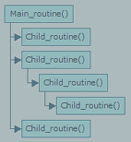
|
|
| |
| # lines: |
453 | | # code: |
453 | | # comment: | 0 | |
# blank: | 0 |
| # Variables: | 33 |
| # Callers: | 0 |
| # Callings: | 2 |
| # Words: | 63 |
| # Keywords: | 37 |
|
|
|
|
|
..
     .. Array Arguments ..
     ..
  Purpose
  =======
  PCPBSV solves a system of linear equations
                      A(1:N, JA:JA+N-1) * X = B(IB:IB+N-1, 1:NRHS)
  where A(1:N, JA:JA+N-1) is an N-by-N complex
  banded symmetric positive definite distributed
  matrix with bandwidth BW.
  Cholesky factorization is used to factor a reordering of
  the matrix into L L'.
  See PCPBTRF and PCPBTRS for details.
  =====================================================================
  Arguments
  =========
  UPLO    (global input) CHARACTER
          = 'U':  Upper triangle of A(1:N, JA:JA+N-1) is stored;
          = 'L':  Lower triangle of A(1:N, JA:JA+N-1) is stored.
  N       (global input) INTEGER
          The number of rows and columns to be operated on, i.e. the
          order of the distributed submatrix A(1:N, JA:JA+N-1). N >= 0.
  BW      (global input) INTEGER
          Number of subdiagonals in L or U. 0 <= BW <= N-1
  NRHS    (global input) INTEGER
          The number of right hand sides, i.e., the number of columns
          of the distributed submatrix B(IB:IB+N-1, 1:NRHS).
          NRHS >= 0.
  A       (local input/local output) COMPLEX pointer into
          local memory to an array with first dimension
          LLD_A >=(bw+1) (stored in DESCA).
          On entry, this array contains the local pieces of the
          This local portion is stored in the packed banded format
            used in LAPACK. Please see the Notes below and the
            ScaLAPACK manual for more detail on the format of
            distributed matrices.
          On exit, this array contains information containing details
            of the factorization.
          Note that permutations are performed on the matrix, so that
            the factors returned are different from those returned
            by LAPACK.
  JA      (global input) INTEGER
          The index in the global array A that points to the start of
          the matrix to be operated on (which may be either all of A
          or a submatrix of A).
  DESCA   (global and local input) INTEGER array of dimension DLEN.
          if 1D type (DTYPE_A=501), DLEN >= 7;
          if 2D type (DTYPE_A=1), DLEN >= 9 .
          The array descriptor for the distributed matrix A.
          Contains information of mapping of A to memory. Please
          see NOTES below for full description and options.
  B       (local input/local output) COMPLEX pointer into
          local memory to an array of local lead dimension lld_b>=NB.
          On entry, this array contains the
          the local pieces of the right hand sides
          B(IB:IB+N-1, 1:NRHS).
          On exit, this contains the local piece of the solutions
          distributed matrix X.
  IB      (global input) INTEGER
          The row index in the global array B that points to the first
          row of the matrix to be operated on (which may be either
          all of B or a submatrix of B).
  DESCB   (global and local input) INTEGER array of dimension DLEN.
          if 1D type (DTYPE_B=502), DLEN >=7;
          if 2D type (DTYPE_B=1), DLEN >= 9.
          The array descriptor for the distributed matrix B.
          Contains information of mapping of B to memory. Please
          see NOTES below for full description and options.
  WORK    (local workspace/local output)
          COMPLEX temporary workspace. This space may
          be overwritten in between calls to routines. WORK must be
          the size given in LWORK.
          On exit, WORK( 1 ) contains the minimal LWORK.
  LWORK   (local input or global input) INTEGER
          Size of user-input workspace WORK.
          If LWORK is too small, the minimal acceptable size will be
          returned in WORK(1) and an error code is returned. LWORK>=
          (NB+2*bw)*bw
          +max((bw*NRHS), bw*bw)
  INFO    (global output) INTEGER
          = 0:  successful exit
          < 0:  If the i-th argument is an array and the j-entry had
                an illegal value, then INFO = -(i*100+j), if the i-th
                argument is a scalar and had an illegal value, then
                INFO = -i.
          > 0:  If INFO = K<=NPROCS, the submatrix stored on processor
                INFO and factored locally was not
                positive definite,  and
                the factorization was not completed.
                If INFO = K>NPROCS, the submatrix stored on processor
                INFO-NPROCS representing interactions with other
                processors was not
                positive definite,
                and the factorization was not completed.
  =====================================================================
  Restrictions
  ============
  The following are restrictions on the input parameters. Some of these
    are temporary and will be removed in future releases, while others
    may reflect fundamental technical limitations.
    Non-cyclic restriction: VERY IMPORTANT!
      P*NB>= mod(JA-1,NB)+N.
      The mapping for matrices must be blocked, reflecting the nature
      of the divide and conquer algorithm as a task-parallel algorithm.
      This formula in words is: no processor may have more than one
      chunk of the matrix.
    Blocksize cannot be too small:
      If the matrix spans more than one processor, the following
      restriction on NB, the size of each block on each processor,
      must hold:
      NB >= 2*BW
      The bulk of parallel computation is done on the matrix of size
      O(NB) on each processor. If this is too small, divide and conquer
      is a poor choice of algorithm.
    Submatrix reference:
      JA = IB
      Alignment restriction that prevents unnecessary communication.
  =====================================================================
  Notes
  =====
  If the factorization routine and the solve routine are to be called
    separately (to solve various sets of righthand sides using the same
    coefficient matrix), the auxiliary space AF *must not be altered*
    between calls to the factorization routine and the solve routine.
  The best algorithm for solving banded and tridiagonal linear systems
    depends on a variety of parameters, especially the bandwidth.
    Currently, only algorithms designed for the case N/P >> bw are
    implemented. These go by many names, including Divide and Conquer,
    Partitioning, domain decomposition-type, etc.
  Algorithm description: Divide and Conquer
    The Divide and Conqer algorithm assumes the matrix is narrowly
      banded compared with the number of equations. In this situation,
      it is best to distribute the input matrix A one-dimensionally,
      with columns atomic and rows divided amongst the processes.
      The basic algorithm divides the banded matrix up into
      P pieces with one stored on each processor,
      and then proceeds in 2 phases for the factorization or 3 for the
      solution of a linear system.
      1) Local Phase:
         The individual pieces are factored independently and in
         parallel. These factors are applied to the matrix creating
         fillin, which is stored in a non-inspectable way in auxiliary
         space AF. Mathematically, this is equivalent to reordering
         the matrix A as P A P^T and then factoring the principal
         leading submatrix of size equal to the sum of the sizes of
         the matrices factored on each processor. The factors of
         these submatrices overwrite the corresponding parts of A
         in memory.
      2) Reduced System Phase:
         A small (BW* (P-1)) system is formed representing
         interaction of the larger blocks, and is stored (as are its
         factors) in the space AF. A parallel Block Cyclic Reduction
         algorithm is used. For a linear system, a parallel front solve
         followed by an analagous backsolve, both using the structure
         of the factored matrix, are performed.
      3) Backsubsitution Phase:
         For a linear system, a local backsubstitution is performed on
         each processor in parallel.
  Descriptors
  ===========
  Descriptors now have *types* and differ from ScaLAPACK 1.0.
  Note: banded codes can use either the old two dimensional
    or new one-dimensional descriptors, though the processor grid in
    both cases *must be one-dimensional*. We describe both types below.
  Each global data object is described by an associated description
  vector.  This vector stores the information required to establish
  the mapping between an object element and its corresponding process
  and memory location.
  Let A be a generic term for any 2D block cyclicly distributed array.
  Such a global array has an associated description vector DESCA.
  In the following comments, the character _ should be read as
  "of the global array".
  NOTATION        STORED IN      EXPLANATION
  --------------- -------------- --------------------------------------
  DTYPE_A(global) DESCA( DTYPE_ )The descriptor type.  In this case,
                                 DTYPE_A = 1.
  CTXT_A (global) DESCA( CTXT_ ) The BLACS context handle, indicating
                                 the BLACS process grid A is distribu-
                                 ted over. The context itself is glo-
                                 bal, but the handle (the integer
                                 value) may vary.
  M_A    (global) DESCA( M_ )    The number of rows in the global
                                 array A.
  N_A    (global) DESCA( N_ )    The number of columns in the global
                                 array A.
  MB_A   (global) DESCA( MB_ )   The blocking factor used to distribute
                                 the rows of the array.
  NB_A   (global) DESCA( NB_ )   The blocking factor used to distribute
                                 the columns of the array.
  RSRC_A (global) DESCA( RSRC_ ) The process row over which the first
                                 row of the array A is distributed.
  CSRC_A (global) DESCA( CSRC_ ) The process column over which the
                                 first column of the array A is
                                 distributed.
  LLD_A  (local)  DESCA( LLD_ )  The leading dimension of the local
                                 array.  LLD_A >= MAX(1,LOCr(M_A)).
  Let K be the number of rows or columns of a distributed matrix,
  and assume that its process grid has dimension p x q.
  LOCr( K ) denotes the number of elements of K that a process
  would receive if K were distributed over the p processes of its
  process column.
  Similarly, LOCc( K ) denotes the number of elements of K that a
  process would receive if K were distributed over the q processes of
  its process row.
  The values of LOCr() and LOCc() may be determined via a call to the
  ScaLAPACK tool function, NUMROC:
          LOCr( M ) = NUMROC( M, MB_A, MYROW, RSRC_A, NPROW ),
          LOCc( N ) = NUMROC( N, NB_A, MYCOL, CSRC_A, NPCOL ).
  An upper bound for these quantities may be computed by:
          LOCr( M ) <= ceil( ceil(M/MB_A)/NPROW )*MB_A
          LOCc( N ) <= ceil( ceil(N/NB_A)/NPCOL )*NB_A
  One-dimensional descriptors:
  One-dimensional descriptors are a new addition to ScaLAPACK since
    version 1.0. They simplify and shorten the descriptor for 1D
    arrays.
  Since ScaLAPACK supports two-dimensional arrays as the fundamental
    object, we allow 1D arrays to be distributed either over the
    first dimension of the array (as if the grid were P-by-1) or the
    2nd dimension (as if the grid were 1-by-P). This choice is
    indicated by the descriptor type (501 or 502)
    as described below.
    IMPORTANT NOTE: the actual BLACS grid represented by the
    CTXT entry in the descriptor may be *either*  P-by-1 or 1-by-P
    irrespective of which one-dimensional descriptor type
    (501 or 502) is input.
    This routine will interpret the grid properly either way.
    ScaLAPACK routines *do not support intercontext operations* so that
    the grid passed to a single ScaLAPACK routine *must be the same*
    for all array descriptors passed to that routine.
    NOTE: In all cases where 1D descriptors are used, 2D descriptors
    may also be used, since a one-dimensional array is a special case
    of a two-dimensional array with one dimension of size unity.
    The two-dimensional array used in this case *must* be of the
    proper orientation:
      If the appropriate one-dimensional descriptor is DTYPEA=501
      (1 by P type), then the two dimensional descriptor must
      have a CTXT value that refers to a 1 by P BLACS grid;
      If the appropriate one-dimensional descriptor is DTYPEA=502
      (P by 1 type), then the two dimensional descriptor must
      have a CTXT value that refers to a P by 1 BLACS grid.
  Summary of allowed descriptors, types, and BLACS grids:
  DTYPE           501         502         1         1
  BLACS grid      1xP or Px1  1xP or Px1  1xP       Px1
  -----------------------------------------------------
  A               OK          NO          OK        NO
  B               NO          OK          NO        OK
  Note that a consequence of this chart is that it is not possible
    for *both* DTYPE_A and DTYPE_B to be 2D_type(1), as these lead
    to opposite requirements for the orientation of the BLACS grid,
    and as noted before, the *same* BLACS context must be used in
    all descriptors in a single ScaLAPACK subroutine call.
  Let A be a generic term for any 1D block cyclicly distributed array.
  Such a global array has an associated description vector DESCA.
  In the following comments, the character _ should be read as
  "of the global array".
  NOTATION        STORED IN  EXPLANATION
  --------------- ---------- ------------------------------------------
  DTYPE_A(global) DESCA( 1 ) The descriptor type. For 1D grids,
                                TYPE_A = 501: 1-by-P grid.
                                TYPE_A = 502: P-by-1 grid.
  CTXT_A (global) DESCA( 2 ) The BLACS context handle, indicating
                                the BLACS process grid A is distribu-
                                ted over. The context itself is glo-
                                bal, but the handle (the integer
                                value) may vary.
  N_A    (global) DESCA( 3 ) The size of the array dimension being
                                distributed.
  NB_A   (global) DESCA( 4 ) The blocking factor used to distribute
                                the distributed dimension of the array.
  SRC_A  (global) DESCA( 5 ) The process row or column over which the
                                first row or column of the array
                                is distributed.
  LLD_A  (local)  DESCA( 6 ) The leading dimension of the local array
                                storing the local blocks of the distri-
                                buted array A. Minimum value of LLD_A
                                depends on TYPE_A.
                                TYPE_A = 501: LLD_A >=
                                   size of undistributed dimension, 1.
                                TYPE_A = 502: LLD_A >=NB_A, 1.
  Reserved        DESCA( 7 ) Reserved for future use.
  =====================================================================
  Code Developer: Andrew J. Cleary, University of Tennessee.
    Current address: Lawrence Livermore National Labs.
  This version released: August, 2001.
  =====================================================================
     ..
     .. Parameters ..
|
|
|
|
01 SUBROUTINE PCPBSV( UPLO , N , BW , NRHS , A , JA , DESCA , B , IB , DESCB ,
02 $WORK , LWORK , INFO )
03
04 * -- ScaLAPACK routine(version 1.7) --
05 * University of Tennessee , Knoxville , Oak Ridge National Laboratory ,
06 * and University of California , Berkeley.
07 * November 15 , 1997
08
09 * .. Scalar Arguments ..
10 CHARACTER UPLO
11 INTEGER BW , IB , INFO , JA , LWORK , N , NRHS
12 REAL ONE , ZERO
13 PARAMETER( ONE = 1.0E + 0 )
14 PARAMETER( ZERO = 0.0E + 0 )
15 COMPLEX CONE , CZERO
16 PARAMETER( CONE =( 1.0E + 0 , 0.0E + 0 ) )
17 PARAMETER( CZERO =( 0.0E + 0 , 0.0E + 0 ) )
18 INTEGER INT_ONE
19 PARAMETER( INT_ONE = 1 )
20 INTEGER DESCMULT , BIGNUM
21 PARAMETER(DESCMULT = 100 , BIGNUM = DESCMULT * DESCMULT)
22 INTEGER BLOCK_CYCLIC_2D , CSRC_ , CTXT_ , DLEN_ , DTYPE_ ,
23 $LLD_ , MB_ , M_ , NB_ , N_ , RSRC_
24 PARAMETER( BLOCK_CYCLIC_2D = 1 , DLEN_ = 9 , DTYPE_ = 1 ,
25 $CTXT_ = 2 , M_ = 3 , N_ = 4 , MB_ = 5 , NB_ = 6 ,
26 $RSRC_ = 7 , CSRC_ = 8 , LLD_ = 9 )
27 * ..
28 * .. Local Scalars ..
29 INTEGER ICTXT , MYCOL , MYROW , NB , NPCOL , NPROW ,
30 $WS_FACTOR
31 * ..
32 * .. External Subroutines ..
33 EXTERNAL PCPBTRF , PCPBTRS , PXERBLA
34 * ..
35 * .. Executable Statements ..
36
37 * Note : to avoid duplication , most error checking is not performed
38 * in this routine and is left to routines
39 * PCPBTRF and PCPBTRS.
40
41 * Begin main code
42
43 INFO = 0
44
45 * Get block size to calculate workspace requirements
46
47 IF( DESCA( DTYPE_ ) .EQ. BLOCK_CYCLIC_2D ) THEN
47   48 NB = DESCA( NB_ )
49 ICTXT = DESCA( CTXT_ )
50 ELSEIF( DESCA( DTYPE_ ) .EQ. 501 ) THEN
51 NB = DESCA( 4 )
52 ICTXT = DESCA( 2 )
53 ELSE
53
54 INFO = - ( 6*100 + DTYPE_ )
55 CALL
48 NB = DESCA( NB_ )
49 ICTXT = DESCA( CTXT_ )
50 ELSEIF( DESCA( DTYPE_ ) .EQ. 501 ) THEN
51 NB = DESCA( 4 )
52 ICTXT = DESCA( 2 )
53 ELSE
53
54 INFO = - ( 6*100 + DTYPE_ )
55 CALL PXERBLA( ICTXT ,
56 $ 'PCPBSV' ,
57 $ - INFO )
58 RETURN
59 ENDIF
60
61 CALL BLACS_GRIDINFO( ICTXT , NPROW , NPCOL , MYROW , MYCOL )
62
63 * Size needed for AF in factorization
64
65 WS_FACTOR =(NB + 2*BW)*BW
66
67 * Factor the matrix
68
69 CALL PCPBTRF ( UPLO , N , BW , A , JA , DESCA , WORK ,
70 $MIN( LWORK , WS_FACTOR ) , WORK( 1 + WS_FACTOR ) ,
71 $LWORK - WS_FACTOR , INFO )
72
73 * Check info for error conditions
74
75 IF( INFO.NE.0 ) THEN
75
76 IF( INFO .LT. 0 ) THEN
76
77 CALL PXERBLA( ICTXT , 'PCPBSV' , - INFO )
78 ENDIF
79 RETURN
80 END IF
81
82 * Solve the system using the factorization
83
84 CALL PCPBTRS ( UPLO , N , BW , NRHS , A , JA , DESCA , B , IB , DESCB , WORK ,
85 $MIN( LWORK , WS_FACTOR ) , WORK( 1 + WS_FACTOR) ,
86 $LWORK - WS_FACTOR , INFO )
87
88 * Check info for error conditions
89
90 IF( INFO.NE.0 ) THEN
90
91 CALL PXERBLA( ICTXT , 'PCPBSV' , - INFO )
92 RETURN
93 END IF
94
95 RETURN
96
97 * End of PCPBSV
98
99 END21
5
|
|
Variables in Routine PCPBSV()
| Summary Report |
| Data Type | Quantity | Size(byte) |
| CHARACTER | 1 | 1 |
| COMPLEX | 2 | 8 |
| INTEGER | 28 | 112 |
| REAL | 2 | 8 |
| TOTAL | 33 | 129 |
List of Variables
CHARACTER
COMPLEX
INTEGER
| BIGNUM | BLOCK_CYCLIC_2D | BW | CSRC_ | CTXT_ |
| DESCMULT | DLEN_ | DTYPE_ | IB | ICTXT |
| INFO | INT_ONE | JA | LLD_ | LWORK |
| M_ | MB_ | MYCOL | MYROW | N |
| N_ | NB | NB_ | NPCOL | NPROW |
| NRHS | RSRC_ | WS_FACTOR | | |
REAL
Variables Dependence Graph
Put the mouse over a right hand side variable to display the corresponding line of the dependence | | - | | - | - | | ICTXT | <--- | CTXT_ICTXT = DESCA( CTXT_ ) |
| INFO | <--- | DTYPE_INFO = -( 6*100 + DTYPE_ ) |
| NB | <--- | NB_NB = DESCA( NB_ ) |
| WS_FACTOR | <--- | NBWS_FACTOR = (NB+2*BW)*BW, BWWS_FACTOR = (NB+2*BW)*BW |
|
|
Analysis elements of the routine PCPBSV()
Put the mouse over each element to display detailed matching information
 Assigned variables Assigned variables |
| | | BIGNUM , BLOCK_CYCLIC_2D , CONE , CSRC_ , CTXT_ , CZERO , DESCMULT , DLEN_ , DTYPE_ , ICTXT , INFO , INT_ONE , LLD_ , M_ , MB_ , N_ , NB , NB_ , ONE , RSRC_ , WS_FACTOR , ZERO |
|
| Active variables |
| | | A , B , BIGNUM , BLOCK_CYCLIC_2D , BW , CONE , CSRC_ , CTXT_ , CZERO , DESCA , DESCB , DESCMULT , DLEN_ , DTYPE_ , IB , ICTXT , INFO , INT_ONE , JA , LLD_ , LWORK , M_ , MB_ , MYCOL , MYROW , N , N_ , NB , NB_ , NPCOL , NPROW , NRHS , ONE , RSRC_ , UPLO , WORK , WS_FACTOR , ZERO |
|
| Accessed arrays [ array name : associated index ] |
| |  DESCA DESCA | : 2 , 4 , CTXT_ , DTYPE_ , DTYPE_ , NB_ |
| | WORK | : 1+WS_FACTOR , 1+WS_FACTOR |
|
| Conditional statements [ statement : associated predicate ] |
| | elseif | : ( (DESCA( DTYPE_ ) .EQ. 501 ) ) |
| | for | : ( AF in factorization ) , ( error conditions ) , ( error conditions ) |
| | if | : ( (DESCA( DTYPE_ ) .EQ. BLOCK_CYCLIC_2D ) ) , ( INFO.NE.0 ) , ( INFO .LT. 0 ) , ( INFO.NE.0 ) |
|
| List of variables |
BIGNUM
BLOCK_CYCLIC_2D
BW
CONE
CSRC_
CTXT_
CZERO
| DESCMULT
DLEN_
DTYPE_
IB
ICTXT
INFO
INT_ONE
JA
| LLD_
LWORK
M_
MB_
MYCOL
MYROW
N
N_
| NB
NB_
NPCOL
NPROW
NRHS
ONE
RSRC_
UPLO
| WS_FACTOR
ZERO | | close
| |
BIGNUM
BLOCK_CYCLIC_2D
BW
CONE
CSRC_
CTXT_
CZERO
DESCMULT
DLEN_
DTYPE_
IB
ICTXT
INFO
INT_ONE
JA
LLD_
LWORK
M_
MB_
MYCOL
MYROW
N
N_
NB
NB_
NPCOL
NPROW
NRHS
ONE
RSRC_
UPLO
WS_FACTOR
ZERO
119#120
| |